

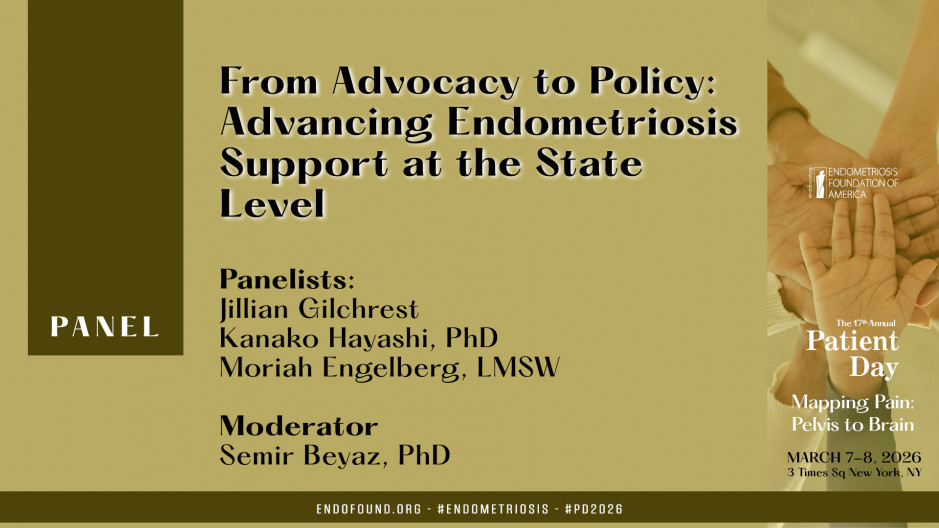
Patient Day 2026
Mapping Pain: Pelvis to Brain
March 7-8, 2026
3 Times Square, New York City
All right. Thanks, Caroline, and thank you all for joining us today. It's a great honor for me to moderate that session. My good friend and the found veteran Diana Falzone was supposed to do that, but she is not feeling well. So I'm trying my best to fill in for her. It's a great honor for that reason. So today we will talk about advocacy efforts, advocacy to policy and how we can instill real changes to make a difference in endometriosis care and research. So as you all know, endometriosis is a debilitating condition. It's very common. The simplest I can put it is a public health crisis right now. And despite that, there is unfortunately minimal recognition from state and federal government level. And at the Endometriosis Foundation of America, that has been a priority more than a decade ago. In 2013, the co-founder of the foundation, Padmalakshmi, traveled to the New York State Capitol in Albany to educate legislators about endometriosis and its impact on millions of women and families.
And so those conversations helped seed funding for what's now called Empower Project and the organizer and the coordinator for that initiative. Caroline will tell you more about that later, I was told. And then in 2018, our co-founder, the one and only, Dr. Tamer Sitchkin, met with the New York State Commissioners of Health and Education to highlight the need for greater menstrual health awareness. And the following year, New York passed one of the first laws addressing endometriosis education, requiring menstrual health resources to be made available through the Department of Health. So those early initiatives ... Yeah, thank you. Thanks, Dr. Sechin. And through those initiatives, it became apparent that when public and foundations like Endofund come together, they can instill policy changes that are well overdue. And so the foundation also has been in good synergy with other states such as Connecticut. And we today have representative Jillian Gilchrist who launched the Connecticut Endometriosis Working Group, bringing policymakers, researchers, and advocates to better understand the needs of people living with this disease.
And Endofound was proud to serve as an integral member for that effort. And these interactions have been continuing. We were in Connecticut a few months ago and we are looking very much forward to expand these interactions. And the foundation also collaborated with Mariah Engelberg and her team at a better balance. She's one of the panelists. This is a national legal advocacy organization working to ensure individuals can care for themselves and families without sacrificing paycheck. And then the most important thing is these initiatives are great, but they are not sufficient. So we need to expand those. And I think this panel will address some of these gaps and how we can collectively work on closing those gaps. And for those interested in getting involved, the foundation recently launched an advocacy toolkit to help patients, clinicians, and advocates engage with policymakers in their own states. It's available on endofound.org.
I'm sure you know that website. So go in there. And if you are in a different state other than New York and Connecticut, those are the examples that we have good. Go and think and come and discuss and ask so that these initiatives will go into sister states and together hopefully will make a difference. So with that, I'm pleased to introduce our panelist Representative Jillian Gilchrist, Connecticut State Representative and a leader in advancing endometriosis policy through the Connecticut Endometriosis Working Group. Welcome, Dr. Representative Gilchrist. And the next, Dr. Kanoko Hayashi, professor in School of Molecular Biosciences and the Center for Reproductive Biology at Washington State University. She's a phenomenal scientist. I've seen her work and I had the pleasure to actually chair the session that she spoke. In addition to her outstanding research, she's a wonderful member of her community in Washington State where she leads advocacy efforts within Washington State.
And hopefully these efforts are going to become legislations and will help women who are suffering from endometriosis in Washington state. And finally, Moriah Engelberg from A Better Balance. This is a leading national legal advocacy organization working to expand workplace protections for individuals managing health conditions and caregiver responsibility. So welcome and thank you so much for joining the panel. So to start, I'd like to talk about the role that states can play in moving these issues forward. And I think Representative Gilchrist, you have taken a really pivotal role in establishing the endometriosis working group in your state to better understand the needs of people living with this disease. So my question is, from your perspective, can you little bit elaborate more why states need to take a more leadership role in addressing conditions like endometriosis?
Wonderful. Yes. Can you hear me? Is this home? Test now? Yes. Yes. All right. Good afternoon, everyone. So to give a little background and context, I have felt for quite a while since my first job out of college was as a child advocate at a sexual assault crisis center. And I learned right away I was not cut out for direct service, very appreciative of those who are. I was more drawn to systemic change and questioning poverty and policies. And so I went and got my master's in social work with a focus in policy practice. And then in Connecticut, I believe you can use public policy to push for social change. And so I worked at a number of nonprofits, lobbying the legislature. And then in 2018, I ran for office. And so I've been, sometimes they use the word outspoken. I think just strong and vocal, maybe we'll say that, strong and vocal feminist in the state working on women's health and safety.
And so a colleague said to me, "Can we grab coffee? I have an issue I think you're going to be really interested in. " And she proceeded to tell me her experience with endometriosis.
And I was horrified because while everyone's experience is unique, unfortunately there are common dynamics and she had been made to feel like she was crazy her entire life, sent to see mental health providers, told she was dramatic. And then when she was trying to get pregnant, she experienced infertility. And that's when they said, "Oh, you have this thing called endometriosis. I guess it wasn't in your head." So I left that meeting angry, went home and did some research. And when I found out that one in 10 individuals with the uterus, disproportionately women, have endometriosis and lo and behold, it hasn't been studied, I was more angry. And so I decided I would use my advocacy skills to develop a working group, a coalition is what we call it. And so I brought together folks who live with the disease, advocates for different women's health and safety issues and different state agency folks, like the Department of Public Health, Department of Mental Health and Addiction Services since the mental health piece, a whole host of folks.
And we started having conversations. And this was 2021. We've met monthly ever since on Zoom and it did a few things, which is incredibly important. It raised awareness in our state. Endometriosis now at our state legislature is something everybody knows about and everybody talks about. I've had countless colleagues, both men and women, come to me and say, thank you so much for doing this. My wife, my sister, myself has endometriosis. It was never discussed. We were able to pass legislation early on to require continuing education for physicians, but the thing we're most known for and we're very excited about is we passed the first of its kind in the nation a state funded biorepository. And so UConn Health, which is University of Connecticut, is our flagship university in our state, partnered with Jackson Laboratory, and they now collect tissue samples from folks who have endometriosis.
They have a contract between the two of them, but they are now creating MOUs with all of the various hospitals across our state so that we can have a diversity of tissue samples. And just last week, because it's endometriosis awareness month, we announced that they've collected over 5,000 samples and are beginning to distribute to companies who are going to be studying diagnostic and treatment. And Jackson Laboratory will be doing that too. Thank you.
And so it is important because as you will hear from others, not only have we raised awareness in our state and taken the lead on research and education when the federal government is not. If the federal government is not going to invest in women's research, we could do that at the state level until they come along. But also I've had a number of states reach out to understand how can they do a similar thing in their state. And as an advocate and a champion for women, I get on the phone every time. If there are people in the room who want to know, we want to partner because I think the more of us who are doing this at a state level, we can push for that change in our individual states, but then that pushes for change at a federal level.
Thank
You. Thank you so much. So the second question I have for Dr. Hayashi, and as I mentioned to you all, she's a wonderful scientist. She knows the cells and the molecules that drive this debilitating disease. But in addition to her role as a scientist, she also took a more important role, I think, as an advocate and moved the community towards making policy changes similar to what was happening at Connecticut. So can you tell us a little bit about your vision, how that process started? How did you go from bench to public and politics in a little bit? If you give us a little bit about this background story, that would be great.
Yes, of course. Hi, everyone. I'm Kanago Hayashi from Washington State, all the way from West Coast to the New York. I told the first day, I'm fast time being New York City, so excited to be here. Anyway, so you all understand, Dr. Shaskin say, everybody understand doctors need to be educated, right? Specialists, how you can see a doctors, specialists, right? You see that somebody ask a question to him, general surgeon knows endometriosis? No, no one knows. So how we can change the education to doctors, how nurses, nursing school never teaches in endometriosis, how nursing system, nursing education can change the education system, PA. We need to work like Jillian, registry people, the state level at the beginning, educational system, training system, and even patient. Do you run the menstruation when you are age 10? Maybe menstruation a little bit. Washington say, what's happening? Ideally, you start learning the production around the fifth grade.
However, you don't need to be in the class. So parents sometimes pull the student, go to vacation. So you don't need to take those class because it's not counting for grades on anything. So we need to have menstruation, endometriosis may be additional to there. How the women's body is changing. Maybe you need including the whole intercourse or other things need to be changed. You need to learn earlier age, right? So that we can understand endometriosis. We need to be educated. By the way, I'm also the patient. We need to be educated and also we need to work at that doctor need to be educated, nurse need to be educated. That's why I'm working to try to develop non-hormonal therapy, but in addition to my science, my background, the research, that I'm really passionate, but we need to work hard. Legislative people, actually I'm working Senator Tina Owal, the Washington State Registry.
Unfortunately, Connecticut successfully, New York successfully doing that, but Washington for a small bill, unlikely we will pass, but we have to have a strong different strategy to make it happen. So we definitely need to connect Connecticut more to Ron. You mentioned the toolkit is available. We need to learn so much more and then start step by step in the local, hopefully make it happen. She's actually trying to run in Congress. We need a hard time person in the Congress. Federal level, right? Please, please make sure it happen. She will be the one of the representative in the US, so that will change it. That's very important. So that's why I'm very passionate to continue working this working group in Endometriosis Washington State.
Thank you, Dr. Hayashi. And yeah, support the best representative that will be ever elected in the US Congress. Yes, let's do it. So we will transition now to Mariah Engelberg. You are doing a very important job in your organization, a better balance, because this is a little bit the untold story, right? So we talk about how we need to do the policy, how we need to do the research, how patients need to see the doctor, but there is a day-to-day life for many of these patients and medical leave policies unfortunately are not in place to provide the support so that these patients live their day-to-day life and support their families. Can you tell us a little bit more how your organization trying to make a difference in that scope?
Yeah. Thank you so much. My name is Mariah Engelberg and I work at a national nonprofit organization and we're dedicated to making sure that people have the ability to care for themselves and their loved ones without risking their paycheck. We've done a lot of work and everybody here has done a lot of work to make sure that people are able to learn what endometriosis is. Research has come a long way. There's still a lot to do. But on the flip side of that, what happens when you yourself need to take medical leave? That might be something that happens for a lot of people in this room, for a lot of loved ones. I'm going to say something that I found to be very shocking, which is that in New York state, workers do not actually have a workable paid medical leave program. Unfortunately, if you need to take medical leave, you are only entitled to a maximum of $170 a week, 170 in 2026.
That's absurd. It's shameful. Nobody can live off of that. To make matters worse, you don't actually have job protection or health insurance continuation. The worst time to learn that you're not going to get health insurance is when you need to take medical leave. We think it's wrong. We've been working with the Endometriosis Foundation to try to make sure that workers are able to take the medical leave that they need. And specifically, the work I focus on is for people who work in the state of New York. Obviously, nobody can live off of $170 a week. You can't live if you aren't going to have a job and you can't live if you aren't going to have your health insurance. So one of the things that we've been working on with the Endometriosis Foundation is trying to raise our paid medical leave program to fit with the times.
It's partially because, as we all know, it can take a long time to get diagnosed. And by the time you finally are able to receive that diagnosis, you might need to take time off of work. It happens. And you shouldn't be forced to sacrifice your own health for a paycheck. And so we've been working very closely with a couple of organizations to try to make sure that you are able to receive the medical leave that you need and deserve. And we work across the country as well, but I specifically work in New York State just to make sure that people can take that time that they need.
Awesome. Thank you so much for your efforts for that. Okay. So now I'll go off the script, screw those papers. Let's be real, like endometriosis facts are a public health crisis, right? So it's unacceptable that many women, our family, sisters, all of you are here, are suffering and we are talking about access to healthcare, medical leave, diagnosis delays, treatment options. And I was talking to someone yesterday at here and I was giving the analogy, like in 1910, 1920s, if you were a cancer patient, the only way that you can get the diagnosis and treatment is by surgery. Now we are in 2020. Not everybody is lucky enough to have an access to a wonderful surgeon like Dr. Setchkin. If it's one in 10 women is suffering from that condition, this is a public health crisis. And so I want to bring it to the panel's discussion.
How can we close that huge gap? How can we take the example of Connecticut now, Washington State, endo found advocacy groups, your organization and close that huge gap? What are the steps that you have in your mind for the next five years or decade we can work collectively to close that gap? It's a tough gap to close, but let's speak it out loud.
So I'd jump in and say, I mean, I think the importance of collaboration is that we each play a different role. And so I can't do what I do as a policymaker in this space without learning from folks who do the science, right? Who work in a variety of fields who have endometriosis. And so I'm doing as much as I can at the state level. My lever is public policy. And so some of the things we're looking at to do in Connecticut, we did ensure that our paid leave program does cover folks for when they need to take off time for endometriosis. And our program allows you to take it as one big chunk of 12 weeks, or you can take it intermittent, which would be helpful because you could use it once a month. We partnered and now have menstrual products in schools and public places in the state of Connecticut.
The one that is in my craw that we keep pushing is to expand fertility coverage in the state of Connecticut to ensure that if someone has a condition like endometriosis, they'd be able to undergo fertility treatment if they so desire.
So you can push as much as you can at the state level, again, policy lens. And what history does show us about public policy, like gay marriage, for example, when states pass it state by state, it eventually pushes on the federal government to pass it. And so I am a true believer in that, and so that is one strategy. That said, you do also get to a place where you need federal policy to change. And if we're speaking about the amazing surgeries, and excision surgery, a big barrier is that the coding for excision surgery is currently the same as the coding for ablation surgery. And I can't change that in Connecticut. We need to change that federally. And so you get to this place where, okay, we're going to keep pushing, but we then need the federal government to make some changes as well, otherwise we hit this wall.
And so that's why I think truly it's a team effort. And the more we can share this information and what we're learning, the more we move it forward.
Dr. Hashi?
I 100% agree with you. We need to work together, all get together. So one of the things all we know, endometriosis, if you go to the ER, we know the symptoms, right? But they don't show. They don't show the ultrasound, they don't show the SGT, they don't show the bread test. You look normal, but your patients. So how we can this situation to see, immediately go to the specialist? This gap, it's so much, that's why you needed to see so many doctors, gynecologists, so many. So we think this educational system definitely need to be changed. I used to teach the medical student first year, second year, medical student. There is no curriculum. Yes, I'm a reproduction major. So I teach the gynecology related everything. There is nothing required those things. No more the PrEP one test exists that time we still need to have a PrEP one.
So we basically follow the what's requirement for maker student. There is nothing cover those things. So how we can change the educational system, including nothing. There is nothing they have no ... Some patient or nurse, right? I know even the UA nurse, but you don't know anything about ... So I think that part we all need to work together. I learn so much. I'm a scientist, but I don't see often listen the health surgeon talking, endometriosis expert surgeons are talking about. Today, this meeting, I mean yesterday, I learn so many things. 100% argue we all need to work together. I love to hear all patient experience. That's very strong power. We need to have advocacy together. And then again, state connection, so many level we have to work together, but hope that happen and then definitely make it hopefully that work. It's just, I really want to move forward and from the state level to the federal level, even current crazy situation, what's going on in the US.
All
Right. Thank you.
Yeah. I think what everybody has said is really a hundred percent true and it is this collective effort and it is also a collective effort of all of our voices and communicating. There are all of these extra pieces. You have the research piece, you have education, you're sharing your own story. And I think that one of those, the key thread there is just that everybody has the ability to speak up and to talk to their friends, talk to their loved ones, talk to their representatives, reach out to people. And I think that that is just that other piece and that we all do really have a role to play in creating longstanding advocacy and longstanding policies for everybody across the states.
That's wonderful. And I share those sentiments. I think collaboration is key. Human nature competes when it comes to endometriosis, we got to work together. It doesn't matter which state it is. The states, our sister states are going to come together and elicit that ultimate federal change. And the world is not composed of just US. So we need to also think globally, like how we can set the stage for many countries that like this disease is not even known and there's no endometriosis foundation in that country because many people all around the world are suffering from that condition. So I think collaboration, open dialogue, but also bringing patients and scientists and clinician and advocacy and policy makers together, I think that's going to be very critical. So we cannot do it alone. So all of you in the audience, call your representatives, tell them about the disease, work together in your neighborhoods and this is going to happen with that grassroots movement.
And I think the panel members are an example of how you can make change. So in the next few minutes, I will give some good news that the foundation is doing and then we will have maybe one comment from you or two comments from the audience because this panel is amazing and we are five minutes early. Yeah. This panel is amazing. We were like, "We're going to be punctual. We're going to use our time effectively." No, no. Hey, I have it here.
25
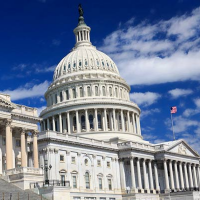
Minutes. We are 30 minutes. I have data. Yeah. So great. Yeah. It's 25 minutes. Yeah. All right. So the news is Endometriosis Foundation of America going to Capitol Hill, talking to HHS people. Dr. Setchkin will be there together with Alexis Roderick Joel this coming week, and they are going to push federal government to understand what endometriosis is and push them towards making policy. It's a long journey, but I trust Dr. Sachi's ability to convince people and bring them together. So that's one. The second one is Endofound has developed, as I mentioned, to this advocacy toolkit. And please check the foundation website. The email is advocacy@endofound.org. If you have any ideas, if you want to learn more about these initiatives, please be in touch with the foundation. And I would like to thank everybody for being here, especially wonderful panelists and the foundation. Thank you all for being part of this important effort