

Patient Day 2026
Mapping Pain: Pelvis to Brain
March 7-8, 2026
3 Times Square, New York City
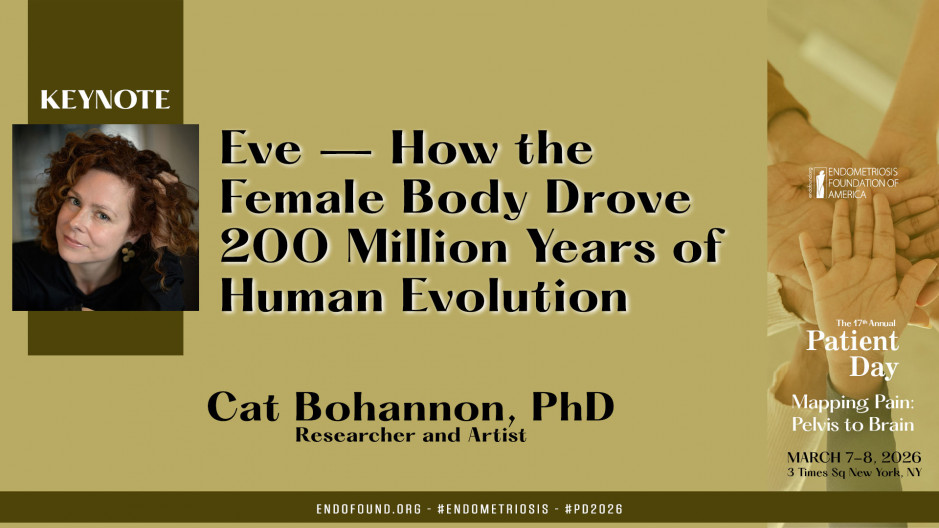
So just quickly to say that today is International Women's Day. Very empowering, very lovely. Don't be greedy, ladies. You get a day. Okay? Half the human population, but a day you get a day. Yeah. It's inside of Women's History Month where we finally tell the often ignored stories of the great achievements in science and other fields that often get ignored, that were done by why women. So if you are already dead, you get a month. But also it's great. And also we're going to talk about the deeper history of female bodies, which most women have. Yeah? Which is why I was invited. Okay. We're going to have some fun. It'll be dark humor, but it will be fun. And then we're going to have lunch after and I'll sign books and we'll do all that. Good? Ready? Okay. So I wrote this book called Eve: How the Female Body Drove 200 Million Years of Human Evolution.
So just a tiny little Tic Tac of an idea, really just wildly unambitious. Really, my advisors at Columbia, I was doing a totally different topic for my PhD at the same time. We're like, "Yeah, you're fine. You're not mentally a little." But they paid me money. It was nice. So I can't do all of that. I'm not going to do 200 million years in the next half hour, right? But we will do a bit and why it matters for your health right now. But let's start with something we can all kind of relate to. All right. I'm going to tell you a little story about how I got into this topic. It was 2012 and I was in a movie theater. I was a PhD student at Columbia and I was a sci-fi fan, as you do. And so I was watching the prequel to the movie Alien.
Yes? The very subtly named film Prometheus. And I'm just going to tell you a little bit about a scene in there. So the main character, our final girl, she's Dr. Elizabeth Shaw. Okay? It's never exactly clear what she's a doctor of. She sciences broadly. Okay? But she has crashed in this moment on a foreign planet. By foreign, I mean alien planet. I mean it's far. Okay? And she, for reasons, has been impregnated with a vicious alien squid, as you do. And she wants something which is very reasonable for any patient in this moment. She would like it out of her. She would like to not actually have the squid, no more with the squid, a C-section, please. So she goes to what we all know is the future of medicine, which is a med pod, the kind of sexy coffin with lasers. As we know from sci-fi, this is where all medicine is going for some reason.
And she goes up to the pod and she says, "I need a C-section." I think she actually says something like, "I need cesarean." Kind of hunched over. It's great. It's a great scene. Okay. And the med pod, unfortunately, says, "Beep boop. I'm sorry. This med pod is calibrated for male patients only." Cool. Cool, cool, cool. So what happens after that scene is she gives herself a C-section in a beautiful moment of self-care. Yeah. With lasers, directs the lasers, gives herself a section, gets the squid out. There's a lot of tentacles, it's great, which is proto-allien and then kind of shambles off to more adventures. If you'll note on her expression, I would say this is most endo patients. At some point before or after a diagnosis, it's unclear. A lot of you have felt post squid. Yeah. Yeah. But I'm watching this in the theater and again, I'm a PhD student at Columbia, not just a sci-fi fan.
And I hear a woman in the row behind me after the not calibrated for female patients. Say, "Shit, who does that? " Yes. Who does that? Who sends a multi-trillion dollar expedition into space and forgets to make sure the equipment works on women?
Oh. Oh, that's us. Actually, that's us, that's you and me. And if you happen to have been born with ovaries, kind of in a way you're already Dr. Elizabeth Shaw, aren't you? Because there is such a thing in biology and biomedicine as the male norm. Some of you know about this, some of you don't. I have to speak to the whole room, so we're going to quickly cover this, okay? If you are studying the body as a scientist and you're probably working with the mammalian model, we cut up a lot of mice, but not just mice. Rats sometimes, actual guinea pigs, dogs, many things, many things in the name of science. However, what you're probably doing and have been doing for decades, and this has only recently started to change, is you are probably studying males. It's just dicks all the way down. It is male rodent.
It is male. Do you understand? It's just male. And I didn't know this when I was a PhD student, but I found out hanging out with a bunch of neuro postdocs because I was over in psych and we had a lot of females. Sexism, yes, but plenty of female subjects. So I didn't know. I didn't know until I met the animal people. And I was like, "Oh, maybe it's a small problem. No, no, no. It's in nearly every field." And for once, the reason for this was not a cabal of horrible, sexist, possible pedophiles in power. No, no, no, no. Actually, I know. Isn't it nice when that's not the answer? So no, actually in this case, I mean, maybe sexism, but no, in this case, it was simply good science run amuck because you see, when you're working with mammals, the female has this thing called estrus.
You and I might know it as our periods, our menstrual cycle, right? And you might also not know if you're not in this field that nearly every tissue in the human body has sex hormone receptors. We didn't know that until recently because we weren't studying females and we still don't entirely know what they all do, but we're making progress. But yes, which is to say every month then in any given female mammal, if cycling normally and built in such and such a way under the curve, is going to have that rise and fall of hormones throughout the body, different cyclicity, different periodicity for different species, but the habit is the point. And if you're a good scientist, you want what I learned as a PhD student at Columbia, you want to build an elegant experiment. You want to control for your confounds. You can't really understand your data if you don't control for your confounds.
And so for many, many years, and by many years, I mean decades, I mean kind of the history of biology, unless you're specifically studying the uterus, the way to control for the confound of estrus is to just not study females. It is the simplest, most elegant solution, isn't it? Just not in the dataset, just not there. Okay? Now you may also not know that in human clinical trials, because I was talking about basic science here, right? In human trials, in the middle of the last century, we actually ... I wasn't alive, but there was this thing where we maybe screwed up some babies. Okay? This was the thalidomide story. We're not going to get deeply into it, but the idea is that there was a clinical trial where some women were taking a drug and it ended up being a thing that was not great for the limbs of babies born later.
And so actually it was a huge win at the US FDA. The US FDA said, "We're not going to approve this drug for women of reproductive age." Actually, we're going to go further. We're going to say that females of reproductive age should not be in clinical trials unless there's a damn good reason because of the babies.
I count for more than just my babies, but still because of the babies, okay? Very good, good, ethical, sound, logic at the time. Unfortunately, reproductive age is ... Well, let's see, that's a ringer monarchy. That's like first period, 13 or so sliding down these days and going to about menopause moving target. Yeah, that's most of our damn lives. So the actual effect then was that for a very long time, again, until relatively recently, females were not included in clinical trials unless you had a damn good reason to justify why they should, right? And in the basic science pipeline, we weren't studying females either because of controlling for estrus, which was the norm in many different fields. And so what you end up with is we knew Jack all about what was potentially different about female bodies, when and where the biology of sex differences actually mattered.
The fields didn't know. There was a huge knowledge gap. So quickly, what might there be in consequences of that? We're going to do this quickly. Let's say a few, okay? Let's say a few. There were many, many medications that arrived on the market having potentially never been studied on female bodies at all, not from the basic science pipeline, all up through clinical, all up through the safety test. And no, we were in fact then guinea pigs. We with the ovaries. Yes? Now, I'm going to make this a little more relevant to you, however. How many of you have ever had insomnia?
Cool. Cool, cool, cool. You may not know that females are 40% more likely to be diagnosed with sleep disorders at some point in their lifespan. Now, I don't know what could be keeping women up at night. I mean, Andrew Tate is back in Florida, hanging out with Rick Scott, I assume, in a swamp somewhere, is rubbing their bald heads together, like two lost sperm. So no, but the thing is, is that there was one of the most common drugs to treat sleep disorders, should you want to be put to sleep at night, was Ambien. You may have heard about Ambien. Yeah. So the thing about Ambien is that it works a little differently in female bodies, which we only learned well after the fact. Now we learned that because not a careful clinical trial, so no. That's expensive and never. No, no. We learned it because of the car crash data, actually.
You see female patients who had taken a standard dose of Ambien, ask PhD, not MD, like the worst, most useless kind of doctor, talk to your doctor, but I believe it's 10 milligram standard dose.
We're more likely to get into a car crash on their way to work in the morning to afford the health insurance to pay for the Ambien. So we only found that out as the data trickled in, of course. You know, that's going to take time. It's a lot of different. You got hospital data, you got local patient diagnoses, you got a lot of different stuff had to come in. And then the FDA was like, this was I think 2012, 2013, something like that. The FDA was finally like, "Ah, female patients need half the dose, the five instead of 10. Sorry about the car crash is weak cool." At that point, the drug had been on the market for 21 years. So there have been some consequences to the knowledge gap between male and female bodies, okay? But good news, it's women's day. Let's get some good news, God damn it.
And things are changing. Yes, things are changing in the early 90s. The FDA said, "Oh, maybe we should have some chicks in clinical trials, just for funzies. Let's actually get that back in there." Okay, then you had to justify why you weren't including instead of why you were. It was a flip of pressure, and that's a wonderful thing. It's been very successful. And then likewise, the NIH caught on, I know it's on fire right now. I hope to have an NIH again someday, but they've done great things and they're still trying to. So they've said, "Well, you know what? This whole research pipeline for women's health is still going to be screwed if we don't get that basic science going for that basic knowledge about sex differences." Again, we don't know when and where it matters exactly, but if you don't ask the question, you're never going to know.
Right? So they said, "Okay, well now you have to include female subjects in your trials unless you have a good reason not to. " Again, flipping the pressure point, right? Now it's a reverse thing. However, change is hard, okay? It is still the case that females are radically under enrolled in phase one clinical trials for a variety of reasons. It is still the case in a lot of fields where they say they're going to start including females, but they just kind of shove some female rats in there and don't actually analyze for the sex differences. And then they say they did the thing and they checked the box, right? But there are also a lot of really wonderful and good actors. In fact, my book would not exist if it weren't for the actual thousands of fantastic scientists and clinicians who've been ringing this bell for decades and are now actually coming out with really exciting shit.
I mean, I'm a nerd. I get excited about this, but it is exciting because it's going to matter for all your bodies, right? But change is hard because science is a group of people. What we're really talking about is changing your mind. We're not just talking about changing some rules. We're not just talking about a checkbox. We're talking about a paradigm shift and how we understand whether or not sex is influencing the questions we're asking in the lab and in the clinic. And if so, what can we do about it, right? So I wrote this giant book, but there's a lot of jokes in it. You'll be fine. And it's called Eve: How the Female Body Drove 200 Million Years of Human Evolution, because I figured the best place to start is the evolution of these bodies. These bodies come from somewhere. Our species is only 300,000 years old.
That sounds big. It is not. It is absolutely not. Mammals are roughly 200 million years old, okay? So a lot has happened to make these things, and they still retain a lot of those features that they always did. So I did each chapter moving on up that taxonomic tree. So I started with lactation, the breast milk that we actually share with all mammals, the live birthing wombs that we share with other euthanians and up and up and up until finally some human beings doing weird stuff. Okay? But again, we're not going to cover all of that, but the main thing I want to show you is that this is my guiding principle. I'm going to invite you a little bit into my scientific thinking here and how I work. I assume that how we tell the story of ourselves matters, okay? Not just for social justice, though that is also a perfectly good reason and should be enough.
It actually matters for research. It shapes how you interpret what you see, whether you're a clinician or a researcher in the lab. All right. I'm going to show you some astonishingly bad ideas and some better ones about our bodies. So let's have a little bit of fun, okay? Because it's going to show you what's going on. All right, here's a basic question. We all start when we're doing science, we all start with some very basic questions, foundational questions, okay? Sometimes they can be really simple like, what is milk? Okay? You think you know, but do you? Okay. I'm going to show you what we used to think milk was because this is going to teach you what a paradigm shift means. This is a da Vinci. This is a sketch from da Vinci. Now this is actually of coitus, which is why there is a black bar.
Underneath that bar is a beautifully rendered direction because da Vinci was not straight and it's actually the most detailed feature of the sketch and you can go online and find that for yourself. He had a good time. Anyway, so what you're seeing here, and I want to show you, what you're seeing here, ignore the penis for now because look over here. Okay? You've got a boob and you've got, this is a uterus and there's this magical tube called the vasa menstrualist. My Latin is terrible, but that was what it was called. So it was this magical vein that let me show you that somehow transformed menstrual fluid to cool, pure, holy mother's milk that would then come out of her boob. That is how we understood the making of milk for about 2000 years. I know, isn't it funny? So basically evil, evil menstrual blood turns into cool, holy madoni shit and that is milk, right?
Now, I should also tell you that da Vinci was a careful anatomist. He actually did his own dissections. I know. I mean, I don't want you to do that. I'm just saying that he did. He was careful, right? He was chill with people who understood what bodies were and everyone who did an anatomical drawing in this era drew in the vasa menstrualities. They all drew it in. They cut open I don't know how many bodies and they all drew it in and it's not there because that's not how that works. But the thing is, the reason it matters is that it's not simply that they were working with the Galenic model where actually they thought the body was full of all kinds of weird lumpy bags of fluid and it was somehow holy or not holy. We don't need to get into that. Okay? The real reason it matters is it was born of careful observation.
When you are lactating as a post birth body, right, you are very unlikely for a certain period of time to be menstruating. The blood stopped, the milk started, the milk started, the blood stop, vice versa, right? And the milk would start going down when you would start menstruating again. So this is careful observation, dude. These are people being smart. Okay? Da Vinci was not dumb, right? Neither were the natural philosophers at the time. Okay? So what I'm saying is that this keeps me up at night, not the erection. That's fine. No. What keeps me up at night is that this is actually how knowledge moves forward and we are all nested in a number of different paradigms, no matter what field you're in, right? No matter what work you do, you inevitably are nested in some set of paradigms that are shaping how you understand your topic, understand your own role in the world, understand stuff, right?
Which means that you can look at the same set of data, change your undergirding story of what that data could mean and arrive at completely different answers from the same reality in front of you. And I am a researcher and I first saw this when I was a PhD student and I don't like thinking that there's a whole bunch of stuff about the universe I'm getting wrong, okay? Because it's like Rumsfeld, you know those unknown, unknowns, like that's how we work. What's up? You want me to turn this way? Okay. I'm being directed. Okay. So that means that like we're getting a lot wrong. We're getting a lot wrong about female bodies probably because where we tend to get a lot wrong is where those cultural stories of what femininity is tend to percolate through, tend to infect our understanding of how such bodies may work, right?
We don't notice it happening, but if you want to peek outside a paradigm, no matter what field you're in, one of the best places to put a little pressure on it, test the edges if you like, is to say, is this understanding suspiciously cultural? Not because I want a certain answer or not. We have to be okay with answers that make us uncomfortable. We're going for truth here, but is there something about this story that seems to be more about the stories we tell ourselves and what the data are saying? That's how we peak past the paradigm. Okay? So what is milk really though? Okay. AI baby bottle, fine. Milk's mostly water, about 90% water, we have discovered. The other 10% are all kinds of stuff, lipids, proteins. What we did find out, we, not my lab, but other people, that's cool, is that actually the third largest solid component of milk is not digestible by human cells at all.
These are the oligosaccharides. They're for your bacteria. Okay? Without them, you are literally up Shit Creek without a paddle. Okay? They are for your growing gut microbiome is the general theory, but we're not entirely sure what all of those oligosaccharides do yet. We just know that the baby is not digesting them at all. Okay. Evolutionary perspective. Why would that be the case? Why would there be so much immuno content in milk? Why would it be such a tight relationship to bacteria? Why that stuff? Well, this is where milk came from. This is more gonikadan. She's the first eve of my book. She is the last common ancestor of milk, or at least the best that we've been able to cut. She's an exemplar, okay? And she's lovely. You can see her in her burrow sweating out her milk. There's no nips yet. No, no, no.
Nipples don't come online for a long time. You just kind of lick them out of the fur, which they still do with the duck bill platypus and neokidnet. No nips. Right? So they're sweating out the milk and they're licking it up. And basically what's happening is that means those pups don't have to go somewhere else for water because water carries a lot of pathogens. So now water goes through mama filter, right? Which is a huge advantage for a neonatal immune system. The other thing that's happening that matters for endo, actually, I promised I was going to bring it around.
Check these out. These are eggs because mammals laid eggs for a real long time. Okay? Still a better plan. Still a way. I wanted to lay a clutch of eggs. I did not want to have to do what I did to make babies. I had all kinds of reproductive mayhem. I mean, can you imagine you just ... Right? No, that'd be great. Yeah, just better, better. So no, but here are the eggs. And what's interesting about eggs here, first milk evolves as a kind of secretion that actually coats the eggs way before they start looking it up and has a lot of antimicrobial antifungal matter, which we still see in many egg layers now. That's one of the best theories going for where milk comes from. But the other reason I wanted to show you these eggs is because there aren't a lot of people asking what endometrial tissue really is.
Y'all probably know better than the common public what the endometrium is. Anyway, tell me what the endometrium is. You're all experts at this point. What you got? Anyone? The lining of the uterus. The lining of the uterus. Cool. Also wrong, it is the lining of your shell gland. Okay? Because that's what the uterus actually is. I wasn't trying to be a straw man, but like, yeah, that's actually what this is. The uterus is actually two organs, because we all had two for a real long time and some mammals still do. Two organs that made the shell of an egg. So it rolled down from your fallopian tube, that's still the same. And it went to this little pouchy glandy thing, secreted a bunch of stuff that basically made an eggshell and then usefully contracted to push it the hell out the cloaka in the back door because you don't want that thing staying inside you.
Right? This is still generally the model for egg making in almost all species that do it. Okay? So what the uterus then does is it slowly evolves to gestate babies inside, which is also a markedly bad idea. But okay, so you're doing that and you're merging that organ into one organ. But remember that the deep evolutionary root of that endometrium is to make an eggshell. And what is an eggshell then? It's not simply a protective layer for that embryo. It's certainly that, that's going to help with that. And eventually that's going to evolve, build that basal plate of that placenta. It's going to do a lot of things eventually in an evolutionary time, but what it's really doing is forming that critical barrier between that embryo and that maternal body. And it's going to provide a thing that usefully protects that embryo to help it finish that dangerous gestation on the way out, right?
But it's forming that bank in between the two. So for anything like that, you're going to expect huge amounts of immune activity. You're certainly going to have a lot of secretions. You're going to have a lot of dynamism. Okay. How we tell the story of ourselves matters, right? So not just for social justice, it matters for research. So this part of the presentation will be called What to Do When Your Kids are Trying to Kill You. The uterus edition. Okay. So basic question again, like what is milk? What if ... Isn't it cute? It's like a stock photo. What if having a period isn't about building up that lining to make you a better receptacle for an embryo? That's the model we often go with, right? That's what we think it's supposed to be for. Its base function would be. What if they're actually about protecting you from an embryo just in case one happens to come down the pipeline.
Okay? Yes, that is a World War II trench. Actually World War I. But that is the right metaphor, I promise. Okay? And yes, our bodies are beautiful and magical things and they're also a shit show. Both can be true. We are complicated beings. Okay? Okay. So when I was writing the womb chapter, I had to ask myself not simply, okay, what the hell's a period? Right? Basic questions. But what's distinctive to our species about the way we go about a menstrual cycle, right? So this work is from Dina Amera's lab. And so what is unique about our periods is actually not that we shed the fluid. It's annoying as hell for people who have vaginas who do shed stuff out of it because that's a job now once you're like 13. But no, what's actually interesting about it is not that at all. What we have is spontaneous decidualization.
The majority of species in mammals wait for a signal from a fertilized embryo, already fertilized egg, coming down the pipe to actually start building up that lining. That's how that works. That's how that starts growing. That's what triggers that, right? We don't wait. We just start doing it at a certain siclicity. That's just part of our cycle of being alive, right? We just start doing it. We don't wait for a single at all. And that's unusual. So what AmeriLab did is she went and looked and said, "Okay, let's do some phylogenetics. What other species have that? Have this weird spontaneous building up of the lining." And it's these guys. It's way too small for you to read, but it's basically a bunch of primates, a couple of weirdos and oddly an elephant shrew. The elephant shrew keeps coming up in my book. We don't know why.
So that's fine. But the thing about them that they have in common is not simply that they do this weird auto buildup thing of that endometrium. What's weird and interesting about them is they all have really invasive placentas. Okay? The placentas, if you don't know, it's the docking station between your baby and your body. It's the invasive ... Now in a mouth, by the way, mice don't have this, which is part of why it's tricky when you study an endometrium in a mouse model because they're not one of the pink lines. We don't know how much that matters yet. Anyway, so what's interesting about that deep thing is there's a deep paradigmatic change in how we understood what pregnancy is. Basically, consider a maternal fetal conflict. If you think of the uterus as a local environment, a micro environment, then that means that you can have competition in that environment, right?
What does that mean? Your baby, should you ever have one and have a body that could host one, has long evolved to get as many nutrients and resources as possible. Obviously, this is a highly metabolically active thing. They're trying to grow bones in there. She busy, right? She's trying to get as much as she can as an embryo, but meanwhile, the maternal body has longer evolved to not die, which turns out to be challenging when a person is pregnant as a human being with an invasive placenta. An invasive placenta means it goes all the way down into the maternal bloodstream. A mouse placenta actually is kind of like a cutest little dinner plate for a baby doll. It just pops off when she gives birth, just like not a problem, right? These invasive placentas go all the way in and they're messing with the immune system.
They're messing with your metabolism. They're getting into your ... Basically, there's no part of your body that's not pregnant when you're pregnant, right? Okay. So that means that they're in conflict. That means They're competing for resources. What was interesting I found about the human placenta is this is a chong from 2013. It's considered to be the most invasive of all eutherian placentas. It goes deeply into maternal tissue. Okay? And you can read that quickly if you want in your science. Okay. So what that means is that you have that direct conflict. So I'm going to give you a little tour of the female reproductive organs then. Keep that in mind, that little thought experiment, that little paradigm shift, like what if periods aren't just about the baby and what's that endometrium for? Okay. So these are your female reproductive organs usually. I had my illustrator for the book draw it up.
Here's what they usually show you. She's very elegant. She's doing this. It's very nice. She's like a ballerina. This is what some of your surgeons are actually going to see in there. It's a little bit tight. There's a lot of bowel right there and so forth, but let's give you something easy to work with. Okay. One of the things I love about this is that it's from Adam. That's the name of the medical imaging company that provided this. Cool. Okay? All right. So here are your female reproductive organs. You've probably seen something like this maybe in a moment of trauma for you, maybe in a moment of education. I don't know, maybe both. Okay. But I want to take a quick perspective, a journey with you, if you like, from the perspective of a sperm. Okay? Okay. Now you're going to come in there with a lot of your buddies.
We're not going to talk about the details of how you got in there, but you are going to arrive in the vagina somehow, let's say. Okay? It's a PG audience. Right. Okay. So you're arriving in the vagina. Now, is the vagina there to help you along? Well, let's look at how it functions. Okay? When you get into that vagina, what's actually happening is you need to get to that goddamn cervix as fast as you can because you are surrounded by death. You are surrounded by chaos. There is a local immune system. There's a global immune system that might be targeting. The pH is wrong. Okay? So there's an acidity and basic problem. Okay. So you are trying to get to that cervix. Some of the fluid you're in is helping you with that. You and your actual millions of buddies, you are getting to that cervix.
Most of you aren't going to get through because it is blocked. It is blocked by a mucus plug. Why is it blocked by a mucus plug? Because it's nice to not die of sepsis. Okay? So we have evolved a space in our bodies where things can get in and we would like them to not get further. Okay? So that mucus plug in that cervix is there to keep stuff out. That's what it's there to do, except for a very narrow, fertile window. When the quality of the mucus changes, you've probably heard and you are more fertile and it's an easier passage and what have you. But even in that most beautiful, beautiful is the wrong word. Lovely. Even in that circumstance in which there are millions of sperm inside of you. Okay. So from the perspective of the sperm, you're hitting that cervix and you are hitting a wall.
And I've seen videos. You're basically just hitting your head against this with millions of them, everyone dying around you. It is D-Day and it is a cervix. And you are hitting your head against this thing. And the way you get through that mucus plug, even in fertile fluid, is one guy, one little wiggly dude manages to find an opening and nearly everyone else who does make it through goes in single file. Yeah, that works. Okay. So the vagina is better understood as a murder tunnel. Okay? That is a better title. It is a more formal title. I will submit it to you and the field. Okay. Once you're in the cervix, are we now at the time where we're at a reproductive organ, something trying to get knocked up? Okay. So the cervix has all of these little pockets in the side. We call them crypts, right?
It's actually kind of foldy. It's not just a straight tube. You got little side avenues as it were all along the middle part of that cervix. Okay. Now we used to have a very nice story about that. It was that you were going to save up some sperm for later. Like if you're not fertile right now, maybe some guys are going to hang out and once you actually have a fertile, they're just going to wiggle their little butts up and yeah, I'm running over, but it's fun and it won't be long. Okay. So the thing is, most sperm that get into those crips never make it out. An astonishingly high number never make it out. What happens to them is, well, they essentially suffocate/starve. It's complicated when you're a cell, but basically they die and the female body breaks them apart and absorbs large port.
We eat them. We eat them. We eat the dead sperm. So this is better understood as a venous fly trap. Okay? That's what's happening there. It's also true that the mucus can form a kind of weird fibrous barrier. And so it's also kind of a laser maze. Like you can see slides of them just like hanging out, broken on the fibrous bits of it. Okay. But if you make it in there, well, how many of your buddies are getting in there? It is less than 1%. Less than 1% of sperm ever make it if they go up that route to the uterus. And then once you're there, oh, it's not easy going. Oh no, you are small and that uterus is huge. Oh my God. It is like the worst American Ninja Warrior course you can imagine. All right? Now there are some things that can help you out.
Like if it is a fertile window, then you can have some local immune agents actually helping your way as opposed to actively murdering you on site, which is mostly what happens, right? No, you can have some contractile stuff. In fact, there's been a study that ... So the uterus makes these kind of contractile waves that most of the time direct sperm away from that fallopian opening, but in a fertile window might, but it really works better if she's had an orgasm. So it does matter if she likes it. We like that story. Okay. So, but if you wayward sperm make it to a fallopian tube, it is not a luge. Okay? That is also a very difficult space for you with lots of local immune agents. And then if you do manage to fertilize a thing at the ovary and you are now, congratulations, a potential eventual person, it's going to be a long road, but if there's anything going on with that body or with you as an embryo, you is a broad term for a clump of cells, but you know, then that uterus is also extremely ready to assassinate you.
So good at it, so long evolved to be good at it. Now, if this is the case, if we've got a murder tunnel and a laser maze and we're kind of a venous fly trap and all of that is true and supported by the data. It's true. It's not just infertility cases. This is the majority of how these organs function whenever anything enters the body through this route, okay? Whether they're sperm or not. Is it right to call them reproductive organs? I think we should call them that. And the reason I think that's useful besides the joke of it, because we know the politics, right? The reason that's useful is because it helps frame many kinds of infertility as normal function rather than aberration. It helps us understand in the lab and in the clinic that there are deeply long evolved features that may well be at play that then if we better understand, we can intervene in rather than thinking that this is something that is just weird, right?
That if this is a sperm assassinator primarily, then that's what we're working with and that's how we make the way forward. But you only get there if you actually think about the evolution of the shell gland, you only get there if you think about basic function and you shed some really weird stories we keep telling ourselves about what femininity is and how these bodies evolved and what they're for as if it were simply a baby making engine that's just waiting and ready to get knocked up at any given moment. Now, how we tell the story of ourselves matters. It matters deeply. It matters in the clinic. It matters in the lab and it costs us about $15.4 billion a year in the United States alone. That's how much more female patients pay in out of pocket medical costs than male. And it's not due to maternal costs.
That's only about 2% of the difference. And it didn't actually involve older people. These were insured through employers people that Deloitte did the study. Yeah? So that means it's not about aging either, right? Because they haven't retired yet. So that's what it costs us when we get the story wrong, but we are, I think, finally starting to get the story right, or at least better, or at least more fun. So I hope that you've better experiences in the clinic. You can talk to me at the signing line, but what I really want you to do is be here because you already are. The way research improves is you showing up, patients being stubborn as hell and showing up, clinicians being stubborn as hell and chasing down a question when it doesn't make sense, researchers fighting the tide, you show up and that's how all of this inevitably gets better and it's how we change the story.
Thank you.