

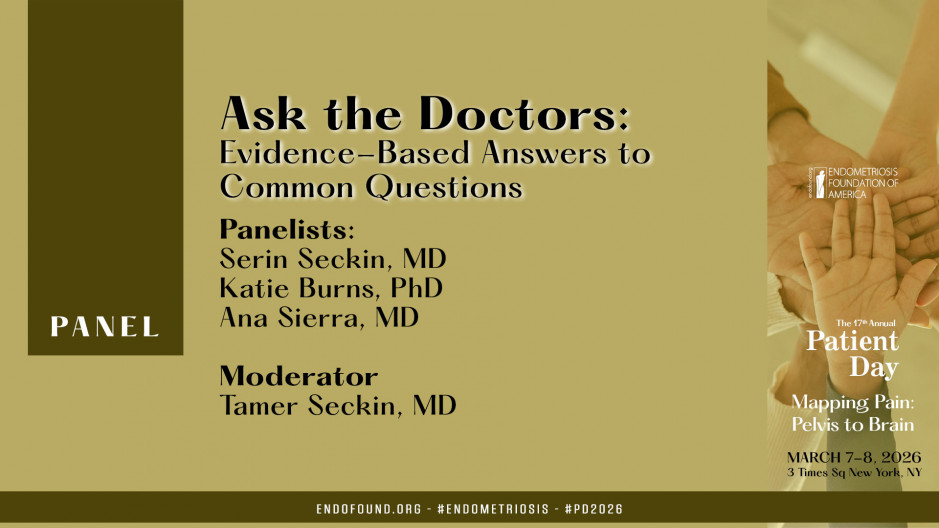
Patient Day 2026
Mapping Pain: Pelvis to Brain
March 7-8, 2026
3 Times Square, New York City
So some of you met Anna Sierra from Mexico. If you were here yesterday, you would have heard her wonderful lecture. I was very impressed. Good doctors are everywhere. So Dr. Sarin Setchkin is a fertility specialist from trained at Columbia. And Dr. Katherine Burr is a scientist who's been around many years. I don't know her story, but I'm sure you would reflect as a patient and a doctor. She's a PhD. She does incredible scientific studies that I'm very, very impressed. So you heard the stories of these women. I don't want to call them patients. Patients is not the good word. They're women. The woman with some experience that are the victims of this disease. So let's start with the scientist. That's perfect. Okay. As a scientist, how do you see the attitude of scientists versus doctors and how do you place the patients in between? And what's your thoughts?
How we could improve things when you look back from your own experience and also knowing things, what goes on out of your experience in the world here, there and everywhere.
Okay. Okay. I'll give it a shot. So I, first of all, thank you all for being here. It's just wonderful to see here and realize that-
I put her on the spot. She didn't know. Did you have replacing someone?
That's fine. The journey that I lived was very similar to many of what you've lived and what I've been saying to people is I can't wait for menopause. So it's a big part of what I hope for daily. So my lived experience has been very similar to the stories that we've heard today. And what I did as a patient is I was a patient at a clinical trial, NIH, where they actually studied reloxapine, which is a selective estrogen receptor modulator to try to block the estrogen part of disease. And what we found is that, well, I didn't find because I was ended up on placebo thankfully, but it actually made disease worse. And what we've learned through the research that I've been a part of is the idea of the initiation of some of our endometriotic disease is due to the immune system. And so I'll be speaking a little bit later on menstrual fluid and what's in menstrual fluid and the idea of how our immune system really drives what we're seeing.
So I think one of the things that really is different from a scientific perspective, a patient perspective and a clinician perspective is how we critically think and how we think about what is happening inside, outside, and to those around us. So I think some of that is you have to live it, you have to understand it to know how to help. But I think as a scientist, critically asking these hard questions that I'm learning from many of you today to take home and to think about, and what I learned at the scientific meeting over the last couple of days really is going to push me. And Dr. Sesh can push me to look into neutrophils, specifically white blood cells, a white blood cell, and the nerves, and how those nerves interact and have new ideas to get home with, and using those critical thinking skills, I think is what's going to help move us forward.
Thank you. Well, I've been hearing things. This meeting was, you were not part of it, but you can really listen to the videos from the foundation. You can learn a lot because we doctors don't know any damn thing about how certain things work. So from scientists, yes, I did push you. I did push others. I pushed myself to learn more because some other scientists knew more than us. We had no connection to each other. I don't know what the next door is doing, even though I'm doing sophisticated surgery. The guy who's doing nerve surgery, he knows the nerves better than I do, and they taught a lot. This wages nerve was a mind blowing. And that's
Why these meetings are so important to bring all the brains together from brains of laypeople to clinicians, to scientists, to learn from each other. So thank you all for that.
This vagus nerve is the black hole of the old knowledge we miss, really. It will teach us so much. It's about exercise. It's about nutrition. It's about every vagus nerve is a 200,000 nerve fibers going and feeling from our lung all the way to the bottom. And I gave an example this morning, how the uterus is directly connected to vagus nerve, and many of the symptoms are associated with it. 80% of the nerves are afferent. It's feeling, completely feeling and sensing. In that sense, it's very important. So the narration is being changed to something else. It's going to affect societally. It's about going to be neuroimmune mechanism we're going to explore. So before I come to Anna, I'm going to ask certain questions to our next panel, young lady. I have to be honest, she's my daughter. I mean, you know that. She's my daughter that I'm proud of.
She's a fertility specialist and there was not too many infertility specialty women joined. So I had to put, why don't you be part of this? So Sarah, in your experience, you're very pre-opinionated on what I do, right? She comes from infertility world. They look at doctors like me, like, "What is this guy really doing?" That world thinks about that. And you witness other things from your other experience with me, and now how are your opinions changed as a fertility doctor? We heard Brian Levin. Did you hear Brian Levin? Who heard Brian Levin yesterday? Good. Who heard Tomar Singer? Everybody heard Tomar Singer. Okay, good. As a fertility, what are your inner thoughts about what do fertility doctors miss about endometriosis? Why do they simplify this disease so easily?
Hello, everybody. That's a very good question. So I've been within the world of seeing how impactful recognition of endometriosis without surgery has been my whole life. I've been in that unique position. And then when I went into fertility training, you do see that a lot of the time surgery isn't recommended anymore because we think we can achieve the goal just with IVF. And that can be true for some people. But when there's pain involved as well, when there are other factors, other symptoms, it can't all be ignored. It has to be acknowledged and it's all connected. And we're seeing there are not many studies showing the connection between endometriosis, adenomyosis, which is hugely involved and also the poor, lower outcomes you might see in patients who are labeled as endometriosis, the correlation there, but that and pregnancy outcomes. We had a wonderful talk on that yesterday and we also don't talk a lot about repeat IVF cycles, repeat heavy menstrual periods somebody may be suffering and the impact on flaring endometriosis and the long-term effects of that.
We see that all the time. Do you guys ask
Endometriosis questions to patients?
We do, but there are so many other questions we also ask. So I specifically, when I was practicing, I asked about painful periods, painful intercourse. And if either is a yes, we dig into further questions. But what about somebody who doesn't have that, but has GI symptoms? There's a significant portion, not most, that just have that, but that can't be ignored too. So it all has to be taken in as a whole. You can't forget pain flaring up of symptoms, which is there are only about five studies out there, specifically about endometriosis and flares of pain after IVF cycles. So it's not talked about because it doesn't go towards the goal necessarily, but everything should be known and considered and talked about. So I have learned the connection between the two and the prevalence.
What did you learn? How does individuals associate with infertility and what do you think your duty should be as a fertility specialist and others should be straightforward with patients?
My approach ... Well, what I learned is how connected is, how prevalent it is. And my approach is mostly education, educating and talking about options. It does put a lot of autonomy to the patient, and sometimes that's not the right thing for every person, but that's the way I approach. And as our wonderful lecture earlier this morning, it's about mapping out options for that patient, customizing it and making it personalized for the person who's sitting in front of you.
Thank you. I'll leave you alone for a while. Ana Sierra, what's going on in this crazy America? Coming from Mexico, as sophisticated as I saw how you practice, I really admire the way you do things. Lots of congratulations. Thank you. In case you missed her presentation, please try to take time and listen to her tape from our video database. What do you think we're doing right? What do you think? You can say what we are doing right first and what you think we should be doing that is wrong.
Okay.
As a physician, be critical.
Okay. I don't know. They place a microphone on me. Okay, perfect. So I see some strengths, for example, this Congress. I think having patients here, giving the right information for them to empower them and for them to seek the correct diagnosis and to seek the correct treatment, to know that excision surgery is the best way to remove the lesions, but it's not the only way to be without symptoms. There are a lot of things that you're doing that are the right thing. So I think that's a very good strength that you cannot see and you cannot achieve, especially for Latin patients or people that speaking only another language like Spanish to have the access of this information because most of this information, it's only in English. So I think that is one thing that you have really good, like in order for the patients to access information and well, to access the correct information.
So that's a good
Thing. So in your training, what are the important elevation of your stature as far as competence and what do you do better and what did you learn from patients?
I think that we can all learn from patients, from physical therapists and from other doctors. I think one of the strengths and the things that we can improve all of us as doctors is to listen to the patient because she's going to tell us what's her diagnosis. And if we listen to them and we really take a very good clinical history, we will begin to understand the way that her pain has developed over the years because all of the pain has a history, has a beginning, has a translation, has been an evolving. And you can see how the pain has evolving and you can see how the symptoms evolve. So a very good clinical exploration also after a clinical history to know how this pain is manifesting in the patient and everything that is happening into her body. So if you have this as a base, you're going to have a stronger diagnosis and then the treatment.
I'm going to be more specific. Can I say something? Do you video ... What's that? Go
Ahead. One thing that I heard you say that stuck out and has stuck out through all of this is listening. And I think that's one thing that the physicians, and we really need to work on listening as scientists, as physicians, as advocates. How can we take that time and listen better?
Listening and hearing-
And
Hearing, yes.
Hearing. You can listen, but you may not be understanding and you're not hearing it. Good point. So it's very important. We're going to come, but truthfully, the time you spend with the patient is so important and you really have to make sure you're looking into her eyes and she's looking at you. The connection between doctor and patient has to be towards the steps of trustworthy and honest relationship that she would trust you after surgery, you will take care of her. So you can't have five minutes. It should be at least 45 minutes and that time, all the systems have to be reviewed in a way that you establish a relationship. Surgery is a little portion, even though it could be 10 hours, it's little portion of the care. The real care, I don't get challenged with surgery anymore. I do. I mean, I may sweat, I may be tired, but that doesn't count.
Most important challenge is taking the patient afterwards. How am I going to deal with her postoperative care, complication, recovery? How is her bowel going to function? What am I going to ... Many times I am not as successful, I have to admit, and I'm trying to do better. Thanks for great presentation this morning, both Nicole Holly. And it was great, Hailey. Great to present. So in your experience, do you videotape patients? Do you share the video with the patient?
The video of the surgery and the video? Yes. The video of the surgery, we show them their video and they keep their video.
That's very important because video of the surgery is a true representation of the surgery and it's a step forward. I have learned so much from patients. What other doctors have done or even I have done, there is always repeat surgery. How many of you had surgery? Oh my God. How many of you had repeat surgery? Oh my God. That's exactly where I'm coming to. All right? So if there is a video of the surgery, you can really see what has gone right or wrong and the doctor has to be honest about it. The patient feels when you're not honest. They're not idiots. I'm telling you. All the bad things that are coming from doctors going to lawyers is coming that the patient distrust the doctor and that is the killer of everything that we are representing here. I mean, this is a very good ... So I had my share and I really remember even cases one by one what elevated me and it all came because the patient trusted me to do repeat surgery.
I said, "Look, I think I missed this. I think exactly that's why you're having that symptom." I remember those most of the patients who had surgery and many of them, a lot of symptoms may disappear, but bowel symptoms stay. And if the bowel symptoms are staying, there is bowel disease either. They're afraid to touch. Many times they're afraid to touch because they may get into bowel and they don't know how to repair it and they leave it and they don't even mention about the patient continues. So that's why the video is important. So you go back. So in your opinion, in this meeting, I wanted to stress the bowel symptoms or these gastrointestinal symptoms have all to do with the vagus nerve and we are really moving into the area where immunity and nerves are going to be the next chapter of our challenge. Hopefully, maybe next year we'll ... I don't want to say that, but immunity is very important.
Where do you think, Catherine, let's start with that, the immunity issue. Let's talk about that.
Well, first, one of the things I want to say about the bowel issue, and everybody can use this phrases. I call them poop festivals, because instead of saying, "I'm having diarrhea again, or I'm having this ... " I just say a poop festival, and it makes everybody look at me like, "Oh, she's absolutely crazy." But at the same time, it helps you elevate like, "Oh, this is what my insides are doing for 20 minutes to just release everything to get this pain out of me. " So the immune system, the immune system is absolutely beautiful and amazing and horrible at the same time, I think, because what we're learning is some of us have immune systems that are not quite right. And I've learned this about myself, and that's what's driven me to try to understand the immune system even more. But what we're learning is that the immune system actually in the menstrual fluid of women with endometriosis is quite different than the menstrual fluid in women that are healthy.
So there seems to be a natural response where you shed your menstrual tissue, the immune cells come in and they respond and it's called a resolution. They resolve that inflammation, they resolve the problem. So if you get a cut on your hand, those initial immune cells come right in and they fight and then they repair. That process is what is needed each time you menstruate. However, that repair process, that resolution doesn't seem to be happening in women with endometriosis the same way. And so we'll talk
About
That a little bit later.