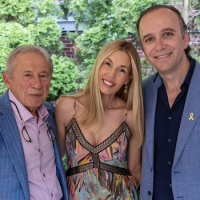

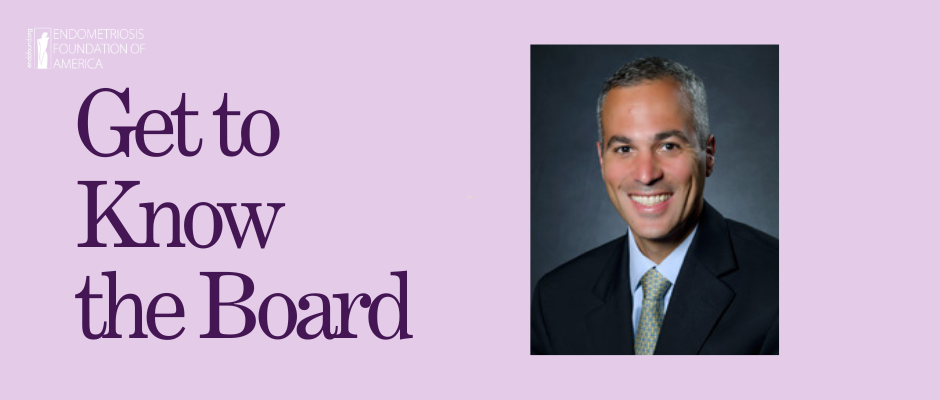
A 2025 study published by the National Institutes of Health revealed a link between endometriosis and several cancers, including endometrial cancer, breast cancer, and ovarian cancer, with the highest risk being ovarian cancer. Given that connection, gynecologic oncologist Dr. Tom Lallas has accepted an invitation from EndoFound to join the foundation’s board of directors.
“These women with endometriosis who are genetically susceptible to cancers need a place to turn,” Dr. Lallas said. “I think I can provide insight and add experience to the board from a different point of view, not just from that of a general gynecologist. Gynecologic oncologists see things through the cancer lens and make sure there is no malignancy, rather than focusing on just the endometriosis.”
Dr. Lallas grew up in Houston and Washington, D.C., where his father worked for IBM in the space program. He studied at Duke University, attended medical school at the University of Virginia, completed an obstetrics and gynecology residency at Lenox Hill Hospital in New York City, and completed a gynecologic oncology fellowship at the University of Iowa. He entered private practice in New York City in 1999 with a partner and has managed the practice himself since 2008.
Initially planning to become an otolaryngologist (head and neck surgeon), Dr. Lallas changed direction after taking OBGYN courses late in medical school.
“When I got to the OBGYN block, they put me on the GYN oncology service, and I loved everything about it,” he said. “I loved the anatomy, and I loved dealing with women. These were sick women with complicated cases, and I really felt like I could make a difference.”
Though Dr. Lallas’ training is not in endometriosis, his experience with the disease runs deep. He and Dr. Tamer Seckin, advanced laparoscopic endomeriosis surgeon and Cofounder of EndoFound, have been performing surgeries together for 20 years.
“Clinically, he and I have overlap,” Dr. Lallas said. “Sometimes, what he sees imaging-wise might be a cancer, so we’ve operated together on those patients. There are also patients he sees who have elevated tumor markers that need to be evaluated. And then there are other patients where endometriosis has the potential to develop into a malignancy.”
Surgery is still part of Dr. Lallas’ practice, but he has also kept pace with the science—in particular, advancements in genetic testing.
“As the years have gone on, I’ve moved more away from dealing with the cancer to preventing the cancer,” he said. “With genetic testing, there’s a vast group of patients who we know have a susceptibility to develop a cancer. For example, a woman has about a 1.6 percent chance of developing ovarian cancer during her lifetime, but there are some genes that can elevate that risk to 20 to 40 percent. Many of those women find out in their 20s and 30s that they have this risk but aren’t ready to have surgery. I help them with prevention, and I take care of a lot of multigenerational families—the grandmother, the mother, and now the grandchildren.”
In addition to his practice, Dr. Lallas has been an educator for many years. He’s served as a clinical assistant professor of obstetrics and gynecology at Weill Cornell Medical College since 1999 and at Hofstra University Zucker School of Medicine since 2019. He expects education to be a significant part of his work with EndoFound.
“I think something that’s so important is getting out there and educating our medical colleagues about endometriosis. So many of these patients are delayed in diagnosis because there’s a lack of education and knowledge,” he said. “Ovarian cancer is often called the silent killer, but it’s not that it’s silent—it’s that people don’t recognize the symptoms. I’ve seen the same thing with endometriosis as I learn more about it. It’s not that it’s asymptomatic—it’s just not recognized, and we need to change that.”