

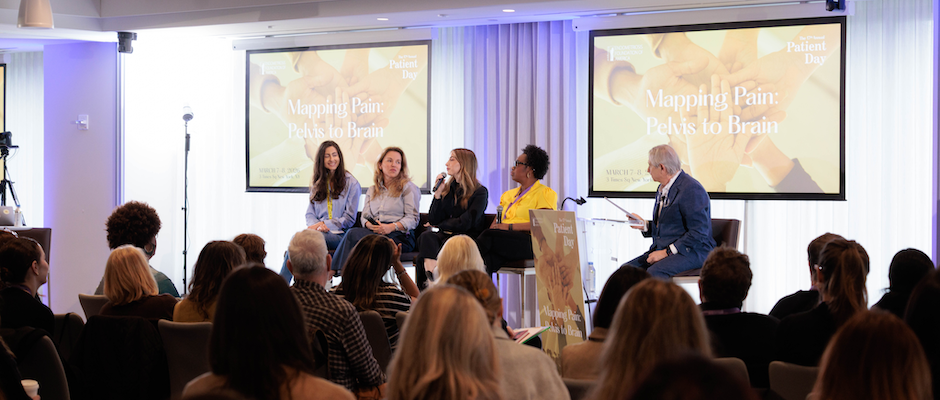
Endometriosis is an extremely heterogeneous condition—no two patients experience it the same way. Some may only experience gastrointestinal issues. For some, their sole symptom might be infertility. The most prevalent symptom, however, is pain. During the Endometriosis Foundation of America’s annual Medical Conference and Patient Day this year, physicians, researchers, patients, and advocates discussed the need to shift perspectives on endometriosis from being solely a gynecologic or hormonal condition to considering it as a nerve-driven disease to better address the root causes of pain.
The Biology of Pain: Neuroangiogenesis and Sensitization
Much of the conversation at the medical meeting focused on the role of nerve fibers in endometriosis. Nerve fibers transmit electrical impulses through nociceptors (pain receptors) to the brain, helping to regulate inflammation and immune response in the body. Research has shown that neuroangiogenesis—the simultaneous growth of new blood vessels and nerves—is a critical part of the process that allows endometriotic lesions to grow, thrive, and contribute to chronic pain.
Although estrogen production drives the development of these lesions, hormonal suppression can be ineffective in reducing pain for many patients. “If estrogen drives lesion growth and lesion growth drives pain, hormonal suppression should work, but it doesn’t,” said Dr. Michael Nimaroff, chair of obstetrics and gynecology at Northwell Health Lenox Hill, during his presentation. “Pain can and still does persist. There’s another pathway for why patients suffer pain despite the therapies they are taking.”
The persistence of pain is attributed to both peripheral and central sensitization, a key reason to shift the perception of endometriosis to a nerve-centric disease. In peripheral sensitization, pain receptors at an injury site, such as an endometriotic lesion, become more sensitive, while central sensitization amplifies pain signals within the spinal cord and brain. Each alone can cause debilitating chronic pain, but together they create an environment for cyclical and acyclical pain that is difficult to treat.
“We have an acute inflammatory situation, and when the cycle is over, that pain is gone,” said Dr. Sylvia Meschner, a gynecologist and researcher at Charité-Universitätsmedizin Berlin, during the conference. “But we also have neurogenic inflammation, which is a main factor in this ongoing pain.”
Another contributor to pain is the widespread impact of endometriosis. Patients often experience extra-pelvic involvement, such as in the chest, bowel, and bladder, which can be missed without proper presurgical mapping. Dr. Paulina Carrillo, a minimally invasive gynecologic surgeon in Mexico City, emphasized to Patient Day attendees the importance of mapping as a key component of modern endometriosis care. “Pre-operative mapping is not just a descriptive map; it can guide the treatment plan,” she stated at the conference. “It can help us plan better, counsel better, prepare the right team, and set realistic expectations. It should inform us about the type of endometriosis present, where it is, how much there is, how deep it can go, are other organs involved, and how these factors correlate with symptoms.”
The different organs involved in endometriosis should be taken into account when exploring pain management strategies. “We have to fix the pain but also keep organ function,” said Dr. Helder Ferreira, head of the Minimally Invasive Gynecologic Surgery Unit at Centro Hospitalar Universitário in Porto, Portugal, during his presentation. “This addresses the neuroinflammation and the neurogenic pain mechanisms while ensuring urinary, defecatory, and sexual function are maintained.”
Coping Mechanisms and Validation as Medicine
The conversation around pain began from a focus on understanding the underlying biological mechanisms to emphasizing real-world patient experience. Patients frequently face a 7-10 year delay in receiving an endometriosis diagnosis, partly due to systemic gender bias that minimizes women’s pain.
For Dr. Autumn Weimann, her first memory of endometriosis was at age 14, when she vomited from the pain she was experiencing. “Every month, I had severe pain, vomiting, heart palpitations, numbness in my arms and legs, cold sweats, I couldn’t walk, and I had blood clots,” she recounted during the conference. “I was experiencing the same pain as women in labor. But for me, it was every single month, and I was told women just have to live with it.”
Similarly, Nicoletta Rasizzi, a registered nurse and endometriosis patient, was also told her pain was normal despite knowing otherwise. “I have had five surgeries due to endometriosis,” she shared at the conference. “Some recoveries were smooth, others were not. But what shocked me most wasn’t the physical recovery; it was the silence after the surgical procedure. I learned that recovery wasn't just about the pelvic area; it was about my entire body. That's when I realized something critical: it wasn't just a painful period.”
Dr. Arnold Wilson, a psychoanalyst and lecturer at Columbia University Vagelos College of Physicians and Surgeons, spoke about the psychological impact that diagnostic delays and persistent invalidation can cause. “Women with endometriosis are tremendously agitated by the fact that nobody has ever really understood them,” he noted during his presentation. “They’ve been told all they have to do is grit their teeth and gut it out. I often see these depression-pain cycles where the presence of depression increases pain, and pain increases depression. It’s very difficult for a woman with endometriosis to escape those cycles.”
The importance of developing healthy coping mechanisms was emphasized by many speakers. “My healing began with the diagnosis, but the flood after was so scary that healing is still happening,” said Halley Ceglia Terrell, a patient and licensed clinical social worker. During her presentation, Terrell offered suggestions for coping and regaining psychological strength, including behavioral therapy, boundary setting, and mindfulness practices.
Savannah Regensburger, a clinical nutritionist and endometriosis patient, echoed the importance of these skills and suggested several additional tools for one’s recovery toolbox: nutrition, sleep, hydration, and movement. “Throughout my journey, I learned how important these were to my personal recovery and rehabilitation,” she said during her session. “We need to increase body literacy to understand how endometriosis impacts you differently. We must stop comparing our experiences and start learning from one another.”
The Future of Pain Management
While it may seem challenging to find hope for patients dealing with chronic pain, the presenters at the Medical Conference and Patient Day aimed to convey that hope is on the horizon for new and improved treatments.
The vagus nerve was a significant topic of discussion throughout the three days. Dr. Sun-Wei Guo, a researcher at Shanghai OB/GYN Hospital, Fudan University, highlighted the vagus nerve’s role in endometriosis and its potential for future therapeutics. “All of the existing drugs are not curative and cannot completely eradicate lesions,” he stated during his keynote presentation. “They stop menstruation and alleviate symptoms, but once you stop taking them, the symptoms return. If any therapeutic approach, such as vagus nerve stimulation, can achieve a similar effect, those possibilities should be explored.”
Bee Bosnak, a yoga and meditation teacher, discussed the importance of connecting with the vagus nerve to regulate the nervous system. “Repeated pain starts to create this hyper-alert state in your body, and when that dominates your mind, it can lead to a shutdown of the nervous system,” she said. “When you connect with the vagus nerve, you start to reclaim your power.”
Vagus nerve stimulation (VNS) is currently used to treat various medical conditions, including seizures and depression, as well as rheumatoid arthritis and other inflammatory conditions. VNS can be delivered via an implanted device in the body or a non-invasive device applied to the skin, both of which have minimal side effects. The vagus nerve can also be activated through breathwork, humming or singing, meditation and yoga, and cold water immersion.
Excision surgery was also widely discussed, reinforcing its status as the gold standard treatment for endometriosis. There was an emphasis on the importance of seeking treatment from a trained specialist. "Incomplete surgery and improper technique are the most common reasons patients return," said Dr. Seckin.
He highlighted the need for specialized training and precise techniques to ensure successful surgery. Dr. Seckin described his success using an aqua blue contrast technique to improve visualization of endometriosis, including the smallest lesions, throughout the body. Since implementing this approach, he has seen his five-year recurrence rate drop from 16% to nearly 8%.
Looking Ahead
At the end of the conference, both presenters and attendees felt inspired by the ongoing research in the field and moved by patient perspectives. However, there is still much work to be done, which can only be accomplished through advocacy at the state and federal levels to improve awareness, education, and research funding.
"While we wait for science and funding to catch up with us, and for our doctors and families to believe us as stewards of our own bodies, we must recognize that we are the well of information we've been waiting for," said artist and patient Amyra Leon.