


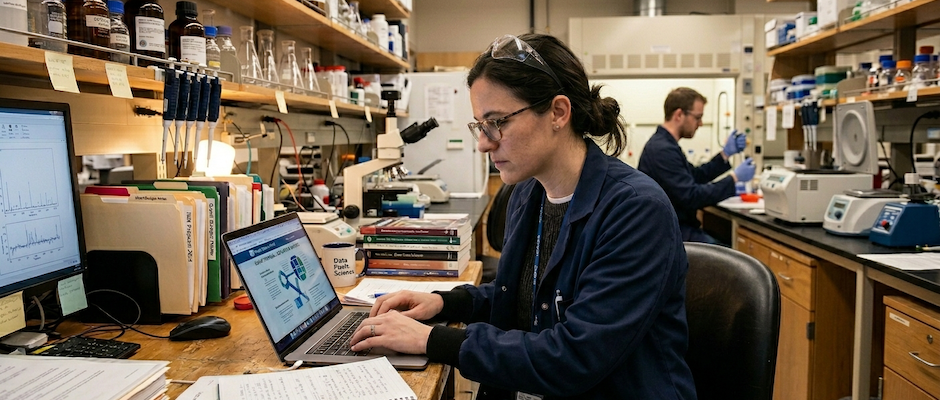
For the millions living with endometriosis, answers, treatments, and relief often feel just out of reach. What many might not see behind the scenes is that every breakthrough a doctor brings to a patient begins years earlier, as a hypothesis in a research lab. And while these discoveries are built on the expertise of dedicated scientists, they are only possible if one critical piece is in place: funding.
Dr. Katherine Burns is an Associate Professor at the University of Cincinnati College of Medicine, and the director of the Division of Environmental Genetics & Molecular Toxicology. Her lab studies endometriosis, looking specifically at the role of the immune system in the development of the disease and the effects of environmental toxicants on disease progression. As Dr. Burns explains, there are so many efforts in basic research directed toward ensuring that the science is well executed, reproducible, and safe. But when it comes to financing these efforts, “that’s where the true challenge lies in keeping the research going and keeping the lab going.”
As Burns points out, research is very expensive. In order to uncover basic insights into the biological mechanisms that drive disease, most labs rely on mice or other animal models. Its genetic and physiological overlap with human biology makes the lab mouse a convenient, more simplified system in which researchers can learn more about fundamental biological processes, pathology, and the safety and efficacy of treatments before they proceed to clinical trials in people. But the costs of caring for and keeping these animals can add up quickly over the course of a study, potentially reaching thousands of dollars monthly just to house the mice needed for a project.
The costs of specialized reagents and equipment also stack up quickly. Antibodies are highly versatile research tools that allow researchers to visualize proteins of interest in specific cells or tissue types, to capture and purify proteins to better understand their biochemical properties, and to identify possible therapeutic targets for drug development. Burns points out that a single antibody may cost several hundred dollars per experiment, and multiple antibodies may be used for a single test. And to visualize and quantify the results of these experiments made possible by these tools, experimenters need highly specialized microscopes and instruments that are even more pricey. “It’s just thousands of dollars that builds up,” she says.
The bulk of funding for basic research comes from the federal government, through agencies like the National Institutes of Health and the National Science Foundation. Within each of these agencies, more focused institutions exist for specific diseases or research areas. As Dr. Burns explains, the resources allocated by the government to each of these branches aren’t equal. The federal budget for women’s health is relatively low compared to other research areas, and funding for conditions like PCOS, uterine fibroids, and endometriosis is even more limited.
Competition for these grants has risen sharply as federal funding across all scientific disciplines has faced devastating cuts and restrictions within the last year. In order to secure these coveted federal funds, investigators heading up research labs have to invest a substantial amount of their time into writing grant applications. At current federal funding levels, Dr. Burns explains that for every half dozen grant applications an investigator submits, maybe only one of these proposals will receive funding. The consequences of losing a funding opportunity can be devastating for a lab and the science that’s progressing within it. On top of the costs of carrying out a study, grant funding also pays the salaries of the researchers who have dedicated their careers to understanding and treating human disease. Without this funding, labs are forced to shutter.
Dr. Semir Beyaz leads a research group at the Seckin Endometriosis Research Center for Women’s Health at Cold Spring Harbor Laboratory, where the lab’s efforts have focused on recreating models of both healthy endometrium tissue as well as endometriotic tissue in a dish to advance new diagnostics and therapies. Dr. Beyaz points out that endometriosis is a pervasive public health crisis, affecting more than 1 in 10 women and representing billions of dollars annually in economic impact. By contrast, one NIH award for an entire lab might offer a maximum of $500,000 in a year. These funds need to stretch not only to support the daily operating and equipment costs within the lab, but also equitable salaries for an entire team of highly trained researchers and support staff. Often, these federal funding limits amount to only modest support for large-scale efforts at discovery science.
Funding constraints can not only limit the scope of projects a lab can undertake or the number of researchers it can hire. Dr. Burns notes that the fiercely competitive funding climate is also pushing proposals and funding away from discovery science and toward more established, hypothesis-driven projects. “The science is so focused on this that we’re missing what we might discover by accident. And some of the best things that are discovered in science and medicine have been discovered because we’re allowed to explore. We were allowed to ask questions, we were allowed to think big.”
Where federal funding falls short, philanthropy, private endowments, and support at the state and local level can go a long way to keeping labs alive and driving their science forward. While federal funding is the bedrock of basic research, government agencies are also vulnerable to federal budget restructuring and government shutdowns, which indefinitely pause the release of critical research funds.
Endowments and donations greatly stabilize the financial ecosystem. Federal funding represents less than half of the financial support for research at Cold Spring Harbor Laboratory, and organizations like the Chan Zuckerberg Initiative and Howard Hughes Medical Institute (two of the largest private funders of biomedical research) can provide researchers with a stable reserve of resources to survive through federal funding challenges. Dr. Beyaz underscores the need for a sustainable research support ecosystem—one that incorporates not only federal funding from the NIH and support from private donors, but also collaborations with pharmaceutical companies and advocacy at the level of science policy. “EndoFound is a big visionary in that ecosystem,” he says. “And that’s how our center was born—a basic science institute working with a foundation that cares about advocacy, patient care, and research coming together to innovate, and to set an example with what we can do together.” When such high standards of research, knowledge, and talent concentrate in one place, innovation in the field will not only grow but also serve as an example for others—a future Center of Excellence (CoE) model for endometriosis research and care, with The Seckin Endometriosis Research Center at CSHL emerging as a leading prototype.
Still, behind every experiment, every discovery, and every step forward for patients is a fragile funding ecosystem that determines what science moves forward as well as what is left behind. When funding falls short, so do opportunities for earlier diagnoses, better treatments, and ultimately, a cure.
But when researchers, advocates, policymakers, and supporters come together, the trajectory of this disease can change. Sustained investment doesn’t just keep labs running, it accelerates the path to answers for the millions of patients still waiting.