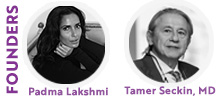

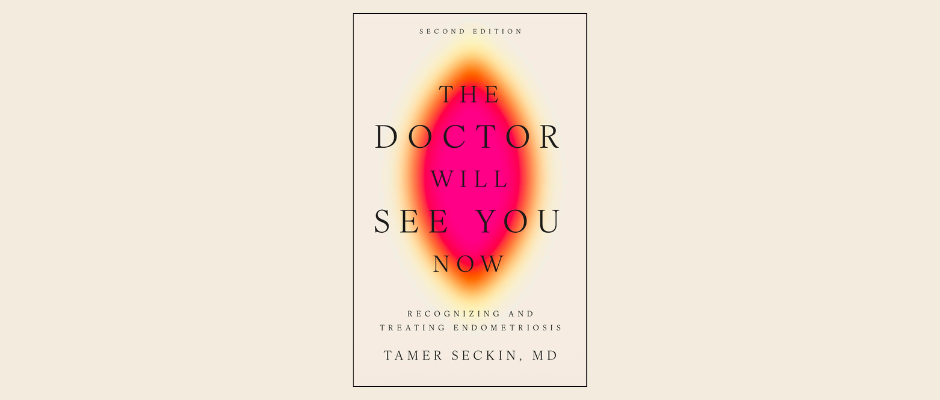
Ten years after The Doctor Will See You Now: Recognizing and Treating Endometriosis first gave a name to so many people's pain, EndoFound cofounder and renowned endometriosis excision specialist Dr. Tamer Seckin's landmark book on endometriosis care has been published in its second edition. Including new chapters on thoracic and sciatic endometriosis, updated research, and new treatment options for the disease, the book centers patient stories and is grounded in the same message that made the first edition essential reading: your pain is real, you are not crazy, and there is hope.
As Bindi Irwin writes in her foreword to the new edition, “We deserve to be heard, to be genuinely cared for when we go to our medical professionals in pain. It is because of Dr. Seckin and his remarkable team that countless girls and women are now receiving the information and treatment that they need.”
Today, we’re excited to share one of these new chapters (and new treatments) in an exclusive excerpt from the new edition that introduces a never-before-done procedure, and the patient whose defunct ovary it brought back to life. The procedure is a form of omentum transplant surgery, where an otherwise defunct ovary is filled with stem cells to essentially kickstart the ovary back to life. As Dr. Seckin explains, “this procedure provided the ovary with a fresh blood supply and new stem cells. A fresh blood supply means oxygen; we delivered oxygen into the heart of the ovary and woke the sleeping eggs, so to speak.”
In Halley’s case, a patient who tried for years to conceive both naturally and with IVF, the procedure helped her get pregnant when there was previously a very small chance. “It was remarkable,” Halley shares. “I had gone in to have endometriosis removed, but I ended up getting pregnant on my first attempt with IUI after the surgery because of this new type of omentum transplant. It was science in the making."
We’re also delighted to share that all of Dr. Seckin’s proceeds from the book will go towards EndoFound.
Order your copy of the new edition today.
ONE ASPECT OF ENDOMETRIOSIS SURGERY is not discussed enough by physicians and patients, an aspect that is especially important when working at the frontier of a disease that is still so understudied. As surgeons in an operating room, we have to be ready to provide a patient with the best outcome possible and do whatever it takes to guarantee that. This might mean innovating, both in and out of the operating room. My mind is constantly spinning with ideas on developing new techniques, tools, or procedures to eliminate the suffering of those with the disease—which brings me to this new chapter.
Some patients, like those in the previous chapter, were no longer infertile after their excision surgery. But, sometimes, by the time a patient has excision surgery, the damage done by endometriosis may be irreparable with regard to having children. This was the case for a patient named Halley, who I first saw in 2020.
Halley's story is fascinating. Now in her mid-forties, she's contemplated writing her own book about her endometriosis journey over the past three-plus decades, so I don't want to divulge too much of it here.
"I got my first period when I was eleven, the scariest day of my life," Halley said. "The cramps were tremendously painful. I'd end up missing a lot of school and dance classes every month, and my friends still remember me lying on the floor of the locker room in fifth grade in agony. But everyone told me it was normal and would eventually go away."
At sixteen, Halley finally saw a gynecologist for the first time. He diagnosed her with human papillomavirus, commonly known as HPV, a sexually transmitted disease. Halley would learn years later that she never had it.
"I hadn't been sexually active, so I had no idea how I could have gotten it, but I was just a teenager and trusted what my doctor told me," she said. "It made me feel horrible and broken inside."
Along with the pain, Halley encountered more symptoms and misdiagnoses over the next twenty-nine years. In college, she experienced blood clots during her periods, severe acne, sensitivity to alcohol, diarrhea, panic attacks, anxiety, and mood swings that others told her made her unapproachable. She had to quit her equestrian team because of the severity of some of the symptoms and struggled to make and keep friends. In her early twenties, she saw several more doctors—a hematologist, a gastroenterologist, and other gynecologists—and they gave her more misdiagnoses, including IBS and interstitial cystitis (a chronic condition that causes bladder discomfort or pain). At twenty-seven, a psychiatrist told her she had bipolar disorder and was a hypochondriac. She was later told she didn't have bipolar disorder—she'd been misdiagnosed and instead had PTSD, which research has shown has a link to endometriosis.
"After all the poking, prodding, and tests I went through from age sixteen to this point in my life, PTSD made total sense," Halley said. "It was a relief to know I didn't have bipolar disorder on top of everything else."
In her early thirties, Halley had a vaginal ultrasound roughly every six months. Doctors found nothing wrong each time. After getting married at age thirty-seven and unable to conceive, Halley and her husband, Colin, tried to get pregnant through fertility treatments.
"We did three IUIs without getting pregnant before our insurance ran out," Halley said. "That's when my fertility doctor suggested IVF because insurance would cover it. I thought this was the answer and we'd get pregnant for sure. And we did, but I miscarried five weeks in. I had never been so depressed."
Halley would have another treatment that failed before one of her coworkers suggested she might have endometriosis. She'd briefly discussed endometriosis with a midwife she'd seen when she was thirty-one, but at the time, she wasn't open to more medical interventions after having just undergone endoscopies, colonoscopies, extensive bloodwork, and more.
"I knew what endometriosis was, but as I learned more about it from my coworker, I realized there was a lot I didn't know," Halley said. "Mainly, I didn't know the complexities of it, like that it could adhere my organs together or that it could affect my fertility."
Before her next IVF treatment, which was also unsuccessful, Halley said she told her fertility doctor that she was certain she had endometriosis.
"He said, 'Whatever. If you have endometriosis, IVF will bypass it. Don't worry about it,'" she recalled. "Three other doctors would later tell me that if I had surgery for endometriosis, I could kiss my chances of ever having a baby goodbye because the surgery would damage my ovaries too much. I was researching the disease at the time, and everything I read was the opposite of what they were telling me. I knew they were wrong."
At the recommendation of one of her friends, Halley came to our practice in May 2020. After running various tests and realizing her ovaries were likely in bad shape due to three decades of endometriosis, we did excision surgery on her two months later—but with an incredibly rewarding twist.
After excising the endometriosis from multiple organs, including her ovaries that had hopelessly low egg reserves, I performed for the first time what I call ovarian bypass surgery. It was a surgery I'd never attempted, and as far as I know, no surgeon in the world had ever tried it. I hadn't planned to perform the procedure going into the operating room, but having met Halley, having developed an extremely trusting communication with her, and knowing just how much she wanted to conceive, I did what I do for every surgery: everything I can imagine to give my patient their most desired and healthy outcome. Halley was now forty with a very low AMH (or anti-Mullerian hormone, a hormone that reflects the numbers of eggs remaining in the ovaries) and had been infertile for years. Her ovaries, even with the endometriosis excised, were in a coma, still functioning yet having a hard time producing mature eggs. I saw a way—one I had never tried—to jumpstart those ovaries. The medical risk was very low and the potential reward high. If the procedure didn't work as I hoped, Halley would be in no worse condition. But if it did work…
The process involved transplanting part of Halley's omentum, a fold of tissue that lines the abdominal cavity, into one of her ovaries. Already, we'd used this transplanting technique in endometriosis surgery to prevent cul-de-sac adhesions and fistulas between the rectum and the vagina, and given how critical it is in ovarian surgery to not burn the eggs, the application of this methodology was very medically indicated. Once removed, my surgical team and I prepared the omentum with stem cells and sculpted it into a thin shape while maintaining its blood supply. We then sliced one of her ovaries like one would a hot dog bun, carefully packed it with the stem cell–filled omentum tissue, and stitched the ovary back up. This procedure provided the ovary with a fresh blood supply and new stem cells. A fresh blood supply means oxygen; we delivered oxygen into the heart of the ovary and woke the sleeping eggs, so to speak.
About four months later, in November 2020, Halley called me.
"I was twelve weeks pregnant," Halley said. "It was remarkable. I had gone in to have endometriosis removed, but I ended up getting pregnant on my first attempt with IUI after the surgery because of this new type of omentum transplant. It was science in the making."
When Halley's child was fourteen months old, Halley called me again to tell me she was six weeks pregnant with her second child. As with the first pregnancy, it happened on the first IUI attempt.
After a heartbreaking miscarriage, so much sorrow from one failed fertility treatment after another, and ovaries that were just about to shut down, Halley had two healthy and happy babies in just under three years after surgery.
"I know there are so many women who are led down the wrong path and given the wrong information and don't get to become moms because of it," Halley said. "I'm so grateful for how this turned out for me and hope that my story will have an impact on other women who are struggling."
Since Halley's surgery, I have now successfully performed this ovarian bypass on three other patients. The surgery is not a cure for fertility for those with endometriosis. The disease still needs to be excised first, and the procedure is not guaranteed to work. But along with the removal of the disease, the ovarian bypass could be an additional option for surgeons trying to help patients get pregnant. It's also another reason why a hysterectomy should always be a last resort. Science is always advancing. Even though Halley had two lifeless ovaries, this cutting-edge approach enabled me and my team to revitalize one of them, creating three new lives: Halley’s two babies and the life Halley always wanted and deserved.