

School nurses are so often the first medical providers that students speak with about their endometriosis symptoms, often long before diagnosis. They’re the first to witness a student doubled over with period pain, a student who has had to repeatedly miss class, or a student who has otherwise been told by everyone else that their symptoms are normal. No one is better positioned to make a crucial difference in these students' lives—which is exactly what brought the ENPOWR team to Las Vegas from June 29 to July 1 for the National Association of School Nurses (NASN) Annual Conference.
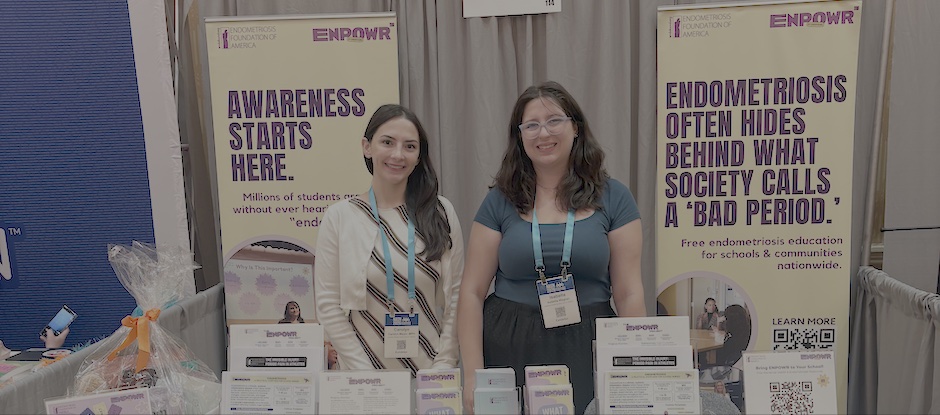
Representing ENPOWR, EndoFound’s signature education program, were our Director of Community Health Programs Carolyn Mayer, and Community Health Program Manager Isabella Wegner. “School nurses are often the first people that young people go to with endometriosis symptoms,” Wegner explains, “and can therefore make a huge difference in diagnostic delay and early intervention.”
Our team arrived with over 200 pounds of educational materials to distribute over three days to the 1,300 school nurses, district health administrators, and state education representatives who passed through the conference. These materials included thousands of symptom cards, pamphlets explaining endometriosis, EndoFound brochures (in English and Spanish), posters, and one-pagers for coaches.
“The hundreds of conversations we had over the course of the weekend centered on promoting greater understanding of this disease and its prevalence, and the capacity of school nurses to serve as beacons for early symptom recognition and compassionate support within their communities,” Mayer shares.
The star of the table was a brand-new resource making its debut: a fact sheet for school nurses to serve as a practical overview of endometriosis. This fact sheet is designed to live right in the health office, where it can help nurses recognize symptoms and support students in real time. Covering endometriosis symptoms, stats, common misconceptions, and tools for students to track their symptoms, the School Nurse Resource Sheet is available online for free.
The impact our education team made in Las Vegas exceeded every expectation. By the time they boarded their flight home, 3,769 schools across 40 states, as well as Mexico and Ghana, had signed up for ENPOWR, numbers which could impact roughly two million students. Many sign-ups came from nurse supervisors enrolling entire districts at once: 71 district-wide sign-ups in all, including large districts in California, Arizona, Texas, Maryland, Connecticut, and Wisconsin. Specifically, 60 districts requested materials to stock in their school health offices, 45 requested professional development presentations for school nurses in their district, and 32 requested curriculum resources.
Mayer shares that compared to when ENPOWR last exhibited at NASN in 2024, more school nurses were familiar with endometriosis and eager to receive ENPOWR resources.
“Although most attendees were at least familiar with endometriosis,” she adds, “many were surprised to learn more about the multi-organ symptoms and system-wide impacts of this condition. We shared information about nerve involvement and endometriosis, and that pain symptoms commonly do not respond to over-the-counter pain medications. This can often help reframe the discussion about what is "normal" and when to provide more support through school-based accommodations, targeted management strategies, or referrals for further care.”
The team signed up two state Departments of Education, health administrators from two of the larger school districts in the U.S., a major nonprofit dedicated to pain awareness, as well as school nurse associations across several states and regions, all of whom are eager to bring endometriosis education, printed resources, and professional development to the nurses in their care.
But the numbers tell only part of the story. “Among the attendees were staunch supporters of endometriosis,” Mayer shares. “Many stopped by to offer heartfelt thanks for sharing free resources and for increasing the visibility of this disease among school nurses.”
Many of these nurses shared that they—or their daughter, sister, or a student—had endometriosis, and stopped to thank the team simply for being there. Their message was clear: school nurses want to better understand this disease, and they want the tools to support the students living with it.
“I had fantastic conversations with many nurses who either have endometriosis themselves or love someone who does, and they were excited about our presence at the conference,” Wegner adds. “I deeply admire their work and was overwhelmed by their positive response.”
The ENPOWR team also held a raffle—congratulations to Beverly J., a school nurse from Pennsylvania, who took home a goodie bag stocked with goodies from past in-kind sponsors of EndoFound's Patient Day.
With the conference behind them, Carolyn and Izzy now turn to the real work: nurturing these new connections, shipping materials to health offices across the country, and bringing endometriosis education to more schools than ever before. To every nurse who stopped by the booth, thank you. And if you didn’t get a chance to sign up your school, you can learn more and do so today.
“And for those who may have previously dismissed pain and other symptoms as "normal,"’ Mayer adds, “it is never too late to become an ally, to learn more, and to spur change in your communities.”
ENPOWR's Adolescent Education Program, College Ambassador Program, and School Nurse Education Program are made possible by the generosity of our donors. The more people understand endometriosis, the more we can push for earlier diagnosis, better care, and stronger support. Your support helps expand access to endometriosis education and empowers more students, educators, and healthcare professionals. To help grow these programs, please consider making a gift today.