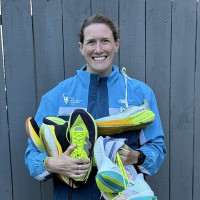

In the late 2010s, Krissy O’Malley led her high school volleyball team to three Division I state titles. She was a four-year All-State selection, Virginia’s 2018-19 Gatorade Player of the Year, and attended Division I Liberty University on a full volleyball scholarship. But her college athletic career abruptly ended soon after it began. The symptoms that she’d been able to fight through in high school had finally overwhelmed her.
“She’s this strong, athletic, young woman who takes the world by storm,” said her mother, Kara O’Malley. “Yet she went from being Gatorade Player of the Year to, ‘I can’t walk to the mailbox.’ That’s what this disease did to her.”
It’s also what brought the Our Daughters Foundation to fruition.
Kara and her daughters—Kayla, Kathleen, and Krissy—have all had or have endometriosis or adenomyosis. Kara and her husband, Burke O’Malley, founded the Our Daughters Foundation in the fall of 2024 to support “the health and healing of women and girls through advocacy, research, and access to compassionate care.”
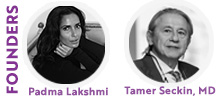
This month, they collaborated with EndoFound and the Seckin Endometriosis Research Center for Women’s Health (SERC) at Cold Spring Harbor Laboratory (CSHL) to form the Our Daughters Foundation Endometriosis Genomics Initiative. The research center opened at Cold Spring in 2025 with a $10 million commitment from EndoFound, which was co-founded by Dr. Tamer Seckin and Padma Lakshmi. Krissy is also a patient at Dr. Seckin's practice for advanced endometriosis surgery and care, the Seckin Endometriosis Center.
This partnership with the Our Daughters Foundation will support scientific research aimed at improving the understanding of endometriosis, including investigation of genetic and hereditary factors associated with the disease. The Initiative’s purpose is to advance research that seeks to better understand inherited risk factors, disease mechanisms, and potential pathways toward improved diagnosis, prevention, and treatment of endometriosis.
Many with endometriosis or adenomyosis symptoms first experience them as young teens, but Kara, 58, had few issues growing up.
“I had cramps, but nothing debilitating. I didn’t have heavy bleeding or any significant pain,” Kara said. “I always had autoimmune issues, things that would circle around endometriosis, but I was never sent in that direction. A couple of my aunts had endometriosis, but I didn’t know anything about it.”
Kara began experiencing continual bleeding in her early 30s that lasted for eight years. In 2008, she had the inside of her uterus cauterized to stop the bleeding, and she was diagnosed with adenomyosis. She suspects that she also had endometriosis, but she didn’t know what it was then and hasn’t looked into it further since the cauterization worked. She only learned about endometriosis when Krissy needed emergency care for severe pain in college.
“The ER doctor pulled me aside and said, ‘I think she may have endometriosis,’” Kara said. “That’s what started us on this journey.”
Krissy had ablation surgery after that ER visit, but it provided little relief. In 2024, she had excision surgery. In 2026, she had a third surgery (and first with Dr. Seckin) to repair the serious damage endometriosis had caused over the years in areas and to organs such as her cul-de-sac, rectum, and nerves.
Kayla and Kathleen, who are 10 and eight years older than Krissy, also developed symptoms as adults. Like her mother, Kayla was debilitated by heavy bleeding in her 30s, was diagnosed with adenomyosis, and has been doing well since the inside of her uterus was cauterized. Kathleen’s symptoms worsened drastically during her third pregnancy, which Kara said were “horrid.”
“She was lying on the bathroom floor in such pain,” Kara said. “She almost lost her baby, who was born a month premature, because her uterus was so damaged. She had a full hysterectomy when she was 31, had horrible adenomyosis, and will have to have excision surgery for endometriosis at some point.”
Since the Our Daughters Foundation started less than two years ago, Kara said it has taken off in ways she never could have imagined. They recently began supporting work at the University of Notre Dame to develop better diagnostic tools for endometriosis, and they have formed an alliance with Endo Excision for All, which helps fund excision surgeries, to accelerate scientific research on the disease.
“I’m working alongside these amazing women in their 30s who are building businesses, leading platforms, and advocating fiercely for endometriosis and women’s health,” Kara said. “Seeing their passion and leadership gives me real hope for what’s ahead.”
A hope that also lies in the Our Daughters Foundation Endometriosis Genomics Initiative.
“When I heard about the Seckin Endometriosis Research Center around a year ago, I told Dr. Seckin, ‘I want to give to that. How do we do it?’” Kara said. “I saw it as a way for us to sponsor research, to get our name out there, and to spread the word about endometriosis.”
Kara reaches out daily to others in the endometriosis community, urging them to contribute however they can—through monetary donations, time, or by publicly sharing their stories—to advance research and awareness.
“I see myself in this foundation as someone in an encouragement and empathetic role, listening to these women and telling them that we need to do something about this together,” Kara said. “I want these endo warriors to see that we can be proactive together. Our mission can be really positive. I don’t care what your motivation is, and we aren’t political in any way. We are for these women who are suffering, and we want everyone to jump on board with us.”
Learn more about the Our Daughters Foundation and the Seckin Endometriosis Research Center for Women’s Health.