

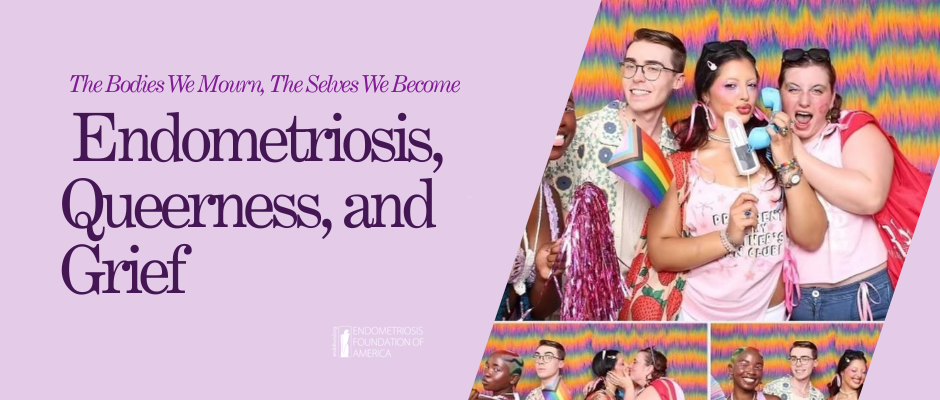
Before and after being diagnosed with endometriosis and then later on coming out as queer, I found myself floating between the five stages of grief: denial, anger, bargaining, depression, and acceptance. There is grief present at both ends of the spectrum of visibility and invisibility. There is grief in proving who you are and what you feel, and once that feeling is validated in any capacity, there is grief in knowing that validation will change the way you live and think for the rest of your life.
Having spent most of my life in the South, grief became a recurring theme within my communities. I watched countless individuals who, like me, were both queer and disabled fight tirelessly to be seen, heard, and valued. Some succeeded in claiming space for their identities and experiences, while others were silenced by the barriers they faced. The grief left behind by those struggles, and by those we lost along the way, became a driving force behind my work as an advocate and educator.
Stage 1: Denial
“If you get pregnant now, your endometriosis will go away, and your mom can raise the baby."
When I was a junior in high school, I was diagnosed with endometriosis and had my first surgery. This ablation, however, was unsuccessful in relieving my pain. At that point, my endometriosis and compounding chronic illnesses were so severe that I was unable to attend school regularly and spent most days in the hospital. Adding to these challenges, I traveled 11 hours by car from North Carolina to Massachusetts every other month to see my doctor because, at the time, there were very few resources available for adolescents with endometriosis. As I worked to better my health, I was falling behind in school.
In response, one of my school administrators sat me down to register me for a type of 504 Plan called home-bound instruction, wherein a teacher would deliver my class materials, instructions, and exams to either the hospital or my home on a daily basis. After my registration was complete, we began to discuss what they saw for my future academic endeavors.“If you get pregnant now, your endometriosis will go away, and your mom can raise the baby,” the administrator said in response to my enthusiasm about wanting to pursue higher education, the follow up being, “maybe that’s the best option instead of college. Pregnancy cures it anyway.” (This is common misinformation about endometriosis, there is no proven cure.)
For the first time, I had to acknowledge the grief that came as a side effect of my chronic illness. Up until this point, I was in denial of the possibility that I might not even make it to college. Changing my future to evade my pain made me feel as if I had already lost myself to endometriosis.
During my time on home-bound instruction, endometriosis had robbed me of my social life. Friends started showing up less and less because they couldn't understand what was wrong with me or why I had suddenly stopped showing up to things. It became clear that college had to be my fresh start academically and socially. I wanted to be known beyond being sick and I desperately wanted my intelligence and potential to be recognized without being dismissed because of my limitations. I knew that to do both of these things, I had to let people know. But the fear of losing my support and the perception of my capabilities all over again loomed heavily.
Stage 2: Anger
"We need to preserve your fertility for your future husband, and this medication will do that."
During home-bound instruction, I was prescribed a concoction of medications with such intense side effects that I was soon on a first-name basis with several nurses at my local emergency department. During every conversation I had with a healthcare provider following a new prescription, they always told me some variation of, “we need to preserve your fertility for your future husband, and this medication will do that.” The constant progression of my disease, despite exhausted interventions, had left me feeling that I had no autonomy beyond survivorship. Beyond that, I started to feel like a different aspect of my identity was being impacted. I became overwhelmed by the word “husband,” as though it were a prophecy I had to fulfill.
Not fully recognizing what that aversion meant and never having the time to digest who I was beyond surviving, I pushed myself to attend school in person my senior year until COVID hit. With everything going on, I detached from reality. I was floating outside my body looking in. To feel an ounce of “normalcy,” I began to date my high school ex-boyfriend. Then, one day, after more than a year together, he told me, “I cheated on you because I knew you couldn't give me a baby one day.” I was 18.
It wasn’t until my sophomore year of college that I formed a romantic relationship again, and this time it was with a girl. For the first time in a long time, I was back inside my body. I started to recognize all the signs looking back. I felt off when I presented masculine but was referred to as feminine, and I never felt connected to myself or any of my previous partners. I recognized the difference between infatuations I had with men, which were built off a fictional internal narrative, compared to the crushes I had on girls, which were based on first impressions and firsthand experiences.
It clicked in my brain that after all this time, I had been saving everyone else’s feelings so I wouldn’t lose all my support again. I was no longer filtering my chronic illness to others, but I was, instead, hiding that I only liked girls. The caveat was that I never felt like any label defined me other than “chronically ill.” How could I grapple with the idea of joining another marginalized identity without the fear of possibly losing the ones I love again?
With this fear came anger. The day I came out, I was frustrated from another conversation about what I was to do for my “future husband.” My doctor was debating the future of my fertility, not my persistent excruciating pain. I was embarking on my second endometriosis surgery in four years and my fifth overall within five years. I was 21 and exhausted from the pain, the recovery, and from hiding myself.
After the doctor's visit, the conversation became an all-day event between my parents and me. A few hours in, with tears threatening to spill over, I remember the exact thought that crossed my mind before I came out: I don't want to keep breaking myself apart. But I'm too scared to find out whether all the pieces fit together—and whether I might emerge stronger on the other side.
Endometriosis taught me that some fears cannot be avoided; they must be faced day after day. I knew it was finally time to face my biggest one: owning my identity. What followed this thought was, I am a lesbian, and I don't always even feel like a girl, but this time, instead of swirling in my head, that sentence plummeted out of my mouth to my family. At first it was a shock for everyone, and I wasn’t immediately met with cheers or support. However, as time went on and more conversations were had, an understanding about who I was started to develop.
Stage 3: Bargaining
"You're faking it for attention."
On its own, growing up disabled in the South is othering. After coming out as queer, the entire experience is compounded. I had to “prove” my disability and sexuality, and gender to friends, family, and physicians. I often found myself in the bargaining stage—bargaining with myself and my support system over what was gone of the old me and what was going to stay.
For years I felt the need to compromise, telling physicians I was a girl so they wouldn’t question me being non-binary and potentially mess up my chart or take the opportunity to invalidate me. I bargained with my gender dysphoria, trying to give myself grace for how I looked and what I was going through, while withholding self-expression in how I dressed and the spaces I showed up in. Later on, I found out I was not alone.
In a study on the association between sexual orientation and the impact, diagnosis, and treatment of endometriosis containing 150 adults in the United States diagnosed with endometriosis, 119 of whom identified as heterosexual and 31 with a minority sexual orientation, nearly all sexual minority participants reported negative healthcare experiences, including feeling dismissed or disbelieved (96.8%), not feeling listened to by providers (96.8%), and difficulty communicating with providers (90.3%).
In another review, “Beyond the Binary,” 33% of transgender people and 48% of transgender men reported delaying healthcare services such as pelvic exams, STI screening, or other preventive care because of fear of discrimination or disrespect, out of 19,157 respondents. This bargaining extends beyond the spaces I occupy; it shapes the experiences of many gender-diverse people navigating healthcare. It is the quiet negotiation that asks, If I do not disclose my gender identity, will I be taken more seriously? If I make myself more legible to providers, will my pain be believed? If I suppress parts of who I am, will I finally receive care? Unlike the bargaining stage often described in grief, these questions are not directed toward a higher power but toward healthcare systems and providers who hold the power to validate or dismiss our experiences. Yet the result is much the same: a persistent search for relief through compromise. In forcing us to weigh authenticity against access to care, this bargaining contributes to the very disparities reflected in statistics on diagnostic delays, social isolation, chronic pain, and, ultimately, survival.
Stage 4: Depression
"The update was not noted on your chart."
As I began to fully embrace my identity, I found myself confronting the depression that can accompany living authentically as a nonbinary person while facing persistent rejection from society. To confine someone to a box they don’t fit in is, in itself, inhumane. But to attempt it in the very spaces where someone should feel the safest—where they should be free to express themselves not only to live but to thrive—is a crime. In numerous studies, particularly the firsthand accounts featured in I Never See Anyone Like Myself Represented in Discussions About Endometriosis: Priorities of LGBTQIA+ Endometriosis Patients in New Zealand and Transgender and Non-Binary People with Endometriosis: Use of Healing Strategies, I found that many members of both my communities grappled with the same struggles.
One anonymous lesbian woman reported, “Every doctor and OB/GYN I have been to has assumed I am heterosexual and [cisgender], which has made me unsure if I was safe to come out.”
Another account from a lesbian discussed the depression that follows being unheard, saying:
“I was having my second surgery. They asked if there was any chance I could be pregnant. I said: ‘No. Definitely not.’ My partner was right by my side. We were holding hands. I said we had been together 10 years, and that I also have a Mirena in. That should be that, right? They said, and I quote: ‘I am really sorry, we still need a urine sample just to make sure.’ I was mortified.”
The depression does not stop at sexual orientation; it seeps its way into gender identity as well. An anonymous trans man said:
“Having a pain that is so associated with womanhood was hard and reinforced the idea that something was wrong with me/my body. The pain of being transgender. To me, [endometriosis] is very much associated with my identity as [transgender].”
Another anonymous trans man, who did not receive gender-affirming endometriosis care and had only just started taking testosterone, reported:
“I’ve kind of accepted through taking T [testosterone] that I’m more of a trans man, um, but that’s not socially my role. That’s not what I’m going to look or act like. I’m just not going to ever have that.”
Like many of the individuals whose voices are represented in this work, I came to the realization that being queer and living with endometriosis can fragment one’s sense of identity. As I discussed previously, I often felt there was no path forward except to prioritize one marginalized identity over another. The emotion most closely tied to that experience was depression.
Depression is among the most isolating human experiences. Yet, reading these testimonies has made me feel less alone. The stories shared here, alongside my own experiences, represent only a small fraction of the countless journeys of LGBTQ+ individuals navigating healthcare systems while seeking diagnosis, treatment, and affirmation. Together, they illuminate the grief, resilience, and ongoing struggle involved in expressing and maintaining one’s identity while living with or pursuing a diagnosis of endometriosis.
Stage 5: Acceptance
"This is my partner Frieda; they can help you!"
With each stage of grief, a metamorphosis occurs. Intersecting identities have a beautiful way of sparking curiosity to yearn for and find spaces where you are seen and heard and where people see and hear you for who you truly are.
If I didn’t come to accept myself as a disabled non-binary lesbian and seek diagnosis for my stage IV endometriosis, I wouldn’t be pursuing my Master of Public Health. I wouldn’t have an amazing girlfriend of almost three years who is my number one advocate, and there are people I love in my life who wouldn't have been diagnosed with endometriosis if I hadn’t shared my story.
I urge you to share yours too.
Sometimes this collective grief is a beautiful thing.