

Patient Day 2026
Mapping Pain: Pelvis to Brain
March 7-8, 2026
3 Times Square, New York City
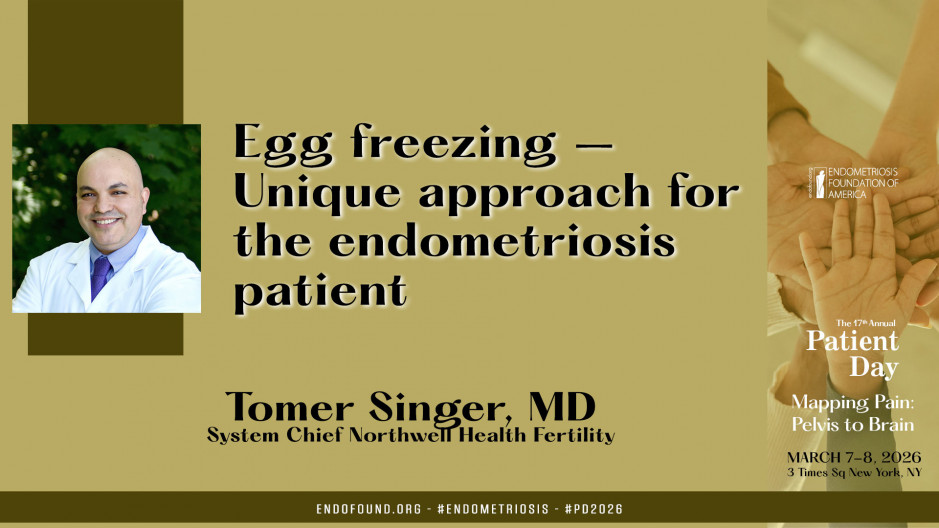
So first and foremost, thank you so much to Dr. Seckin and Dan Martin Foundation of America for inviting me year after year. I've been operating with Dr. Setchkin for over 20 years at Lenox Hill Hospital. A lot of familiar faces in the audience. And thank you for taking the morning to come and educate yourself and learn more about the endometriosis. I'll try to review today in the next 20 minutes or so, how important the fertility aspect or the infertility aspect that's associated with the endometriosis. So we'll go over a little bit the scientific background, the effect of endometriosis on fertility, how do we test for the ovarian reserve? And then we'll talk briefly about what the egg freezing process entail and then how do we counsel our patients. So this slide was shown back in the 70s that really the best time to conceive is somewhere in our late teenage years or in the early 20s.
And this is the time when we all try to avoid getting pregnant, of course. So what happens is if you have a patient who's in her early 20s in college suffering from pelvic pain, usually what happens, she'll see the general OB/GYN will probably recommend birth control pills to suppress the period, maybe drop even an IUD, a Mirana, Kylina. We all heard those buzzwords. And then by the time they're ready to embark on a family journey, you're kind of like pulling the IUD out, getting her off the birth control pills and the whole hell break loose essentially. We try to find out, okay, what was going on in the past 10 years and you've been masking a lot of those symptoms. So going back to the previous speaker and the question, so I think education, education, education is key because you're really masking a lot of those symptoms.
The same with fibroids, the same with PCOS, but endometriosis affect 10% of women in the reproductive age. And when we see patient in the fertility setting, 50% of our patient have a component of endometriosis. So really it's a disease that has to get more attention. And thanks to organization like this one, I think we're doing a good job, but not enough. So what we see here is that if women start having families in their early 30s, it's going to be very challenging to have two or three kids, if that's the hope. And this is something that's called the facundity rate. That means if you're checking ovulation, having francinatran a glass of wine, those are a chance of getting pregnant. And we see that at age 30, it's about 20%, but when you get to age 40, we're dropping to about 7%. That's really, really low.
So that means one out of 12 couples will have a chance of conceiving in their early 40s. Endometriosis make things much worse, much faster. So these are the factors that affect fertility. First and foremost is ages I showed you in the last two slides, but you can see that endometriosis, weight, smoking, radiation, chemotherapy, and family history, like Dr. Sachin mentioned, we've now have patterns of grandmother, a mother and a daughter also suffering from the same condition. And we're hoping maybe there's going to be some genetic breakthrough that will allow us to identify genes that put women at risk of endometriosis. And then maybe by doing egg freezing or IVF, we'll be able in the future to eliminate that gene from the family tree, but that's going to take some time. So this slide really shows the impact of endometriosis and fertility and all the organs that could be affected.
The uterus, the endometrium, the fallopin tube, the ovary, the cervix. We can see that it can distort the anatomy. Everyone who operates on patient with endometriosis knows that the rules or the textbook that you read or the atlas doesn't apply in that case. You'll have to kind of orient yourself, where's the ovary, where are the ligaments and not really assume that everything will be normal. A lot of adhesion fibrosis, Dr. Sestrain spoke about it this morning, scarred fallopian tube, which puts the patient at risk for ectopic pregnancies, inflammation, which are some of the symptoms that we described this morning, altered immune system, changes in hormonal environment. And then when we also go through the process of doing egg freezing or IVF, we find out that even if the embryo looks gorgeous and we're transferring into the uterus, patient with endometriosis have much harder time maintaining that pregnancy.
And then obviously we reduce age quality where an egg freezing comes in handy. So this is just some pictures from surgeries that we do. And even though you go in and it looks like the ovary is intact and it looks like the uterus does not have any large fibroid, this patient is struggling with six or seven years of infertility and no one bothered doing a laparoscopy and taking a look at what's going on. And along the same lines of MRI and pelvic ultrasound, suspicious and education and talking to your provider is key. And I think that if we take one thing from today's lecture is really having a multidisciplinary approach, having your doctors, the surgeon who's doing the endometriosis, the PCP, the general OBGYN and the fertility doctor talk to each other will save a lot of time and a lot of pain. This is just a pelvic ultrasound of a patient that presents for egg freezing.
She comes in, she says, "Well, I haven't found Mr. Wright or Mr. Maybe, and essentially I want to freeze my eggs because everyone is doing it now." You do a pelvic ultrasound, you see the tip of the IUD, you see a large endometrioma on the left, you see very few follicles. And that's a tough discussion. You came in just because you broke up with your boyfriend a day or two ago, and now we're really looking that there's going to be much more challenging ahead, much more challenges ahead. And you can see here that there is a cyst in the right ovary and right next to it, those are precious eggs. So it's very tough because sometimes, and I spoke in this conference two days ago about what comes first, the egg freezing or the surgery, and it's really individualized. It depends on how bad the pain, how many kids the patient wants, how old she is, how many founcles we still see, and more importantly, the access.
To get to the left ovary, I'll have to do an egg retrieval and go through the uterus through that where the IUD is placed in order to get that precious ache. So it's not always feasible. Sometimes we'll have to do the retrieval through the abdomen. Staging of endometriosis is very important just for guidance, but it really doesn't have much implication when we talk about fertility. Meaning I've seen a lot of patients with stage one endometriosis that went undiagnosed and patients struggled for many, many years, whereas a patient with stage four endometriosis gets pregnant just by timing her ovulation and having unprotected intercourse. So really the correlation is not there when it comes to fertility. This is a term that I came up with. It's called the age visit. Very, very few visits are now being conducted with the general OBGYN. Mammogram is being pushed to their 40s.
Pap smears are being spaced out to every three years, sometimes even five years, if you're in a monogamous relationship. And what happens is if you only see your GYN once every two or three years, you're not going to pick up a lot of those things. And there's a simple blood test called AMH that tells you where's your reproductive potential is. And there's essentially correlation between the age and that anti-malarian hormone levels. And you can see that at age 25, it should be 5.4, at age 30, it should be 3.5 and five years later it starts dropping significantly and you can see what happens at age 40. So ask your OB- GYN to run this test. There's some companies that now offer sending a kit to your home and running it yourself. And it's really within 24 hours, you can get the results. In our center, we get the results within 23 minutes.
So while the patient is still there, we draw the blood, we get the results at the same visit, but it really changes how patient are addressing their fertility goals. Genetic is a big one. We can now do a simple buccal swab and get a full panel of genetic conditions that could put the patient at risk for infertility, for developing cancer. We all heard about BRCA with Angelina, Lynn syndrome and other genes. So if you know that you have that gene and you may need to do IVF to eliminate that gene from your family tree, you may want to start by freezing eggs even before you have the partner, even before you're ready to have a baby, because you're going to have to do less retrievals. You'll get healthier eggs and you're going to have to inject less hormone and tackle it while you're young. And then talk to your doctor about eggs and embryo freezing depending on the situation.
If you're single, interested in waiting for the right guy, then egg freezing is the right way to go. If you're in a same sex relationship and going to choose a donor sperm. So embryo freezing may be the right way to go. Or if you're single mumbai choice, talk about those options. What are the common indication? We all know about social egg freezing. Women that freeze eggs just because it's not the right time to have a baby. But really the main reason women start freezing eggs is because they were diagnosed with cancer. And we see about 10 or 15 patients a week, young women who are diagnosed with breast cancer, cervical cancer, lymphoma, leukemia. And those are the main patient that are coming to seek egg freezing. And the main reason is because of awareness, because the oncologists know to send them. So I'm waiting for the day that every GYN knows that the patient has endometriosis and the reflexes go see a reproductive endocrinologist, jump on a quick 15 minute telehealth, understand what it is, because there's a lot of misinformation out there.
And then genetic condition, as we mentioned, and egg donation program. A lot of our endometriosis patients are diagnosed late, as it was mentioned this morning. So by the time they're diagnosed in the late 30s, early 40s, there's not a lot of variant tissue left. And at that point, we have to embark on egg donation to achieve a healthy family. What are the risks with egg freezing? It's a very well controlled, safe procedure. The same thing as IVF. Since 1978, the first IVF baby was born in London. I encourage you to watch the show on Netflix called Joy, that's the history of IVF. Again, because of a patient having blocked tubes and endometriosis, Luis Brown, and we use the same protocol with some tweaks when, and I'll show you that for endometriosis patient. The risk as usual in any surgery, small risk of bleeding, one in a thousand.
Risk of infection is about one in 500 because when we do the retrieval, we do it for the vagina. And the vagina is not a sterile environment, but I cannot use Betadine. So I'm using water and soap and you have to go with a needle to the vagina into the ovary. So the risk is about one in 500 and endometriosis patient receive antibiotics prophylactically. Ovarian hyperstimulation, very rare. That's when you get 30 or 40 eggs. Had a patient recently about 72 eggs, obviously that's not going to be fun for a few days, but we know how to manage it now. Propofol is needed for anesthesia, just like in the colonoscopy. And if you're about to embark on surgery for endometriosis, that will have to be pushed by two weeks. This is the big debate of what's better, egg freezing and embryo freezing. Egg freezing has been around since 1980, but really the experimental label from the American Society of Reproductive Medicine was only lifted in 2012.
So we're doing it for about 14 years pretty much routinely, and it's mainly for single women or women who have severe endometriosis, so don't have time to delay and get the male partner or the sperm analysis and the genetics. And some patients have ethical and some social cultural issues, so they don't want to have embryos, so it's much easier to freeze eggs. There's some countries that only allow freezing eggs like Italy in a situation when a patient is not married. And embryo freezing does have a lot of advantages. You can see in the picture here how an embryo looks like on day five, we get much more information. So we take the eggs, we inject the sperm, and then we can tell if the endometriosis really had an impact on the quality of the egg by injecting the egg, creating an embryo, testing the embryo.
And egg is a one cell. It's the largest cell in the body and it's 90% fluid water. So if you test the egg, you may, after the fact, find out it was normal, but you just kill the egg. So embryos does have a lot of advantages and a lot of couples are coming to freeze both eggs and embryos. Eggs for a rainy day or for baby number three, and embryos to find out that the eggs are healthy. It's a pretty quick timeline from the time that you see the REI until you start the stimulation. This is one of the more important slides. This is what's unique about egg freezing when we're doing endometriosis egg freezing. We use a medication called letrozole, which reduces the estrogen significantly. It's a pill that you take daily. We use lower dose of stimulation, so we're not trying to get 30 eggs.
We're trying to get 10 or 12 quality eggs. And then we use a trigger with Lupron. You can see that at the trigger shot, instead of using 8cg, which was used in the last 40 years. So that really gets the patient safely to the process with as minimal pain and bloating as possible. You can see here that it requires two weeks of self-administered subcutaneous injection. There's a picture of some of the medication that we use, and you can see how the ultrasound changes from point A to point B when the follicles are growing. Each one of those black pockets have one egg, and we do the retrieval after two weeks, transvaginally. There is no scar. It takes about 15 minutes, and then we get the eggs through the vagina and essentially freeze it for future use. We can use it all the way to age 50.
So the American Society of Reproductive Medicine shows that there's really no changes now with frozen eggs and fresh eggs when you use them later on, which provides a lot of reassurance. This is essentially as revolutionary as the birth control pill was in the 60s and 70s, and there's no increased risk of chromosomal abnormalities in babies born via egg freezing. We have tens of thousands of babies in the US born via egg freezing, and we have probably about 10 to 15 million babies born via IVF. So a lot of good data, very reassuring. And this is kind of how the eggs are stored. You can see here, each patient has a color coded, there is a name, date of birth, medical record number. I joke that 30 eggs is enough for three husbands, so you don't have to use all at once. And this is what you can expect once you have those frozen eggs.
You can look at the age, you can look at the eggs axis and see how many eggs were retrieved. So if, for example, you take a 40 year old who had 30 eggs all the way at the bottom there, and you can see that the chances are about 80% of having a child and in the dark blue line, not 40% having a second child. But the older you are, the less likely you'll be able to get a good outcome out of it. So the younger you are, the better. This is a nice model that you can put your age, the number of eggs you have, and it will tell you how many eggs you got, and what are your chance of taking a baby home. And cost really remains the main stumbling block. So as a system chief for Northwell, one of my first decision was to recognize endometriosis as medical conditions.
So all our members, and we have over 100,000 employees, get three cycles of egg freezing if you're diagnosed with endometriosis. Even the members' daughters up to age 26 get that covered. So I'm hoping that other centers will follow other academic centers, but it costs to get the medication, to do the retrieval, to pay the anesthesiologist, to store those eggs. In summary, the demand of oxide preservation or egg freezing for non-oncological patient and endometriosis in specific have gone high, probably about fivefold in the general population. OBGYN should offer testing AMH, FSH, pelvic ultrasound. Egg freezing is really a very powerful tool, especially in patients with endometriosis. The younger you are, the better the eggs, and you need to have at least six or eight eggs frozen to have a decent chance of getting a baby out of it. And those numbers should be individualized as the patient get older and with the severity of the endometriosis, and hopefully insurance companies will start paying more for this.
Thank you very much.