

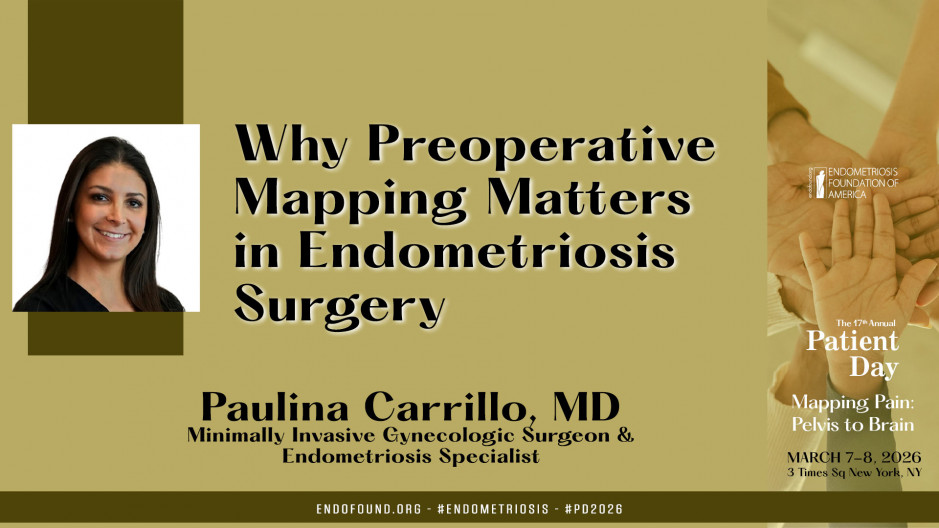
Patient Day 2026
Mapping Pain: Pelvis to Brain
March 7-8, 2026
3 Times Square, New York City
Hi, everyone. Thank you very much. I'm deeply honored to be here. And I would like to start with a story. Actually, true story. A patient of mine, she's now 36 years old. She's had pain ever since she has a memory, as we know. She went to multiple specialists, seven total. She went to multiple gynecologists, gastroenterologist, nutritionist, even psychiatrist who told her that everything was normal. Her labs were normal. Until one day, acute abdominal pain, 10 out of 10. She goes to the ER. She's had this pain before, but this was different. They do a pelvic ultrasound and they find a complex cyst, ovarian cyst. They see some free fluids, so they take her in. Open surgery.
She's never had surgery before and a lot of adhesions, the bowel, the bladder. So they take the whole ovary, right ovary out. And then the path report comes, and that's when someone named it. She had endometriosis cyst. They gave her suppression hormonal therapy the worst days of her life, she said. So she stopped. She felt better for a couple of months, three, four, five. And then the sixth month, her irritable bowel syndrome symptoms were worse. She started having diarrhea every day, not only on her period. She felt like an electric shock going through the rectum. So she went to see a general surgeon. A general surgeon did a CT. Something wasn't right. They did a colonoscopy. They took random biopsies because they couldn't see anything. And then they took her back in laparoscopically this time. But the diagnosis was frozen pelvis, as we've all heard.
Everything, multiple additions, the bowel, the small bowel, the bladder, everything. So they released most of it, or at least that's what they said. They did everything they could. There was no gynecologist don't call. So it was only the general surgeon. And they said, "You have to go to another gynecologist." She had PTSD from the hormonal therapy. So she said, no. This was two years ago. And then one of her friends is actually a patient of mine. So she came with her. In Mexico, I'm from Mexico. We've pretty much standardized the diagnosis with MRI, protocols. So I explained, I listened to her story, terrified, of course. And she went through this mapping. And tell your story, it was the largest nodule I've ever seen, bowel nodule. It was almost 15 centimeters long, almost half the bowel vase was involved. And of course, deep endo, another endometrioma where the ovary was gone, so a bit residual disease.
So we scheduled her for surgery. A third surgery that could have been the first and the only one if we ever got the diagnosis right. So I really want to shift the way we think about endometriosis, not as a label, but as a map. A map of the patient, a map of the pain, the comforts itself is calling mapping pain, and then a map of the disease itself.
How do I ... Not technological. Apparently this. Sorry. Oh, there you go. Thank you. And can I see my notes? I don't think so. I'm sorry. That's fine. So you have endometriosis. Now what? For too many patients, the diagnosis still stops too early. They don't tell you what type of endo you have, the extent, what organs may be involved. In this century, that is no longer enough. The diagnosis of endometriosis shouldn't be the end of the conversation. It should be the beginning of it. This is what I mean when I say endometriosis is not one single diagnosis. It's just not one disease. We can say or majorly brought the categories into three, superficial disease, ovarian endometrioma, and deep endometriosis. Each behave different. They affect different structures and have different implications in terms of diagnosis and treatment.
For me, in modern endometriosis care, as I said, diagnosis should not be based on a label. A label can validate the disease, but a map guides care. It should tell us what type of endo we have, where it is, how much there is, how deep it can go, are other organs involved, and how does this correlate to symptoms? Before surgery, before anything, pre-operative mapping is not a descriptive map. It can guide the treatment plan. It can help us plan better, counsel better, have the right team prepared, and set realistic expectations. We cannot go in and find surprises there that could have been anticipated, let alone say, "Oh, we found endo." First of all, we should map the patient. This is the first map before anything is the history. The diagnostic suspicion is the most important part. If we risk or we skip the history, we risk skipping the diagnosis.
This comes from time with the patient to actually listening to the story, to asking the right questions to validate the symptoms. History in endometriosis is not formality, it's data. The pattern of symptoms, bowel, bladder symptoms, sexual pain, how this impacts on her daily impact.
Second of all, we map the pain. This conference is called mapping pain, pelvis to the brain because of the complexity of it. We got to say that endometriosis does not equal pain, but we know that over 80% of women have some kind of pain at some point. So we cannot just ask, "Do you have pain?" We get to ask the pattern of it. Is it cyclical? Is it not? The location, the radiation, the triggers, and the impact. We also got to rule out or identify other causes of pain in this complex, not gynecological, but chronic inflammatory, multisystemic disease.
And finally, we're going to map the disease itself. As Dr. Setchkin said, we cannot rule out the other two maps that gave us or guided us through here. It gave us suspicion, clinical context, but we got to know where the endo is, how deep it can go, which organs are involved. If you Google, there are many, many standardized mapping protocols for different mapping standardized, sorry. But they try to teach us. This is the part of the multidisciplinary team we talk about. We're not radiologists. We're not pathologists. We need people who can see it because the eyes cannot see what the brain doesn't know. So there are MRI ultrasound protocols across, there's a lot of variation or variability between countries, between practices, but we now know that these are very, very useful and have very high sensitivity and specificity to diagnose, at least suspect, the extent of it.
These are pictures that I love from my radiologist. She's actually Brazilian, Luciana Chamie, but she'd worked here in the US her podoctoral degree, and she's done this. She has mapped the disease graphically for patients and for doctors to just be at the same moment trying to say where it is and show the complexity of it. Anatomy shapes the plan, it shapes risk, it shapes complexity, it shapes the need for the multidisciplinary team ready. It needs the counseling we owe to the patient before any treatment, before any surgery, to set this expectations. And this diagnosis can make the plan. But symptoms give context to this anatomy. Pelvic is not only a pelvic finding, it's a nervous system experience. So pending endometriosis is real. It is complex. As I said, this conference is all about pain because of the complexity of it. It takes the nerves, the brain, the pelvis, everything together.
What we fear most as doctors is central sensitization where the brain trains itself to transmit the pain more easily. We're training it by just delaying and feeling it. And pain in endometriosis is biologically real, but anatomy alone does not explain it. That's why I'm asking. I'm asking to have these three maps and then add them together.
So back to our first question, you have endometriosis and now what? Now you need a map. We need a map of you first as a patient. We need a map of your pain and we need a map of your disease. And then we make the plan because the patients deserve more than a diagnosis. They deserve a map and a plan. So thank you very much.