

Endometriosis 2026:
A Nerve-centric Disease
Medical Conference - March 6-7, 2026
3 Times Square, New York City
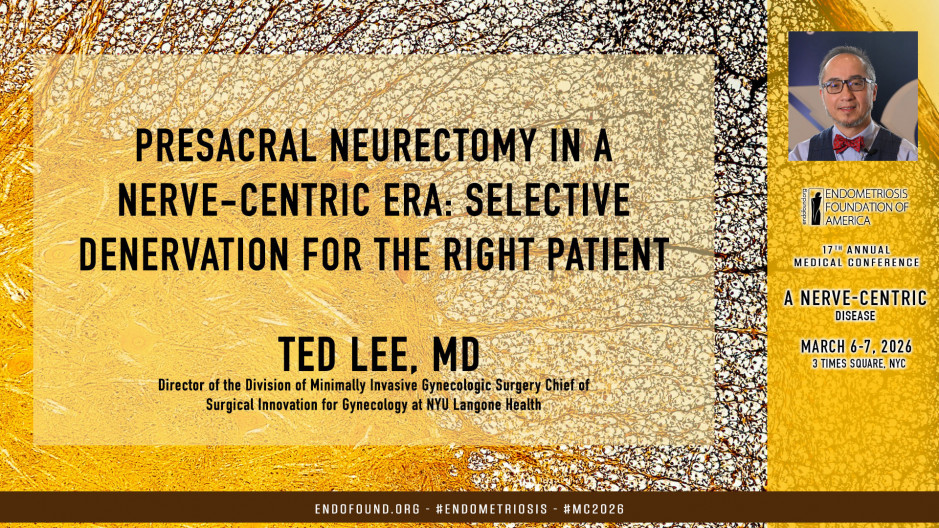
I want to thank Dr. Seckin for giving me the opportunity to give this talk. I have been at this medical conference for many, many years, and I think the first time was more than 10 years ago. I was helping Dr. Seshkin to conduct a suturing workshop for the resident and for any people who want to do a laparoscopy. That was more than 10 years ago, and I had been at this meeting many times after. And I think Dr. Harry Rich was the one who introduced me to Dr. Seshkin during that first time. Today I'm talking about presacro neurectomy. I think the forgotten procedure in the nerve-centric era. I think over the years that, especially the last few years, that I think this procedure has been done less and less frequently for various reasons, and this is just my conflict of interest.
So history of bresacle neurectomy has been around for over a hundred years. In the old days, when they did not have birth control pills, when they did not have ibuprofen or any kind of anti-inflammatory medications, the treatment for severe dysmenorrhea in those days were presacred neurectomies done through the parotomy. And so from the days of Jubilee Rugi in 1899, and the Gaston Cote defined the triangle cote in between the interiliac triangles. And currently is the first person to describe it in as a laparoscopic approach for presaconeurectomy. And so the reason for this talk is that I think it's become over the last 10 years or 15 years or so that presecronneurectomy has become sort of culturally unfashionable, almost sacroiliacious in this era of nerve sparing surgery. But the pan pathway is still very real, very specific and it's pre-war map. Many patients who have severe midline pelvic pain, dysmenorrhea, undertreated, and then just go over the biology anatomy of presecular neurectomy and then trying to use it on well-selected patients.
I think it'll be still very beneficial to the patient who are suffering chosis as well as patients who have severe midline pelvic pain and dysmenorrhea.
So the clinical problem of midline dysmenoria is severe sickly midline pelvic pain. And at times in the patient who have minimal endometriosis, it's often proportionate to the visible disease and sometimes will persist even after a good excision hemetriosis and it's really driven by the superior hypogastric plexus efference fibers. And I'm going to go here. Let me see here. I want to do just ... Oh, here. All right. So we can enlarge the drawings here. Here is the superior hypergastric plexus, which is mostly efferent fibers, sympathetic fibers. Whereas the part that cause people problem is the parasympathetic fibers on the inferior hypergastric plexus and then splenic plexus in the pelvis.
I'll go to the next slide. And here you can see right here that the superior hypergastric plexus is mostly efferent sympathetic fibers. The part that causes the most problem, the problem that's mostly in blue, that's parasympathetic fibers. And that causes a lot of dysfunction in terms of bladder emptying, bowel dysfunction, sexual dysfunction. These are the fibers that gets involved in a lot of patients who are undergoing radical hysterectomy and have deep excision in those areas. Whereas the superior hypergastric plexus is mostly efferent fibers where the pan pathway pass through. So this is really a landmark study that really changed. In the beginning, I was doing presacro neurectomy, but after this study, I was doing a lot more presequor neurectomy after this study. And this is a study that was published by Zurlo many years ago in 2005. It is the first and only double-blind randomized trial for presacral neurectomy.
So patient who has the nitriosis was assigned to either having an excision hemetriosis alone versus having existentiome plus presacroneurectomy. Patient themselves did not know which group they belonged to, and the people who interviewed the patients afterwards did not know which group they belonged to. So this is as good as a surgical study as you can ever do for surgery. And so in this study, over the period of times, starting with six month and 12 month and down to two years after surgery, the group that has both procedures done are consistently approximately 30% better in terms of the core cure rate. Currate is either absence of dysmenorrhea or dysmenorrhea that does not require medications. So your current went from 50 plus percent to 85 plus percent. So there's a consistent 30% improvement over time. So this is kind of the first study that really showed this to be true.
And then this is also true across stages of endometriosis, whether you have stage one disease or stage four disease, that the improvement that changed the differences in terms of the cure rate persists regardless of the stages of disease. And so this is what prompted you at that time during that time, people who were trained by me during those years, including NASH, who was one of the speaker. Those years, I was doing a lot of presecuritime. I was doing hundreds of presacrooneectomy. In a year, I pretty much counseled any patient who had neutrosis the option of having presecronectomy as an adjuvant therapy for a patient with pelvic pain.
So the issues with the presaconeurectomy is that the procedure, where the procedure occurs, it occurs very close to major blood vessels. You are very close to the proximity of the aortic bifurcation. You are over the left coming iliac vein. You are next to the inferior mesenteric artery. In terms of the side effect profile is actually not that bad. Constipation's about 15%. Uninar hesitancy is about 5%, and usually those symptoms gets better over time. So why is the precinct neurectomy not associated with significant bowel and bladder sexual dysfunction? I think I explained to you before when I explained the anatomy, it's because the precinct neurectomy only interrupt the superior hypergastric plexus, and that's mostly FRN fiber, sympathetic fibers from the uterus, bladder, and central portion of the pelvis. And the motor parasympathetic fibers do not go through that pathway. They go through the lower pathways. And they are above three centimeters above where the pelvic splenic nerves are, which control the bladder contractions and rectal motility and sexual arousal.
So the presacral neurectomy is almost like a heck that you can bypass all these issues by interrupting this pathway.
And whereas radical hysterectomy and deep exclusionometriosis cause those problems, that rectumy does not. All right. So because of these procedures are very, very close to the pelvic splenic nerve, the S2-S4 region, and they are both mostly sympathetic fibers to the bladder and rectum. Also lower down below, when the superior hypogastric plexus divide to two major branches, down below, that's where the inferior hypogastric plexus are. And they are a mixture of parasympathic fibers that come to feed those areas as well. And then if you have any deep dissections near sacral nerve roots, that's when you get really into problems.
So in my practice, the ideal patient for presecular neurectomy is patient who have severe dysmonia, midline empire pain like stage one, two disease, patient who have very mild endometriosis and patients with primary dysaminuria are not responding to medical therapy. Theoretically, based on that study, zero studies, stage three and four patients are candidates as well. But I'm a little bit leery about those patients because those patients, by the nature of the disease, I'm likely to disrupt some of the nerves that's going to cause their bowel and blood dysfunction in the first place. So if I add the presacor neurectomy on top of that, I'm afraid that it's going to be very difficult to tell the patients what causing them their bowel and bladder and such dysfunction after surgery. So those patients, I'm very reluctant to perform the presacral neurectomy on those patients. So now if you have interventional pain management in your healthcare system, usually by anesthesiologists who are trained to do those different pain blocks, the superior hypergastric nerve block is also something that can be used as a armamentarium for patient with pelvic pain who has not responded well to surgery.
It's an image guided procedure used for chronic pelvic pain, craniometriosis in the right patient can help with pain reduction.
And if you compare superior ... So there are actually most of the studies, a lot of studies on superior hypergastric plexus block has been on cancer patients to help the cancer patient with those pain. All right, so there's a lot of data, although not like randomized trial kind of data, but observational studies showing that it's effective for those patients. And if you think of the superior hypergastric nerve block as more of a temporary diagnostic block, just like when you do pudendal block for a patient with neuralgia, in a patient who has persistent pelvic pain, meaning pelvic pain, despite good excision pneumotiosis, that superior hypergastric nerve block can be used in that way as well. It's obviously it's temporary, it doesn't last very long, up to a few months at a times. And obviously it's reversible. Whereas presequal neurectomy is basically permanent interruption. And I think it's a good way to, a segue for you to determine whether the patient will benefit from presacral neurectomy.
And so in patient, the type of patient that I think will benefit from prescri neurectomy is patient with persistent dysmenorrhea, minimize pain. After good excision, let me choose this based on the pictures that they provided you. So a lot of times when patient comes to see me, they show me the pictures of their surgery. It was surgery done by Dr. Seshkin and look at it and say," It's great, great surgery. Everything's done already. Why are you still having pain? "And then those are the kind of patients that maybe perhaps presacral neurectomy can have a place. And then maybe I refer them to my interventional pain management for superior hypogastric nerve block. Keep in mind that obviously it's a very operative dependent procedure as well, depending on the interventional pain management person who is doing the procedure. If you really trust your interventional pain management doctor and they do a good block, then I think it's a very good resource to have.
I'm going to show a video of a presacral neurectomy, just a disclaimer. This is at 1.5 times speed of the actual procedure. All right, so that's the left coming vein underneath the peritoneum. I'm elevating the peritoneum. I'll make an incision and I'll extend my excision towards the bifurcation of the aorta. I'm lifting up the peritoneum so I don't injure the underlying vasculatures. I'll continue the dissection, the incision all the way up towards the bifurcational aorta. So this is basically trying to see that you guys see, visualize what this procedure looks like basically in its entirety essentially. All right. So I open the peritoneum and all the tissues, the fibrotical procedure underneath. I began to see the inferior mesenteric artery underneath. I'll continue to extend our incision.
So this is just showing that the anatomy in this area, that's inflammasic artery. And then you can see the left ureter and underneath the left ureter is the left common iliac artery. And that's really defining the left border of your dissections in presequor neurectomy. So I'm going to use the lift and cut so that I don't injure the underlying structures. So let's finish the left side. I'm going to go to the right side. The right side is much easier. I'm just trying to mobilize all the fibrose tissues medial to the right coming ilear artery. Obviously a lot of traction traction is key, and that is the right communal artery underneath. I'll continue dissection, get all the tissues off the peritoneal edge.
And laterally it's the ureter that's not in ... It's off the operative field. You can see in the corner of your eyes perish dosing, that's where the right ureter is. So you should not see the ureter on the right side during presecondurectomy. And that's a presacral nerve that's supergastric plexus. That's been grabbed by my assistant. That's the left coming iliac vein, which is actually a midline structure, not on the left side. And I'm trying to over circumparmatory below the left coming leg vein. I'm trying to develop tissue plane underneath the nerve and to hook it. And I'm going to have my assistant grab the opposite side. I'm going to do the blunt dissection myself to make a tunnel underneath the nerve over the sacral paramatory.
I'm going to switch back and forth, have my existing grab the nerve for me. Now I'm going to make a tunnel underneath the nerve over the sacrum pulmonary and I'm all the way through and I'm going to bipolar. I'm going to desiccate the distal end of the presacral nerve. That's sacromatory. The white part is sacroinatory. And then we'll go ahead and desiccate the nerve. And I do take a segment of the nerve just to prove that I have the nerve, not just a bunch of fat. So that is the nerve going to finishing up complete transection of the superior hypergastric plexus.
You can see the sacral pulmonary. So usually when people do that sacrocolpexy, they usually end up sacrificing the superior hypergastric plexus frequently. So going to skeletonize the common artery on the right side a little bit more, been pulling up and the vein is right underneath my scissors, that's the left coming in the vein. And we'll finish up by transecting a segment of the nerve about two, three centimeter of the nerve. And we'll just send to pathology at that point, we'll just transect it. And that's the presacral neurectomy. And you can see all the structures underneath the ureter, IMA, common leg vein, right community artery. You can see them all underneath, and that's a presacral neurectomy.
So I think the myth is that presecular neurectomy is outdated. I think the reality is, in my mind, it's targeted neuromodulations and then presecronic conflict with the nerve sparing procedure, but I think it's complementary. I think in my mind it could help to improve your curate, overall curate on all stages of mutiosis. But at the same time, obviously if the endotriosis is not involving the nerve, especially lower part of the pelvic splenic nerve plexus, that's part of the dangerous part of it. You want to preserve those nerves, and then I think the side effect is really, relatively speaking, it's really minimal, and it's actually, in my mind, it's actually best for minimal disease.
So my takeout message is that presecular neurectomy is not obsolete, and I think in fact it's underutralized. And I have to admit to myself that I have been influenced and peer pressured by the whole nerve sparing movement that I have not done as much presecular neurectomy as I have done in the past, even though I've done hundreds of them in the past and have very much success with it, but I don't do them as much. And also the ER issues is that since I stopped doing them as much as I used to, I also stopped training people doing it. So the next generation of pelvic surgeons and mutual surgeon does become a loss technique in the armamentarium. And I think if you are not sure whether the procedure's going to add much to the patient, do a superior hypergastric nerve block first to see it will help the patients.
I think it's the right tool for the right patient. Thank you.