

Endometriosis 2026:
A Nerve-centric Disease
Medical Conference - March 6-7, 2026
3 Times Square, New York City
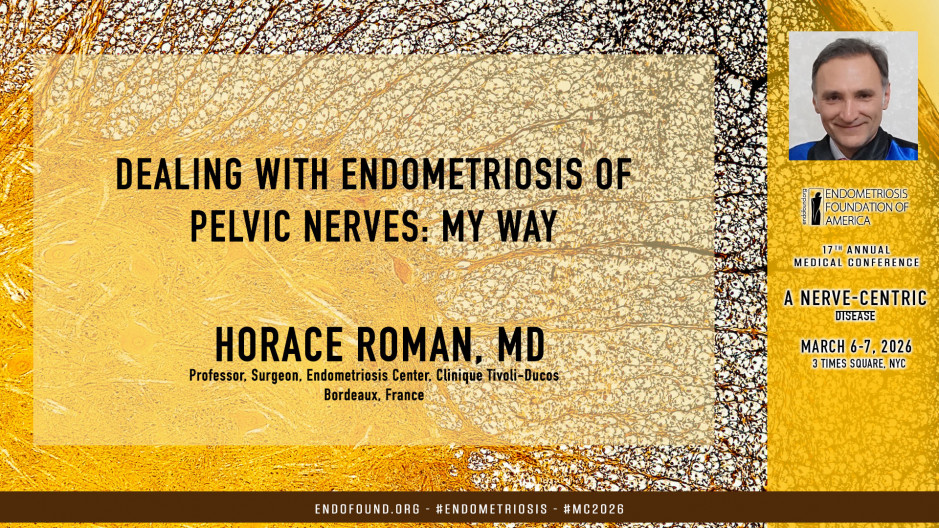
Here, connect dear friends. Ladies and gentlemen, it is my absolute pleasure to be involved as almost every year to your prestigious meeting and to support in this way the Endometriosis Foundation of America created by my friend, Dr. Tamerseking. So this year you have a very interesting, exciting topic, which is the nerves, the complex relationship between the nerves and the endometriosis. And I will try to bring my contribution and to speak about one of my favorite topics, which is the surgery of pelvic nerves. And Tamil asked me to present my way in this specific field. So I have some conflict of interest because I organize trainings and lectures, and sometimes they are organized by companies which pay me some fees for my involvement and my talks during these training sessions. Now, when you speak about the endometriosis of the nerves, of pelvic nerves, we need to fix the area where these nerves are located and this happens into the parametrium.
So the parametrum is this anatomical area, which is located between medially the rectum, the vagina and the bladder, and laterally by the pelvic wall and the sacrum. So in this area, we find nerves, vessels, the ureter, and of course, deep endometriosis lesions which may come in contact or infiltrate these anatomical structures. And these areas correspond to the DPEI areas midilateral and posterior lateral. Now from the onset, we have to fix a difference between two types of nerves. We have the somatic nerves, which are large nerves visible, easy visible, such as the sacroots, the sciatic nerve, the optuatory nerve, the pudendal nerve, the superior inferior gluteal nerves. So this are somatic nerves which are responsible for the movement of muscles of the legs and buttocks. So this nerves should not be injured, should not be cut because the consequence will be a pelsia motor pelsey or anesthesia of a dermatome of a territory.
So when we speak about nerve sparing, we do not refer to these somatic large nerves because they should be spared anyway. So when we speak about the nerve sparing, we make reference to these theme nerves which are vegetative or autonomic, such as the superior and inferior hypogastric plexus, the hipogastric nerves, the splanic nerves. And these nerves are seen, they are difficult to identify when the parametrum is infiltrated by deep endometriosis. Their function is vegetative, so they are responsible for the contraction for the function of the rectum, the vagina and the bladder, and we have to preserve them. But in a majority of cases, we are not involved because the involvement of this nerves actually does no longer allow to preserve them. So we usually we remove them together with the nodule which surround them. Now, the pelvis nervous network is a spider web. So even into the anatomical models, you see very well the nerves and they have some very limited connections.
Actually, the functional connections are very numerous. It's like a spider web into the pelvis. That's why if you have the irritation of organs such a bladder rectum on the uterus, the patient may have symptoms from somatic nerves, such as perineal pain, pain into the leg, pain into the thighs, or genital burning, even though the somatic nerves are not actually involved. That's why it is difficult to fix the level of the infiltration by only clinical examination. But fortunately, fortunately, we have the MRI. And the MRI, for me, it is a revolution, actual revolution in the understanding, in the knowledge about deep endometriosis, because thanks to the MRI and the three sections, so sagittal, axial and corneal, the surgeons can see the nodules before the surgery. They can understand the limit of the nodules, the organs which are involved. They can plan their surgeries and estimate the outcomes.
That's why it's important that the surgeon look at the MRI before the surgery with eyes wide open.
Because what it may happen, if you do not know that the nodule exists, you may very easily miss it because here we have, for example, a very big nodule of the sciatic nerve on the right side, but look at what we see during the surgery, only this very, very small lesion on the parameter on the peritoneum. So this endometriosis is a stage one endometriosis with only this small lesion. However, when we go deep into the pelvis, and here we have, you can see that we remove a big nodule, five centimeter large, which require the complete dissection and releasing of the sciatic nerve of the pudendal nerve of the obturatory nerve, which is here, and the section of several major vessels of the pelvis. And this lesion corresponds to only this small infiltration of the peritoneum. So without this MRI, I think it is impossible to remove this nodule.
Now, the surgery of deep endometriosis involving the somatic nerve is difficult because the somatic nerves represents very, very deep structures. So this somatic nerves, the sacral rules, the sciatic nerve, the pudendal nerve, and even the inferior hypogastric plexus are very deep, and they are covered by the veins reputary to the internal iliac vein. Then above next floor, the arteries coming from the internal iliac artery, and then above on the fourth floor, we have the ureter and the addiction. So to go to the nerves, you have to cross all these major anatomical structures, and this means that we have to cut sometimes major vessel in order to release like this, the sacral plexus.
So as it happens here, you see to have a large view on the right sciatic nerve, we had to put all these clips and to cut the obturatory vessels, the pudendal vessels, the inferior gluteal vessel. So we have to open the field. Otherwise, it is very difficult to perform safely this surgery and to avoid a hemorrhage, intraoperative hemorrhage. So here you can see here we have the nerve into the death and look at the vessels which cross the nerve. So to have full access on the nerves to perform a neurolysis and to remove the deep endometriosis nodule, we have to use the clips and to cut these vessels.
Now we can identify two major types of deep endometriosis nodules. The first type is related to nodules, big endometriosis nodule switch or more medial. We are close to the midline. So they usually have an origin maybe from the uterosacral ligaments because the uterosacral igament is inside, and they may also involve the vagina, the rectum. And usually they come in contact with the third and fourth sacral root. They involve the etheripogastric plexus. That's why in a majority of cases, this woman have not somatic complaints, but more vegetative troubles such as bladder avoiding troubles, constipation, or vaginal dryness. So here, the somatic nerves involved or in majority S3, S4, sometimes S2. Here is the localization. Then we have a second type, which is much more lateral because the midline is here, and you see that the nodule, it's on contact with the lateral wall. In this case, the inferior hypogastric plexus usually is medial and the nodule may involve the lumbosacral trunk, which is here, the L5-S1, S2.
So the symptoms, sometimes the opturator nerve, the pedendal nerve, so the symptoms are somatic pain into the leg, into the buttock, into the perineum, and much less vegetative troubles. Usually the patients avoid the bladder without problems. Of course, sometimes both nodules or we have big nodules which involve both areas, and we have a type one and two nodule, a mixed one.
Now, our team, FMendo, is very concerned by this pathology because we are carrying out routinely a lot of cases with patients with endometriosis of pelvic nerves, and we also tried to improve the knowledge with our observations. So we published a lot of articles about step-by-step techniques, tips and tricks, how to approach this nodule, how to remove them safely and completely. And also we have studies about the outcomes because it's very interesting to perform the surgery, but only if the outcomes are favorable. And now we are ongoing and other studies ongoing on 230 or 40 cases with this type one and type two nodules. So most of them are in full access, so I invite you to have a look at these articles. Now, Tamer asked me to specific my way how I came to do this surgery on pelvic nerves, and my way is very particular because you have to know that nothing was destining me to be a gynecological surgery.
I decided to become general surgeon when I was 10 year old, and I stepped for the first time in the operative theater at the end of the first year of medical school, and then I never left the operative theater. However, I took the decision to become neurosurgeon in 94 when I lost my mother due to a glioblastoma, which is a cancer of the brain, and I was admitted for the neurosurgery residency in Paris in 94. So I accomplished four year of residency in neurosurgery with very good results. However, for various reasons, I changed in the fourth year to the gynecological surgery. And once I did it, I asked myself, how could I use my knowledge in neurosurgery to treat lesions which are located at the overside of the body, extremity over extremity of the body. And I had no answer. I had had no answer for 10 years until I met the patients with sacraments endometriosis, and I started the robotic surgery.
And actually, I think the robotic surgery is very suitable for this kind of approach because the robotic surgery allows you, thanks to the mobility of the instruments, allows you to work in a very small area into the death, and this is exactly the deep parametrium.
And now all the surgery we do, surgeries we do are with the robotic assistance, and we do not stop to publish our sealing, our observation, our tips and tricks in different publications. Now, why the robotic surgery is interesting, but for various reasons, because when you approach on type one nodules, so on nodules involving the sacroots, the sacroots are covered by the ureter, then by the internal acary, the internal ac veins, and then at the bottom you have the sacraments. And therobotic instruments allows you, thanks to the mobility, to perform the hemostasis preventive hemostasis by placing clips and hemologs exactly perpendicular on the vessels which covers our nerves. So I think the robotic surgery increased the feasibility and the safety of these kind of excisions. You see, we have very, very large veins and to put a clip on these veins to control them preventively in order to release these sacral roots or the sciatic nerve which is behind, the robotic assistance is very useful thanks to the mobility of the instruments which allows to put the clip exactly perpendicularly on the right situation and to control in efficient manner the vessels.
On the type two nodule, maybe the efficiency is even more because we can go directly on the nerves and we can clean all the surface of the nerves with instruments which are placed in generatorly on the nerve. So I think we reduce, we minimize the trauma on the nerve with reducing the edema and the neuropathic pain after the surgery. So you see here, actually we can control very, very well and you can excise in a very precise manner with very small instruments, miniaturized tips of instruments, and this makes, in my opinion, makes the difference.
Now, you have to know that this surgery is efficient. So we published not many years ago, two years ago, an article on our first 100 cases in Manage in Bortel, so until 2022, and you observe that there is an overall improvement in pain intensity. I don't want to say that all the patients are pain-free because it is actually impossible and any neurosurgeon will tell you that it's impossible to stay that all the patients are pain-free, but I don't remember any patient who regrets the surgery or the surgeon for the lesions of the sciatic nerve sacral plexus.
There is also some unforgettable story, and this is one of them. So you have to know that sometimes the patients tell us, "You saved my life." But actually when you perform the endometriosis surgery, you do not save the life. You improve the quality of life, you can render good life back, but you do not save the life except it in some cases, and this is one of them. There was a patient with anticipate of surgery and a big nodule infiltrating the type one, type two, the low rectum. It was a terrible, terrible, terrible lesion, and nobody was willing to perform the surgery. And ultimately, she came to me and I said, "Yeah, we'll do the surgery, no problem." And we removed all these lesions. The surgery was very long because of the severity of the lesions, but also because of the anticipants and the postoperative adhesions of over incomplete surgeries.
And we cleaned everything and the histology found a cancer here. So there was degeneration in a cancer and we could remove without knowing that there was a cancer. We removed everything. We clean everything. So six years after the surgery, the patient is in very good health. Of course, our surgery was completed by lymphadenectomy, which was always L0, so nothing was negative, no residual endometriosis and chemotherapy, but she's in very good shape. So in this case, I think we saved her life. However, whatever surgery we do on the deparametrum, we have to be very humble because the recurrences may occur. This is endometriosis. You can excise everything. The recurrence is always possible because we do not know where the endometriosis comes from, and we do not know how to prevent a recurrence. And this is the case of a woman with excision of a right sciatic nerve without medical treatment.
And four year later, she had this big recurrence intra and extrapelvic, but also another most likely missed nodule during the first surgery. So in this case, the patient is in very, very bad shape with an infiltration of both parametria, with bladder dysfunction, with infiltration of the ureter, with infiltration of the rectum. So this should never occur. And to prevent the recurrence, we can prevent it by prolonged amenorrhea by pills or any other hormonal treatment. The data hormone treatment is the unique treatment you have to prevent the recurrence. So in this cases, we have to use it because the reoperation in this area is very, very, very, very challenging.
So to in outline, I think that based on my way and on my experience, I think that this surgery is actually physical because if I can do it, everybody can do it, but it requires good anatomical knowledge of this area, very deep and hidden area. You have to learn to read the MRI to understand where you have to go, where you have to stop, what you have to remove, what you have to conservate. Then it depends on the surgeon himself or herself because the surgeon should be confident, but not too much because in this case, it may be in danger because it may be imprudent, but the self-confidence should exist, otherwise the surgery will take 24 or 48 hours, very long procedures and incomplete.
The hemostasis is mandatory preventive hemostasis. The robotic assistance is the most useful tool and which is very important is to have in mind a very clear stepwise procedure. So it is important for us to elaborate and to share with our colleagues step-by-step techniques. And that's what we are doing at Ifamendo Academy because we try to share our knowledge by various ways. So we propose to our colleagues online or onsite training e-learning, and we have an e-learning in somatic pelvic nerve surgery. You need maybe 30 hours or 50 hours to read and to see everything. We have videos live, we perform live surgery on sciatic nerve, and we share them with people who record through theacademyfemin.com.com. And of course, we are always happy to receive your visit for a fellowship, for a masterplus, for a workshop, and to discuss to exchange with you and to share with you our technique, our approach, our questions, and if we have our answers.
So thank you very much for this kind invitation. It is always an honor for me to be every year with you, and sometimes I can come to be onsite as it happens last year. Sometimes I am only online, but the pleasure is always the same. So thank you very much, and my greetings to all the participants to this meeting and to Tamersekin, my friend. Thank you very much. I