

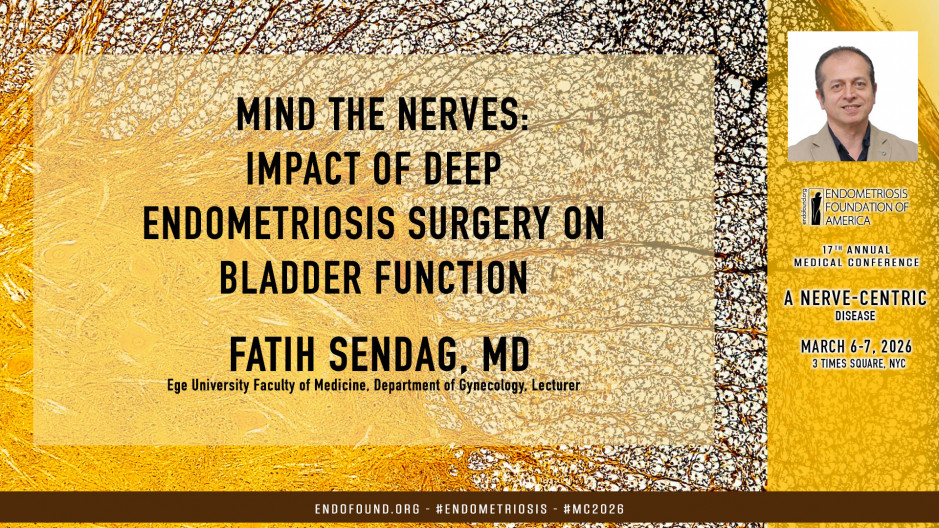
Endometriosis 2026:
A Nerve-centric Disease
Medical Conference - March 6-7, 2026
3 Times Square, New York City
This issue is underestimated because urinary symptoms are masked by pain symptoms. The incidence of urinary symptoms in endometriosis varies from three to 15%, and the instance of denourinary dysfunction, whereas from six up to 17% after surgery for posterior deep endometriosis. In this paper from functional group, they reported very high incidents like 76% had one or more urinary symptoms in endometriosis patient, and they concluded preoperative documentation of bladder function should be proposed before surgery. And another paper from dura group, and they reported patient with deep endometriosis have a high risk of preoperative urinary symptoms and neurogenic dysfunction, and colorectal resection appears to be detrimental factor to de novo peripheral neuropathy. This paper is coming from WTS group about long-term urinary retention after laparoscopic surgery. They presented four case, as you see, the site of lesions, possible injury site and duration of retention, eight months, 24 months.
And they report that it's important to be aware of the anatomy of the pelvic nerve plex during surgery, and lateral and deep lesions near to the scale spine had a high risk of causing such injury. So if we go to lateral and deep, so we have a high risk for nerve injury. And this paper from Fabio Gazi, again, similar result, they reported very high presence of bladder dysfunction in endometriosis, even in asymptomatic patient. So they recommended that a operative urinary evaluation allows us to know urinary dysfunction before surgery in asymptomatic patients. So this paper is from the group urinary complication after surgery for posterior deep endometriosis, and they compare unlateral uterosacral resection and bilateral uterosacral resection. And they found that in complete emptying risk is higher in bilateral uterosacularization. And they compared the uterosacral group versus colorectal group, and they found, again, the risk is incomplete.
Emptying is higher in the colorectal group. So how can we decrease the risks? So detailed preoperative essential ultrasound mapping is very important, and we should inform the patient about risk. We should keep in mind that the expected benefit is surgeon dependent. So this surgery requires experience, advanced skills, teamwork, nautrophonitomy, nulture, gastrointestinal and urinary system. So we should have a good surgical strategy, start with non-distorted area towards the distortary, improve the exposition, find the ureter, spend always, open the space, restore the anatomy, and be aware of the nerves, and then complete excision of the disease.
This is an example from our cases. This is a typical view for endometriosis, casing ovaries, or deteriorated cold sac. I always start from the left side, mobilize the sigmoid column, open the peritonium, find the ureter, follow the ureter, follow the bubbles, and then release the auris, then open all parectal and rectovaginal spaces. I use always rectal probe. And after the anatomic restoration, I start to exist the all endometriotic implants. So after the restoration, it's easy to exercise the old disease. So final view, we protect the nerves and everything. So the surgeon's knowledge of the nerves is the main factor for preserving the postourinary function. And thanks to checkroni, to these nice pictures, the method was described by checkroni, and surgeons should know where the sperogastic flexus, where is the hypogastric nerve, and also splanting nerves. Also, thanks to Horstroman for this nice picture, you see this left urtar and when you go medial to reiterate space, left hypogastric nerve, splenic nerves and left inferiorpoglastic plexus.
And again, left side, this is the left hypoglastic nerve, splentic nerves, and left impropastic plexus. So if we know the location of the nerves, so we can protect the nerves. So we should know also consequence of injury of the pelvic nerves. If we cut the hypogastric nerves, what happened, urinary incontinence or reactive bladder, neurogenic bladder. If we cut the splantic nerves, this is parasympathetic nerves. What happened, bladder, Tony? If you cut the inferior gas plexus, what happened for upper plexus, sensitive impairment of the posterical dissect for middle plexus, sensitive bladder, more morbidity and lower plexus that contraction dysfunction. So another example from our cases with the dissections of the spaces, and just I want to show some particular part of this video.
Sorry. Yes. You can see here, yes, we distract the right side, right uretane. This is occupied space and right hypogastric nerve. So we should know the nerves is medial to the ureter and ureter should be lateral side and under the below the ureter and below the uterine, deep uterine main. So another example from our cases, we did dissection, but we don't need to dissect the nerves. So just should know where is the nerve, location of the nerves. So you can see here again, this is the right side, right pelvic side, all dissection, right hippogastric nerve here. And then you go a little bit lateral and deep below the ureter and below the deep uterine vein. And so then we find the splenic nerves and also inferior prograstic plexus here. So we should know about this anatomy. And it should be noted that impairment of sympathic nerves does not only cause acute dysfunction, but also lead to voiding problem in long periods.
So over the years, progressive bladder rotation results in the loss of elasticity and contractuality, impairing the voiding even further. And bladder post-valid should be controlled regularly. In case of neurogenic bladder treatment with alpha blockers or intermittent catheterizations must be started early enough before bladder neogenic damage becomes irreversible. So how can we prevent bladder dysfunction due to surgery for dependentmetriosis? This study was first study reporting the feasibility of nerve sparing surgery by laparoscopy in deep infiltrating endometrials by WP groups. It was also forced study to show that even monotherapy nerve resection can induce the important urinary retention. This study from the colors group, they reported 16 patients with laparoscopic neurosparing surgery for Dependo and they reported identification of inferior pagastic nerve and plexus was feasible and no cases of bladder cell catheterization was observed in north spring group. And another study from Marcelluchekuroni group about nerve sparing surgery, and also they found similar results.
The urinary retention risk is less in the nerve sparing group when compared the conventional group, and also sexual functions is better in the nerve sparing group. And another study from fabulogist group, again, they found similar result. Nerve sparing approaches effective in a radication of deep animators of posterior compartment with satisfactory pain control, significant improvement of sexist function and preservation of bladder and rectal function. This is meta analysis about the risk of urinary retention after nerve sparing surgery, and they found in the hands of experienced surgeon, the nerve sparing technique reduced the risk of persistent urinary retention. So beginning from the horse, this paper coming from horse trauma and the imported functional impairment of deep endo may preexist prior surgery and function may not be restored despite no preservation. And in cases where endometriosis are deeply embedded in the parametrium, nerve sparing techniques may only feasible in those with urinary movement.
This is another example from our cases. We removed a big rectovaginal nodule, just scientific particle. Yes, you can see we removed including posterior vaginal wall, but we still have a disease. As you see, disease infiltrated nerves and deeply embedded in the parametrium. So it's really hard decision to say remove it or live it. So sometimes it's a little bit difficult. So another paper, this paper is also very important. I think from the passover, he recommended patient after surgery for deep endemics require long follow-up with particular attention paid to post-void residual to prevent myogenic distractions, secondary chronic bladder over distension. So I think this is very important because the cold patient after the surgery, we checked after one month, but it's not enough. We should check three months, maybe six months post-void volume, and then we can say, yes, everything's okay. And this lung technique described by the pastoral group, we know this, and the report laparoscope dissection and electrostimation of the pelvic lengthening nerves were feasible in all patient without any complication.
The rate of post-bladder dysfunction was constantly reduced to less than 1% of the patient. So this is very nice. So we have now good technology, ICE technology. We use it, we do stescopy, we inject ICG inside the ureter, and then we obtain these good pictures, we see the ureter in green line, green color. And so it helps the surgeon, I think, and I call this, this is ureter guided anatomic navigation. So if you know where's the ureter, you can localize the other important anomalical structures. You see your tire in white and this is in green color. So I think all surgeons prefer this technology when compared to white color. You see, if you know the green urethra, if you location of the ureter, you see very well. So always you are under the vision, and so there is no way to damage the ureter. And in other case, you can see here we remove the big nodule from the right parectal space, and I want to show some ... Yes, you see here, the right side, we will do nodule, excise the nodule, and you see very well the ureter.
And if you know time loss, because during the operation, you are not seeing where's the return? Where's the return? You know where's the return. You see very well. So if you know the ureter, you can do anatomic navigation, you can see the nerves and you can protect the nerves. You can see here, hypoglastic nerves. And if there is any lesion, you can also protect the nerves and remove the lesion above the nerves. It's possible.
As you see, we detect lesion above the nerves and we can excise it without damage to the nerve. So as conclusion, first rule is do no harm and detailed preparative assessment is required to determine the complexity and the choice of treatment should focus on patient symptoms and expectation, not under lesion. And surgical principles should be followed by decrease of risk complications and functional impairment may preexist prior to surgery and function may not restore despite the nerve preservation. We should keep in mind this. And although periatral injury causes more damage, urinary excision alone are sufficient to cause long-term retention and positively urinary retention is a frequent complication and nerve sparing surgery should be used to reduce the incidence of the urinary dysfunction and despite the routine use of nerve sparing techniques, functional impairment cannot be completely avoided and nerve sparing process such as nerve navigations or nerve stimulations seems to be promising technique to avoid postoperative urinary tract dysfunction.
So this is my academy and the academy, this is a training program for minimal measure surgery and I call this the sustainable education, education and the nature. So I believe that it brings different perspective to education because I believe that you can improve the learning capacity of the training by reducing their stress.
And as Tamar Skins said, you should find something for adrenaline, so I found this skydiving. Thank you very much for your attention.