

Endometriosis 2026:
A Nerve-centric Disease
Medical Conference - March 6-7, 2026
3 Times Square, New York City
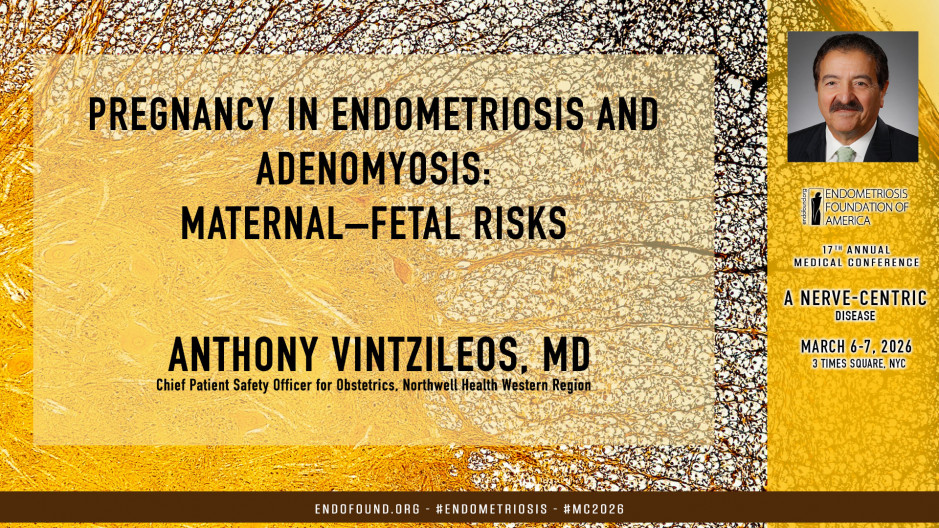
Thank Dr. Seckin for inviting me. I'm honored to be among colleagues, but among colleagues that we don't communicate with. And that is what pretty much the subject of my presentation will be. And that is pregnancy and endometriosisenomyosis, maternal fetal risks. Dr. Sekin asked me to give this talk with the same title, but I edit three words. The untold story. Disclosures. I am consulting a company that produces the autonasis device, which is a assisted vaginal birth device. Has nothing to do with what we are talking today. You all are familiar, I'm sure, with this SEOG practice bulletins, diagnosis of endometriosis this month had off the press. 17 pages. There is not one word about pregnancy. That's serious. Then I try to figure out what do the gynecologist or the biopractice bulletin say about adenomyosis. Actually, I couldn't find a practice bulletinatomyosis, just non-existing disease. I found it under diagnosis of abnormal uterine bleeding.
What's going on?
Gynecologists are doing an ecology. Obstetricians are doing obstetrics don't talk to each other. Well, that's our problems in obstetrics, you all know that. Preterm labor, preterm prom, preeclampsia, UGR, placental abruption. These are called great obstetrical syndromes. Why? Because we have no etiology in obstetrics. We have been naive for years. We describe things as we see, preterm labor, contractions, blah, blah, blah, that they face dilated cervix problems when you break your order before labor. What is preeclampsia? Blood pressure plus proteinuria. Whatever we see, nothing has to do with the etiology of this, right? Somehow think about this philosophically. How is it that a human can have gynecological diseases? And when pregnancy starts, a new entity starts with a new diagnosis. We don't know what they are, but we give them names according to what we see and we call them syndromes. Nevertheless, this great obstetrical syndrome, synopstetrics is number one cause for perineal morbidity mortality along with congenital anomalies.
Amazing to me that since 2015, there are eight meta-analysis and one narrative review on endometriosis infection pregnancy. Five meta-analysis and three narrative reviews on adenomyosis in terms of the effects on pregnancy. That's not articles. That's narrative reviews over the last 10, 50 years. However, those are published in non-US and mostly non-obstetrical journals. You see the gap in the communication between obstetricians and gynecologists. I will summarize for you, a summary pulled odd ratios what all those meta-analysis come together to show. So connection with preterm birth, preterm prom, preeclampsia, SG, epilepsy, placenta, intrauterine fetal death. Everything within asterisk is our grade obstetrical syndromes. And you can see the odds ratios when this is going to become pregnant in terms of endometriosis and adenomyosis. Anything that is yellow or orange statistically significant. What do you notice right from the very beginning? The risks, the obstetrical risks for women with endometriosis are increased.
Moreover, those with adenomyosis, you start getting this.
Adenomyosis is more of a risk than endometriosis. If you put altogether, however, the question number one answer will come in mind is does the usual ART confound the adverse pregnancy outcomes in patients with endometriosisosis? Is it the IVF procedure or is it just the disease perself? Well, here's the answer. There is a meta-analysis biologic endometriosis, 33 studies from Canada. Over three million patients actually putting together the results, the associations in three groups of patients, patients that with ART and endometriosis, patients who had endometriosis and conceived spontaneously, and then they analyze the data with combined. What do you see here, endometriosis, risk for preterm labor, all three groups had increased risk for preterm birth as well as stillbirth. Placenta previa, if you see the odds are creeping up again for placenta previa on all groups. Combined spontaneous conception and ART, also just spontaneous conception, you don't need ARD to be at risk for pregnancy outcome in terms of placenta previa or cesarean delivery, of course.
And all these complications, we get additional goodies here in addition to the obstetrical syndrome, women with endometriosis are at increased risk. You can see the old ratios, preeclampsia, SGA, term prone, hemorrhage, gestational diabetes, cholesterol presentation, dystocia, et cetera. And there is pathophysiology to explain all of those conclusion. Both group of patients with endometriosis, either those who spontaneously perceive or via ART, they are at risk for adverse pregnancy outcomes. How about adenomyosis? Same thing. 17 studies in urianitis, this is a metaanalysis that put together three groups, patients who conceive with ART only natural conception and a third group ART plus natural conception. Again, preterm birth, preeclampsia, SGA, intrauterine fetal death, cesarean rate, postpartum hemorrhage, they are all increased. The conclusion, similar to the previous one, both patients with spontaneous conception and ART with adenomyosis are at elevated risk for abnormal pregnancy outcome.
Now there is another interesting one, meta-analysis where Busnell is trying from Italy tried to untangle the independent effect of endometriosis and adenomyosis. And via systematic review meta-analysis to me, I'm not sure I would have done it because obstetrically, to be honest with you, I start getting the feeling that this is the same disease, just in the two different locations. So women with endometriosis alone, again, they're at increased risk for preterm birth, very preterm birth, sarian rate, placenta previa. And you can see even the risk for placenta previa depends on the stage of endometriosis being greater at stages three and four, as well as deep endometriosis. When they coexist endometriosis with adenomyosis, you can see that the other ratios are the highest.
4.6, 7.29, 6.51, 32.6 stage for placenta previa. What does that mean? The burden of the disease, the more it is, the more in trouble you are. Adenomyosis, poor adenomyosis, and I say poor for many reasons. We all thought that you cannot make a diagnosis of adenomyosis, but only in the hysterectomy specimen. That's an anathema teaching, which of course, as you all know, it's not appropriate anymore because we have powerful imaging, but we are behind now. I think adenomyosis has been studied much less anatometriosis from your groups for obvious reasons. I don't think you can do too much for the lesions being in the uterine wall, whereas you can do a lot of things when it's outside and you can write more papers for that. But obstetrically, adenomyosis appears to carry a greater risk while a simple man. I think it's because of the adjacency to the uterine cavity.
So in this study, positive associations were again positive regardless of the methods of conception. Now, this population-based study from Australia that showed, again, patients with endometriosis where it increased risk for preeclampsia, placenta previa, preterm birth. But the new information here we found out from this is that that preterm birth increased risk is for spontaneous preterm birth, as well as indicated both of them. Why both? Via preeclampsia, UGL, et cetera. So again, that was independent of ART use. Is that real really? Is that cause and effect here? The associations are real. I hope I convinced you. I haven't seen a metaanalysis that's negative on the subject, either looking at enomyosis or endometriosis, but is that cause and effect? Well, what could be the possible pathophysiologic mechanism for endometriosidinomyosis to cause trouble in pregnancy? Sterile inflammation, systematic disease. These too says everything. Dr. Hugh Taylor had a great slide there about systematic disease.
I would think that perhaps it could add a pregnant uterus in there because all the organs being attacked by those disease, but pregnant uterus is also attacked. So now few studies over the last five, six year, they have shown in patients with endometriosis, HMGB1, high mobility group B1 protein is a great mediator of this inflammation in endometriosis, as well as in adenomyosis. It appears that this molecule here, which can see very high ectopic endometrium and the expression of it, that it appears that in both situations, the excessive release of this molecule plays a critical role. Why do I say that? Because it links directly to obstetrics and premature labor. How? Look at this study. This study was demand by Roberto Romero a few years ago, prior to the identification of the molecule that I described to you having a major role in the pathogenesis. What you see here is people in preterm labor that he did amneosynthesis.
All his life is trying to study the cause of preterm labor and he's been after microbial associated amniotic infection. This study throughout the years have been identifying that the biggest group is sterile inflammation. Now, in this study, there are four groups of patients based on amniocentesis results. This is a survival curve showing you the proportion of women that remain pregnant according to the amniocentesis results. The first group here has a normal amniotic fluid analysis when the longer. When you see the second group had this molecule, HMGB1, which is increasing steroid inflammation, which is characterizes endometriosis and adenomyosis that now is in the uterine cavity. And when you see that molecule in high concentrations, you can see the green line. These patients did as badly as the ones that they had microbial invasion. So you got that statin inflammation in high quantities in your intrauterine cavity, you're doing as badly as if microbial invasion has occurred in terms of the outcome.
And this is the same study there. You can see the blue represents the proportion of sterile inflammation in people going premature labor. Overall, for a woman who delivered prior to 37 weeks, you can see sterile inflammation 33%, microbial invasion 14. Whoa. Now our thinking about the cause of preterm labor has to be reversing in terms of cause. For years, we are looking for this ascending infection that causes inflammation, but if indeed that was the inciting factor that first infection comes and then the inflammation, it would be the group with microbial invasion much greater in proportion. So what appears to be is inflammation comes first and infection infection comes. Second, makes sense on the genetically, telegenetically. So in patients with endometriosidinomyosis, it appears cell injury that occur because of the stern inflammation. We have the release of AMGB1, which is a molecule that's released in sterile inflammation.
And if you are pregnant, and then there's a binding on immune cell receptors in the chorioamnion, that results in premature absorb the membranes. You have cytokines and other inflammatory mediators on top of this. You got preterm labor. You have the sterile inflammation that I show you 33%, and then you have secondary microbial invasion. In other words, people with the steady inflammation appears they are predisposed to microbial infasion. Is that a new concept? No, it's not. From all areas of medicine, we know if you're inflamed, you are at risk for microbial invasive. Same thing happens here. And there are other obstetrical conditions where sterile inflammation is much more prominent as compared to microbial invasion. This is amniocentesis results done in patients with preterm labor, secondary master miscarriages, cervical insufficiency, second trimester short cervix, idiopathic vaginal bleeding and probe. If you notice, the proportion with sterile inflammation is always greater, which means in all these conditions coming first.
Where it's coming from? I saw you the molecule is the same one that patients with endometriosis and adenomyosis produce in high amounts.
Just another indication about the sterile inflammation, it's the first inciting factor, and that microbial invasion is secondary is these papers where antibiotic administration in patients with intraamniotic inflammation, in preterm labor and intact membranes, as well as patients with cervical insufficiency or endopathic vaginal bleeding, all these patients have had amneosynthesis and steady inflammation was proved via amniosynthesis, and they did better as compared to no therapy with antibiotics. It makes no sense to give antibiotics and inflammation you do better. Well, it does because antibiotic treatment, it appears that basically prevents the secondary microbial invasion in this group of patients. Diagnosis, I'm not going to say too much, you guys are better than I am, but I want you to show you this nice uterus adenomyosis. Wow, look at that third uterus. Imagine implantation going to that uterus. I want you to see that uterus, the global interraptic junctional zone uterus, which is so inflamed, and I want you to compare it with the first uterus.
Well, that uterus, my opinion, represents fatal environmental hazard.
And I know that there is a lot of literature coexistence at endomyoise. As I said before, the best data in my opinion, which I review is that both conditions coexist in overwhelming majority of patients. As a matter of fact, obstetrically speaking, I don't see the difference. It depends where the disease is. And actually, I'm concerned more about adenomyosis also with endometriosis. But to me, if you find one, based on what my understanding is, based on the latest study, the other coexists. Either you identify or not take home messages. Of course, the great obstetric syndromes I meant before, it seems to me, remember what I said in the beginning, they're all syndromes. Why not? Some of those patients with these obstetrical complications, preeclampsia, UGR, why not are patients with endometriosis, syndromomyosis? I believe many of them are.
In obstetrics, we have identified only IVF as a risk for abnormal pregnancy outcomes. However, this is something that we as obstetricians have to study prospectively. More important, we have to start looking about endometriosidomyosis in the first trimester ultrasound screening. Most importantly, educate our patients. Even more importantly, as a colleagues, we got to speak to each other and kind of fill the gap, bridge the gap that has been created between gynecology and obstetrics. To summarize, endometriositomyosis, sterile inflammation that leads critical obstetrical syndrome when the woman becomes pregnant. At the same time, it leads to impaired perfusion and placentation that leads to preeclampsia, UGR, abruption, fetal death, and some other conditions, placenta previa and other outcomes. My bottom line is it appears to me at least that these diseases do not cease to exist during pregnancy. Think about again, how come we have accept that these gynecological diseases cease to exist during pregnancy.
There's no other disease that cease to exist during pregnancy, either medical or surgical. That is the only exception. I also want to finish by saying, in my opinion, based on the data I'm seeing here, endometriosidinomyoias are the nearest fetal environmental hazards. Thank you.