
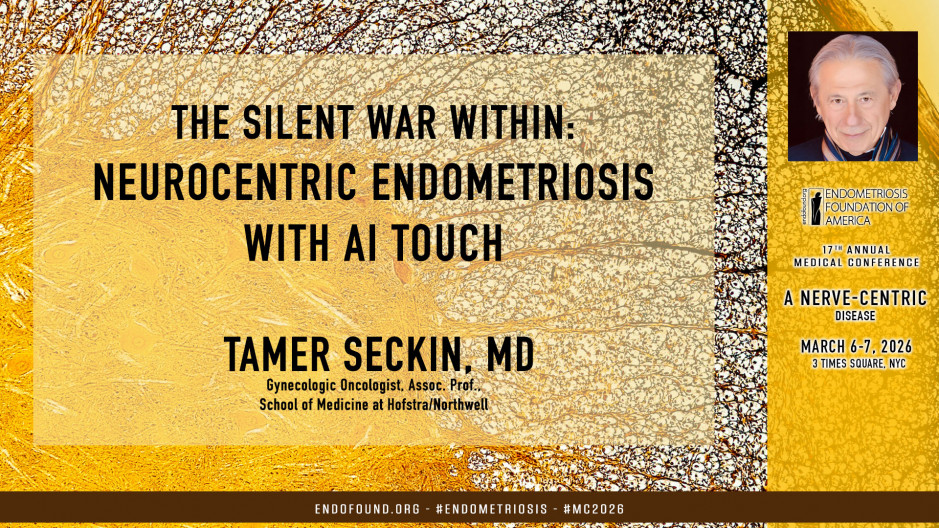
Endometriosis 2026:
A Nerve-centric Disease
Medical Conference - March 6-7, 2026
3 Times Square, New York City
So this is me and I'm a general OB- GYN and I ended up in this field. They usually ask me, "How did you get here?" But I did seven years of residency. In that seven years, there was vascular surgery and GYN oncology in my training. So I kind of felt very comfortable retroperitoneally in my early training. And when I started, and I was lucky to be trained in Buffalo. Buffalo is an incredible surgical culture where Roswell Park Memorial Institute is there. And I had the pleasure to work there in breast surgery. I mean, we did adrenalectomies and things like that. So anyways, I'm so excited to be here again, especially this new thing that initiated there without my control. Someone very wealthy called me, look, we said, "You have a lot of specimens. We need to make them use. What do you want? So we'll do everything for you to come here.
We'll name. Okay." And bottom line, this was called Springs Harbor Labs. The importance of Cold Spring Harbor Lab is, as you know, James Watson, who declared the presence of double helix was the president. First time it was announced here, double helics. And for that, it's probably one of the most well-recognized center.
Thank you for coming and we need to move on. This is a Linux hospital newly being built. I hope it's going to happen one day. It's finishing, right? Somewhat. So endometriosis, we learn it is not only just a simply misplaced endometrial tissue. It's an inflammation fibrosis. One of the thing is, nobody mentions about this, but there is contraction in this. So this was an animation, I'm sorry, but this tissue contracts. Fibrosis bring constraction. It's like rubber going different, squeezing things. And that tissue gets thick. You see how many nerves are there? Imagine the nerves are being squeezed with fibrosis over time. So it doesn't need ... Everybody can imagine. And when you cut this like this, you can tell fibrosis just contracts within. So there's surface tension there. So when we talk about neuroangiogenesis, the whole process is there. And last night I was talking to my friend, Dr. Balloon.
I said, look, the first ever buds, remember I show you buds floating around like this underwater. So this is a picture of one of those. This patient was previously operated. This area was excised before. I took her back due to her persistence of complaints back. And there is an area, you see, you cannot recognize that area yet. But when I get close to that area, so I basically, you can tell right now this area is really non-specific changes there. But when I look under the water, you can tell there's something flickering there. You see that bud there. So what I did was with Harry's three millimeter forceps acid, I went, it's a very finance and it's custom-made. It's true, custom-made. I took that little thing out and we looked at it under microscope. That's an exploating bot. Let's see what we saw. We saw amazingly that top thing there is the lesion that I biopsied.
It's only stroma. There is no gland there yet. Yet the baby is not born. The baby is not born. There's stroma there. The bed is ready. Then this other guy, this is how it is, this stroma and that blood is floating. And the other guy, again, it's the same thing again. So this other guy that was sitting behind this one who was flattened, I took that out. And in that, there was a gland. So someone is born there. And basically this was the first lesion I really ... I was very excited.
We were talking with Dr. Balloon last night. It took some time to find these slides for you, but I think some of you may be ... This is how neuroangiogenesis probably will start. And this is going to be the bad news for the ... Not everybody. A lot of people have endo. They don't even know it, let's face it, but some people are suffering with it. So this is those buds and this is the other destruction that happens in the peritoneum. Not everybody gets this, but this is very common. Okay. So we have a way of seeing things so little. This is five millimeter. We can see one fifth of a millimeter when you get your scope very close. That's 200 micron. So all my work has been obsessed with this type of precisional attitude towards endometrials. I think in complete surgeries are one of the most common reason why patients come back and in proper techniques also other than fear excision.
So this is what we do. I introduce blue dye under peritonium and it becomes the red and yellow hues are blocked and suddenly you just get pure peritoneum to your face. And you see so many different stuff there. So David Redwine was an interesting character. God bless him. He's gone now, but he left a lot of good anecdotes. And I didn't agree with him, so many things, but this is something we agreed very much, and I adore him for that. He was an excision surgeon. He was meticulous, and he did say things very nicely. And read this. I mean, very important to recognize these tissues. Inaccuracy could lead every statistics down the drain. So we really have to respect this kind of with Dr. Martin and him just always struggled on certain things. He's here hopefully ... Oh, you saw him yesterday giving his lecture.
So this is my experience. So I focus, I'm obsessed with peritoneum because peritonium is what makes this disease look bad. There is no blood test for that. There's no imaging that says peritoneal endometrials. Is the patient complaining you? And you have to believe in that and you have to ask the right questions. So I took, I have in the last 12 years, believe it or not, I have removed almost 35,000 specimens on more than 2,000 patients.
Among them, peritoneal endometriosis, almost 50% of it. All right? So I looked at these peritoneal endometrials. Let's see what I found. All right? So many of the times- Before applying
The ABC solution. Both
Oversight. So I want to introduce this ABC technique to you. So this is a AI-based video we did and it's been published in fortune sterility, but-
Before applying
These-This is how we do this.
Ovaries were suspended using a 30 monocle suture on a grainy needle. With the uterus position and interversion, a thorough panoramic survey was followed by close range near contact inspection of the peritoneal surfaces of the pelvis. Initial laparoscopic inspection revealed some non-pigmented lesions on both the right and left pelvic side walls. Small three to five millimeter
Bilaterally
Near the ureters of power.
It's not black. It's not-
Within the cul-de-sac and over the bladder dome. Through these access points, a dilute methylene glue solution prepared in three liters of lactator ringers was carefully infused into the retroperitoneal space. Using a laparoscopic irrigator, the solution was directed within the peritoneal incisions along the medial aspects of the ureters and pelvic side walls, enabling gentle and controlled hydro dissection of the underlying connective tissue. With the application of ABC and the peritoneum now distended, a distinct chromatic contrast was immediately apparent enhancing the surgeon's ability to differentiate between healthy tissue and subtle previously indistinct lesions. Following hydro distension with the ABC solution, retroperitoneal reflection was effectively eliminated. The red and-
I'm not going to play this all. What this is doing is the drone technology. It's war technology like we're drawing right now. It's the same concept. How many of you have a drone? Great. So in drone, there is one person, there's active tracking. So in this, there's multiple tracking and it also remembers it. It's a memory. So once you remove something, it points out another one. So active tracking to multiple subjects. So we programmed this with, I'm going to tell you more, but I just want to show you the ABC technique here, what we are doing. This is the AI application. We're working on this, but this is a new thing that's coming and we are not the only one doing this. So I'm going to move on. So let's see what happens here. Okay. Actually, this technique I gave lectures 12 years ago in AAGL.
Nobody listens to me. It's okay. But bottom line is I'm sure it's going to be discovered. This is the way I see twice as much minimal more lesions with this technique. So the reason I ... And also, this is being done by also by retina surgeons. Retina surgeons are doing a blue eye on the eye to see things that they cannot see. These are eye surgeons being challenged with their disease and they use this blue technique. It's very mind-blowing. I found out later I think they started doing ... I mean, it's been there apparently, but I had nothing to do. I discovered this by accident. So prior to using ABC, I used to not use. So I removed without ABC to 300 something. And when I looked at their recurrence, they're almost 12%, one out of eight patients went back to surgery recurrence. Five year, it was 16.
And these are true values. It's been by one PhD, MD, one MD, they looked at these values. After using AVC three years recurrences, 3.2, five years recurrence is almost 8%. So it really dropped down to eight. I may be wrong because every patient do not come back to me for reoperative surgery. Less even then, it's a good result there. So you're seeing better and you remove better. And this is the way it is. So basically before and after, you see 16 versus 7.7. So again, when you look back the reoperative surgeries, there's statistical difference between when positive specimens are more removed by ABC surgery. When you look back, it's less positive compared to without almost twice as much you have positive specimens. But what happens is the amount of fibrotic specimens are increased when you do this. So you see more white, but in the end though, endosurgery is really, ladies and gentlemen, please understand, it's not removing the gland and stroma, what you see as pigmented that says endometrial.
You got to remove the white area around it and the destruct. That's the area that connects to nerves and other organs or fuses organs together. That's the whole concept. It's a fibrosis surgery as if you're working on a burn tissue. So we have to move a little bit because I don't want to usually ... So in the AI time, this is what Ellen Musk is saying. What does Ellen Musk know about surgery? He knows something though. He says, it takes super long time to learn to be a good doctor. True. Knowledge is constantly alone. That's true. And doctor makes mistakes. We do make mistakes.
Not intentionally, but we do. So there's a robot, humanoid robot doing spine surgery. It's just computer electronic show, just there it says completed. Robots probably not going to replace the physician's surgeons, but there will be a lot of assistance in our OR, that's for sure. So one thing for sure, for the last 10 years, the amount of complications from endosurgery has not changed much. There's on the average 10% complication rate, and these are bowel resection, 13%. I'm not going to go specific on these, but even in the hands of best surgeons, there are complication and high morbidity. So how can AI help us?
Basically, it will increase recognition or many things that you see here, AI may help us. And I'm positive it will do significant change. But the honest truth, with these things, we need help. And this is a system that YOLO system, software that we use to do our training. So YOLO, you only live once, it's not your only limb once. It is you only look once. So we are not the only one that did this. This group did it before us from France or Switzerland. They have a lot of training, yet all their annotations are basically on visual diagnosis. There's no pathology. That's why their F1 score is so low with white lesions. Look, 0.18. They're recognized as superficial black, bang, bang like that. So that's a problem because endo is more white. So they don't have pathology, but we are talking to them. So in our system, we did ABC and AI, and we trained the system without ABC AI.
So we don't have as much annotations because we don't have NVIDIA. We are doing these on MAC. It's much cheaper, but it's doing the same thing. So we came up with the, look at the ... Our precision confidence curve is very significantly high when you use ABC plus AI. So in other words, using AI will increase our recognition and completeness more. I'm hoping that that is going to be proven by others also.
So AI is going to sense vision. The other thing, it will have neuro navigation and depth perception, right? So let's see what we have.
Before applying it-
So we saw this. We saw this. Let's go. So this is for the retroperitoneal fine structures, which demonstrative purposes, I'm showing this to you, but these tissues are in deep endo. The disease doesn't for every structure here is invaded by fibrotic connective tissue and you can't really, at times you cannot identify these things easily. So AI could be really helpful in safe recognition. This is already segmental recognition system. This is from a Japanese company. They're doing the same thing. We talked to them online a couple weeks, a month ago or so. This is their system trained. They automatically recognize bladder. There's no dye in the bladder. So computer is recognizing bladder and its borders. And it's also recognizing the ureter too on the other side, right? Okay. So here, we train this system in a deep retroperitoneal segmentation. This is an approach to sciatic and the nerves and obturator nerve ureter sciatic nerve is being recognized during the surgery as we move along.
Okay? So having seen that, I want to mention how much we owe Dr. Monk passover for things that is done. So we showed this before. This is one, another, this is a aberrant compression by on sciatic nerve bio.
Aberrant superior gluteal venous identified. So
This is interesting. Most of the time- The problem is not endo. ... sciatica symptoms. It's the varicosities in these veins that pressurize this area.
And venous dilation was observed at the compression site.
How many minutes do I have?
Variations of the piriformis month.
Okay. I'm going to go fast. But what happened in this is I want to show you this video. See how that greater sciatic foramen is moving? So that should be free exactly like that. Look at that. So anything that compresses it restricts it movement is going to give you sciatic pain, I think. I have to go Mark's lectures and course. I have to finish it too. So there's a lot to be learned. I'm going to move faster. We did also segmentation here. So let me go. There are a couple things I want to show you. Okay, let's see. So in the lab, I'm not going to go to thoracic much, but in the lab, we are really aiming to really go after heteritary and familiar endometriosis cases. So we are just starting this. We think the heritage and familial endometriosis is very actually up there and parents are always wondering if their children will have endo one day.
And I think this kind of research will help us to get to the bottom of it when we compare twins, mothers, and daughters. And this is something exciting. I'm just finishing up.This is something that when I did extensive endosurgery by accident again, I had one patient who were past, she may be even here, past 40, failed so many. So I did her endometrioma surgery and during ovary was so bad, obviously we don't burn. What I did was I brought the omentum, I made a pedicle, put it inside the ovary, sutured that with a little very nicely. This patient got pregnant from that ovary and she had another baby after that. This was exciting. And I have three more and two of them are physicians, these patients, one from, let's not get, but they are known in our thing. There are three more like that. So we did a mic study.
So this is a control. This is premature ovarian failure we created insufficiency, and we brought omentum, and then we put stem cells into the ovary. So we compare that. So these results, I hope I will explain you correctly, but they looked at the follicle density. You can tell follicle density after the ovary is killed, recuperated with omantepix significantly compared to stem cell injections. So this is proven in mice. These are just coming out right now. Similarly, RNA expression levels, all components to RNA, again, signifying the angiogenesis markers. These were significant too, angiotensin, vascular endothelial growth factors and so forth.
And also Western blood for protein expression showed each similar way, similar way. It's not as prominent as the follicle count, but the activity is similar and significant statistically with ommentum and stem cell. So when we imagine we use that together, maybe it's going to be better, right? This is how it is. This is the distracted ovary. And after we attach the omentum, you see early follicular formation. Again, in the top is ovarian failure of mitotic activity with angiogenesis gone, angiogenesis recuperated, and this is the follicular activity. And in this corner, you see the omentum, you see the follicles. These are just, we just received. And just to show the effect of angiogenesis, this is uterus with nothing atachia. This is omentum brought to you truth. You see how the angiogenesis take. Actually, for the sake of this meeting, this is neuroangiogenesis. You don't see the nerves.
Again, you need good pathologists. You're as good as your pathologist. So this is how it is.
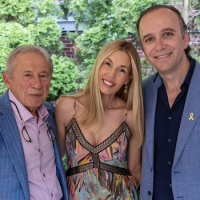
This is how the ovary is this endometrioma, let's say. This is one of the many I have done. So bring the disc there, and this is exactly how it is. Finally, I bury it like a Nathan bond there. We bring the omentum inside. So I'm an adventurist, the stressful life of endometriosis surgery in New York. I don't take any medicine to relieve my stress. I mean, I do crazy things. Whoever saw me yesterday, I did the Atlantic crossing with a boat. You didn't see this. So it took almost three weeks. I swam just in the middle of the ocean. We jumped. That was a great adrenaline discharge, right? 6,500 meat down. And I also flew fly with some crazy pilots, but it's the same thing. You have to know your pilot. You have to know your surgeon the same way. You have to trust your surgeon.
You can't really do these kind of crazy stuff if you don't. I knew this pilot. He's an F-16 pilot. He does this. So this is Southern Turkey across Greek islands. It's a great pleasure. I take go with them often. So in life, you have to find time for things that make you feel happy to be alive. And these are most precious to me, my grandchildren. Thank you very much.