

Endometriosis 2026:
A Nerve-centric Disease
Medical Conference - March 6-7, 2026
3 Times Square, New York City
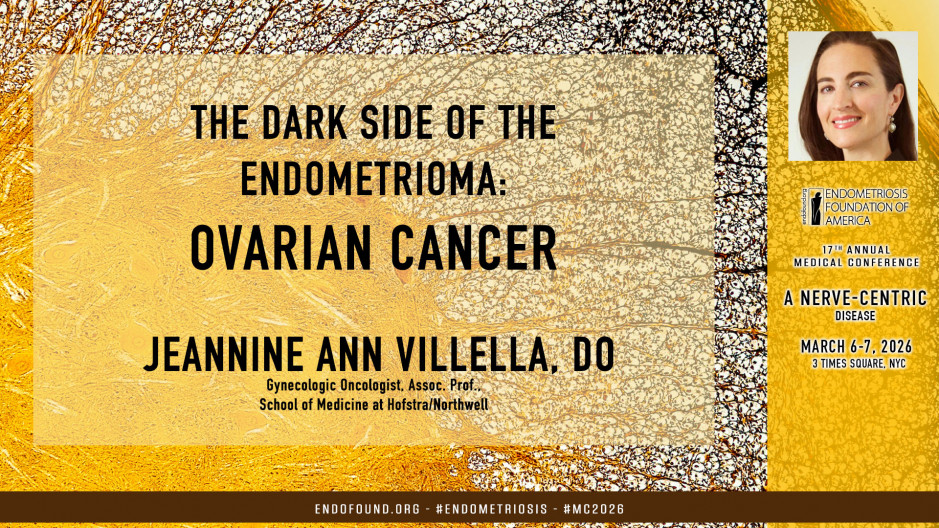
Morning. Thank you for the invitation for speaking. I am thrilled actually to talk about this topic because- It's been long known that oncologists hate endometriosis, but now we really can't avoid it, can we? So thank you to our previous speaker, which was truly fascinating. So I'm going to review what we know about endometriomas and the relationship to ovarian cancer, which obviously causes a lot of anxiety to patients and practitioners, but really it's a rare event for an endometrioma to become a malignancy. So endometriosis, endometriomas are ovarian cysts, the chocolate cysts that we hear of. It's ectopic endometrial glands that come out onto the surface and then dive into the invaginate into the ovarian cortex. And 40% of patients, especially with advanced and moderately advanced endometrial cancer, will develop endometriosis in their endometriomas in their lifetime. The interesting thing is that this micro environment is very unique and it's actually central to understanding why in these circumstances they undergo malignant transformation.
So if we look at the microenvironment of an endometrioma, we're looking at a highly biologically active and a very unique environment. These conditions promote the persistence and the pain and the progressive symptoms and tissue damage and over time cause genetic instability. So if we think about, we have these cysts, this tissue that has bleeding. There's a lot of iron, which is very caustic to the tissues, to mitochondria. And what happens is they have old menstrual blood that causes and repeated cyclic bleeding that this builds up. And all this caustic material allows it to be walled off with fibroblasts and accumulation of breakdown and accumulation of this excess iron that really fuels tissue injury and causes oxidative stress. And it really damages the mitochondchondrial membranes, which we know are important in tumor progression. And once you have this thick walled off area, we have pro- inflammatory cytokines that you could see, TNF-alpha, IL-1 beta, and IL-6 that actually cause tissue damage and further fibrosis.
And it's kind of like a cytokine storm that causes all inflammation and recruitment of immune cells, which unfortunately in this environment are really unable to work to combat this process. So it causes this chronic inflammatory state. And what happens with all of this inflammation and the iron overload, you get this reactive oxygenation, and this causes further epigenetic changes, oxidative stress, and it's a major driver of fibrosis and chronic pain. And this happens in this very hypoxic environment. Unfortunately, this continues to happen and you continue to have proangiogenic factors that form very poor blood vessels that are weak, and that further causes the bleeding into these endometriomas. And the fibroblasts, which we know is really one of the hallmarks of this disease, the fibrosis. So this sort of microenvironment is primed to cause pro- inflammatory and oxidative stress that can cause epigenetic modifications.
Sorry, my slides are not working. Okay, sorry. So what is the frequency of cancer arising in endometriosis? Well, we have to know it's very low. So if a patient in the general population has a chance of ovarian cancer about 1.9 to 2.3%, it might be one and a half to double in a patient with endometriosis. But really the issue is that it's not all ovarian cancers. The most common ovarian cancer we know is serous carcinoma, and the ones that really arise in endometriosis are not serous carcinomas. They're actually a rare form of ovarian cancer, which is either clear cell or endometrioid types. And as we heard from our previous speaker, that these patients are also subject and susceptible to developing other cancers of the endometrium, breast, non-Hodgkin's lymphoma. We heard about also pancreatic cancer today. So really what happens? All of this toxic stress causes somatic alterations in the tumor.
So these are not genetic alterations. These aren't alterations that are hereditary. These are only in the tumor microenvironment because of that environment that's happening in this ovary. And we know that the most characteristic mutation is IRIDIA-1A, which is a tumor suppressor gene involved in chromatin remodeling. And the loss of this is seen about half of clear cell carcinomas and endometrioid carcinomas. So this loss is not only associated with developing cancer, but it also promotes this stepwise approach from a benign lesion to a premalignant lesion to a malignant lesion. And this happens just along the way from the repeated tissue injury, inflammation causing the DNA damage, the iron overload, the oxidative stress that occurs in endometriosis, and the clonal expansion of these cells. Then you have the exposure to all the estrogens and the aromatase that further increases this. So it's really sort of like a perfect storm, but it's really happening very insidiously and it causes obviously all the symptom paradigm that we know is so horrible for endometrial cancer.
So these are the genetic alterations that occur in this endometrioma. Remember, it's a somatic mutation, so it's really in the tumor and because of the microenvironment that we get in the PIK3K AKT MTOR pathways for clear cell carcinoma and for endometrioid, also the KRAS pathway.
So clues for malignant change, and I have a question here because I'm not really sure that there's really a good way to know which endometrioma is going to have cancer. I think one of the things you have to think about is what are the symptoms that are happening in this tumor? If you have a rapid increase in size, obviously if you have a new onset of symptoms, if you have a patient that's postmenopausal, you have increasing pain, you have ascites. If you do a laparoscopy and the washing's very typical, those things may be indicative. But I really would say that you have to think of this as a disease that is very difficult to know if you're going to have an endometrial cancer, I'm sorry, an ovarian cancer arising in endometriosis. But these are the things that I would look for, anything that's a solid populations, nodules, anything that shows papillary projections, and obviously in the postmenopausal patient, you would consider not biopsy, we don't biopsy lesions, we remove them, and that's what I would do in any patient that you have suspicion of.
So I kept it very brief. I only had 10 minutes, but I would like to take a moment just to thank Dr. Setchkin. He's truly an icon in my eyes, and not only because of his tireless passion for this disease and understanding and interrogating the causes of endometriosis, but because, and his meticulous surgical technique, his passion for doing work that really is giving the women their lives back and having conferences such as this to educate people on this disease, but because of his passionate curiosity, which for many people goes away in childhood or maybe goes away with the administrative burdens that we all have with medicine these days, but it's really his is ever expanding and limitless. And he actually made me, a GMON oncologist fascinated by endometriosis. And now we're talking about the vagus nerve, which I don't think anybody would've ever thought that this would be so pervasive in this disease.
So I just want to thank him and thank you for your time.