

Endometriosis 2026:
A Nerve-centric Disease
Medical Conference - March 6-7, 2026
3 Times Square, New York City
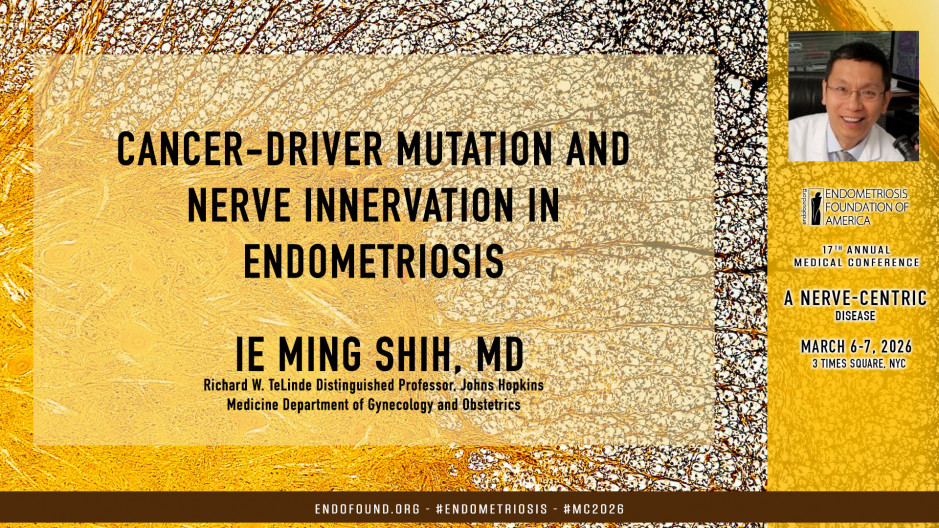
Okay. I have nothing to disclose. And the objective is to introduce a cancer driver mutation in the endometriosis, then how the nerve innovation in the cancer research field. And it's quite exciting results from the oncology. And I would like to propose a new hypothesis. And finally, I will summarize what we known so far and to point to the future research directions. Okay. So many years ago, we and Dr. Sachin and also Dr. Ahen here, we published first paper to identify the cancer driver mutation in the endometriosis. And what we found is the most about 25% of these endometrial technicians harbor the cancer driver mutation, like endometrial cancer, like lung cancer, pancreatic cancer. And the most notably is a KRAS mutation, PIK3CA, 81A, and the PPP2R1A. And those mutation has been found a lot in the endometrial cancer. So at that time, it just suggests to us that there is some relationship between the endometriosis, coronal expension, and the endometrial cancer.
Okay. So after that, the PASO still lingers because we don't know what's the phenotypes. What's those mutations do to this endometriosis lesion, which are frankly benign disorders? So there's many study including my Japanese friend, Dr. Suda, and they published in 2018, and they showed a cancer driver mutation in the endometrioma without concurring ovarian cancer. And what they found is there's still a lot of things we don't know, but most importantly, they found additional mutations, cancer driver mutations in addition to KRAS. Okay. So there's another study to show that KRAS mutation actually is related to the surgical difficulties and the complexity of these endometriosis disorders. And the data show that as compared to superficial or DIE or ovarian endometrioma lesions, and the KRAS mutation increase a little bit in those DIE and endometrioma. But you see the P value is only 0.04 is really borderline. And so also in our group, we are really interested in this study and we try to microdissect endometriosis including the epithelial cells and the trauma to see whether we can correlate any genotype, meaning mutations and the phenotypes, meaning the location of endometriosis and also the severity of diseases.
So the short answer is we did not find any correlations. So it trigger even more positive thinking that what is really working for this KRAS mutation. But we do find that compared to superficial and the non-superficial endometriosis, KRAS actually is enriched in this non-superficial endometriotic lesions. So KRAS may play a role, but we don't know what are those. Okay. So in published studies, we have one 35 years old female with a dominomas. And at the time, the clinician and the radiologists don't know what is that. Maybe a lymphoma, maybe a pancreatisis, et cetera, but it turned out to be endometriosis. And this case did not have a KRAS mutations. Okay. So we do a genotype in a bunch of this really severe, we call it very aggressive endometriosis, and we did not find any correlation between the cancer driver mutation and the lost extreme endometriosis cases.
And this is not surprising because in 2020 that Dr. Moore group, as you all know about this study, they showed that individual indometrial glands in a normal indometrium, they all harbor individual cancer driver mutation, either KRAS, PIK3CA in every Crohn's. But apparently as a pathologist, we did not find any of a normality in terms of proliferative or nuclear tipia in those glands. So what that means to us. I think it suggests to us that cancer driver mutation itself is not sufficient to drive any tumor initiation or neoplasty transformation. Instead, they may be do something else. And why is something else is why we are really interested in this research. And also this is coming from our collaborative studies, and we try to map different cancer driver mutations in a normal appearing endometrium. And this is after hysterectomy due to myomyoma. And then we found that different regions of normal indometrium, they have different types of cancer driver mutations.
So this confirmed Dr. Moore's research. So now the other thing is when Dr. Sachin sent me this invitation and it's a nerve center disease, I'm so amazed because the cancer driver gene and in cancer and the nerve and the immunity is just starting in cancer research field. So that means endometriosis can really catch the trend in our cancer research. So as you know, that there's a different microenvironments in endometriosis and also like in cancer, neuronal cells, immune cells, and tumor cells, but we can replace the tumor cell into endometriotic epithelial cells. And we know that there's a lot of interprets and communications and social networking among this population in these endometriotic subpopulations. So there are several seminal articles in cancer research fields, and especially in the pancreatic cancer. And we know that pancreatic cancer is characterized by this nerve neurotropic mechanism. So this cancer cell like nerve very much.
So they infiltrate through the nerve findings and causing pain and many other terrible symptoms. So in the natural communication, they publish sympathic axonal sprouting induced changes in macrophage population and protest against pancreatic cancer. So I think this is the first one to show how the nerve can affect immunity, especially M1, M2 macrophage. And there's so many things so exciting over there. Then the other one is the 3D promote pancreatic dotodenocarcinoma progression and the metastasis through macrophage reprogramming. So I think this phenomenon is not only can be recapsulate in other study, but in to us, the nerve has a crosstalk with immunity. And we know that immune response and the surveillance is so important in the inflammation in the endometriosis. Okay. So there's another two. I think it was to mention, but because of the time, I don't have too much details to tell you, but you are welcome to look into the PAMAT.
The other one is a cancer nerve system crosstalk from the biological mechanism to therapeutic opportunities. So even in cancer research field, we think about how can we block or abate the crosstalk between the tumor cells and the nerve, and we can benefit those women with ovarian cancer and others. The other one is a nerve and to cancer transfer of mitochondria during the cancer metastasis. This is published in nature just recently. So that means that the nerve is not only they provide the growth factors neurotransmitter to the T cells, B cells, macrophage dendrit T cells or cancer cells. They also transport their energy or the battery into the cancer cells. So you can imagine that the exome, okay? So because we know nerve is highly metabolically active and they try to generate a lot of ATP. So they must contain a lot of mitochondria, but at the same time, they can transport their powerhouse, the electricity to the cancer cell and the thrombo cell and the immune cells.
So we don't know what is going on there. Okay. So because I have only 10 minutes, so I just skip this one, but I want to mention this one because I just mentioned the KRAS mutation in pancreatic cancer duct epithelium. This has been reported. And why this paper is important? Because we know that the KRAS mutation is the most dominant in the endometrial cell lesions. And this is a nice study to show there's a normal pancreatic epithelial cells that grow organoid, and they can introduce the KRAS mutations, and they produce the KRAS mutation for the epithelial cell to produce natrium and bind to the receptor called NEO1. But at the same time, this KRAS mutation will activate ERG pathways. Then they can secrete natrium and they can induce the sympathic nerve sprouting and the growth. And eventually in the late stage of pancreatic cancer, the nerve infiltrate into the pancreatic cancer regions and increase the fitness stemness.
And so I think this is quite interesting and inspirationally to us, how can we study endometriosis with KRAS mutation and the disease progression? Okay. There's many things that I think this is a great article so you can look into that and it show us that there's a different type of neuron with different transmitters. They are doing the different things to the epithelial cells and also immune cells. And there are different drug developing to target this nerve and the cancer cells interactions. So in the future, when we have a more valid data to show that the nerve can really impact endometriosis, severity or pain, I think this is really important for us to think about how can we implement the clinical trial in this setting. Okay. And there are several endometriosis and the nerve papers probably mentioned yesterday, but I just want to highlight. There is a few papers, but not a lot, but they all show that endometriosis associated with the nerve pertonal fluid cytokines and many other exciting science is going on in this fields.
Okay. Okay. So I'll stop here. So the feature direction, I think this is the most important to me. Where do we go from here? So I think we need to think about when we design the endometriosis study, either in vivo, in visual, or even facial clinical trial, we need to bear in mind the cancer driver mutations and the neurobiology, immune microenvironment inflammation, and the hormone. I think this is the most fruitful area of research we need to think about the interdisciplinary research directions. And the final thing is as a pathologist, as Dr. Sachin said, that we are limited in the capacity to profile nerve because nerve is growing in a spiral way, in a really irregular shape. So we have no idea we cannot trace the nerve in endometriosis by single cross sections. So in our lab and with collaboration with other industry, we are developing 3D pathology, meaning we can really see the nerve.
How can they go with a different disease stack, how will they go and where they touch the immune cells or epithelial cells? And this new technology will transform our feature pathology practice, but not only that, also the research like endometriosis. Okay. So the summary is the hypothesis. Cancer driver like KRAS mutation drive neuronal enrichment in endometriosis. It can increase endometriosis, fitness, inflammation, and the pain, that's hypothesis. And the challenge is we need to have a 3D micronatomy that we are developing, I hope I can share in the future. And we also need a special multiomics and a single cells. And a single cell and a special transcriptomic monteomic usually is mutually exclusive because if you have single cell analysis, you lose the MAP, you lose their geographic context. So I think this we need to really think about that. Also, the better clinical parameters. If we have a genotype, how can we correlate those patients phenotype pain or severity?
I think we need to have more quantitative metrics. Finally, whether we can identify markers and therapeutic targets so that we can block the nerve and endometriosis interventions, and hopefully we can benefit many women with endometriosis. Thank you very much.