

Endometriosis 2026:
A Nerve-centric Disease
Medical Conference - March 6-7, 2026
3 Times Square, New York City
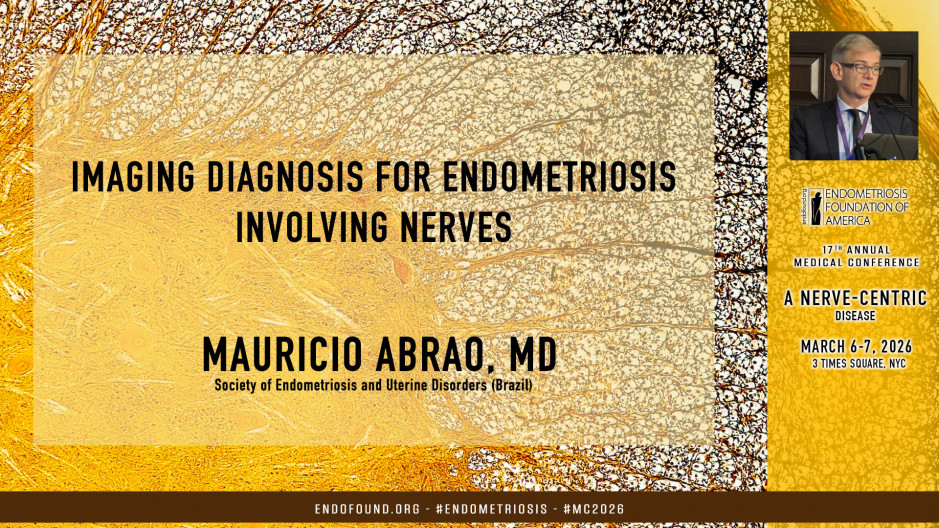
Thank you so much for your kind introductions. Thank you to Amir for the invitation. It's an honor for me to be here. And this is my disclosure. So I think that I will divide my presentation in four main topics starting from the clinical spectrum of neuro involvement for this proposal. So pelvic nerve involvement in endometriosis, why it matters. Why do we have this special event focused on nerves? We know that pain is the most important, most common symptom in endometriosis. 90% of patients with enometriosis may have important severe pain. And in some patients, it's related to direct neuro involvement. We know that pelvic nerves can be intrapid, infiltrated, distorted by fibrosis, and the true incidence is likely underestimated for sure. So this is something that we truly believe.
We have some anatomic pathways to consider when we talk about enometriosis involving the nerves. Pathways from the uterus through the novosacral plexus along the autonomic nerves, this study to the sciatic nerve, or proximally towards the spinal nerves. But we truly must believe that there are many clinical implications when the symptoms suggest imaging must include neuro pathways and plexus for us to evaluate. Of course, we have many different symptoms that may suggest the nerve disease, the nerve involvement, starting, of course, from pain, weakness, numberness, incontinence, or even severe neurologic depth is what is more rare. But the early diagnosis is essential to prevent this issue.
As it was mentioned before, we were working on imaging for many years and strategic imaging for endometriosis. We prove it after many, many publications that it's very, very relevant. It can provide a pre-op roadmap of the disease, and there is no role nowadays for us to start a laparoscopy without a good imaging. We can plan a multidisciplinary team. We can look for target protocols in other ways. It's very relevant for us to think about imaging. And in terms of what we did before, we are studying imaging since we in Sao Paulo University faced a line of patients look for endometriosis, and we needed to decide properly when to recommend the laparoscopy or not, and how to proceed, how to plan, how to have a roadmapping for this purpose. So in 2007, we started with a very important publication that showed that ultrasound is very relevant.
The concept of the ultrasound mapping for the disease, we compared with MRI. We also looked for different sites of the disease that should be compromised. We worked on the inclusion of imaging for an endometriosis classification. And also more recently, we published a paper showing that the imaging can even replace the concept of the laparoscopy as the gold standard pattern for the diagnosis for the disease. And in the last years, we are working hard in terms of the advanced, the nerve-focused MRI protocols for surgical roadmapping. And even because it's very relevant for us to discuss with the patient with some neurological problems what needs to happen, what can happen during her procedure. So this is the paper that I mentioned before from 2007 when we showed a very good accuracy for deep endometriosis. And after this, in this paper from 2009, we showed that it's possible for us to define endometriosis in different sites.
This is the paper for the endometriosis classification, AGL classification through ultrasound. You know that you can look for this through the app in the app store from your phone. And this is the study that shows that ultrasound mapping can replace the diagnostic laparoscopy. So this is very important for us to move ahead and to show what we are doing in terms of nerves. We have some anatomic basis of nerve imaging. We know that the key nerves may involve the sciatic nerve, the obturator, the pudendal nerve, the inferior hypogastric plexus that must be considered, but the fibrosis as well has an important role for us to think about the treatment of the disease. We may think about infiltration, direct invasion of the nerve shed, and of course the spread must be mentioned as well.
The nerves that most commonly can be involved, as I mentioned before, are these nerves. And there are some MRI signs for the location of these nerves. First of all, the thickening, right? The nerve enlargement with the T2 hypersigno signal indicating edema or infiltration. Denervation is an important issue as well. Muscle edema or fatty atrophy in the corresponding dermatoma distribution should be mentioned. In terms of fibrosis, the T2 hyposignal tissue distortion, the nerve pathway or causing the entrapment must be considered. And there are mimicers as well that should exclude malignancy, shivanomas, or neuritis, inflammatory neuritis for this purpose. Thinking of MRI, we should consider also the 3D MR neurography for endometriosis. There are some studies, and this group from China is studying very well this proposed.
They use the contrast enhanced 3D steer T2 space to the 3Tesla MRI and compare with the conventional 2D MRI. And the issue that they visualized it was the sacral plexus visualization. The interreader agreement with a nice CAPA index, as you can see here, with diagnostic confidence from 0.66 to 0.81, and also abnormalities were identified in 17 out of 20 patients, unilateral in 10 and bilateral in seven cases. In terms of the sciatic nerve, this is a very nice case from us, from our team, where you can see using the MRI, the involvement of the sciatic nerve, right? You can see here in the laparoscopy, the obturator muscle, the sciatic nerve here, the sacrospinous ligament here, and the iliocoxision muscle and the obturator nerve in this position. So for sure, when we correlate the anatomy with the MRI, it can provide us information enough for us to identify the disease compromise in the sciatic nerve, and to remove discussing with the patients the detail of what was done, discussion with the patient about the strategy that we are going to use and the postoperatory possible effects after the surgery, the recovery, and of course, and to have a good team to proceed to this treatment.
So this is a case of our team in Hiki spent almost one year with Mark Posobar in Switzerland, and we are focusing a lot our job in Brazil in looking for in our endometriosis division, focusing on the nerves because we think that this is something that is very relevant. So the neuropaviology approach that we are calling now requires deep understanding of pelvic anatomy and of course neuropathology reasoning and assessment. As Mark is showing a lot, the goal, the start point of everything is a good clinical exam. We change it a lot. Our exam protocol, we don't have anymore, only six questions. We have more than 15 questions to ask the patients. And we use MRI to help us to give a drive before the surgery for us to try to predict what's going to happen. We must look for neurologic manifestations, as I mentioned before, and for sure using neurography or even tractography, as you can see here, it's possible for us to evaluate endometriosis using imaging diffusion tension imaging, as you can see here, looking with techniques that can reconstruct the nerve pathways in 3D, and of course based it on principle that water diffuses along the nerve fibers and non-invasive visualization of nerve architecture.
We know that the main diffusion direction reflects the fiber orientation, and we have algorithms reconstructing the virtual nerve tracts from diffusion data. And with this proposal, we are looking for, it's a very good tool for deep endometriosis, for nerve entrapment syndromes, and of course for chronic pelvic pain as well, that may correlate with severe and neuro involvement. So this is the way that we do nowadays, the reconstructions helps to establish the relationship, the spatial relationship between the lesion and the nerves, allowing a better visualization for this purpose.
Which is the protocol that we are using now, right? We start with the clinical exam and then we go through the pelvic MRI using tractography, and we also add the magnetic, the MR angiography. And this is one thing that is very relevant as well. And as you can see here, I will show two cases. The first one is a patient with mild mechanism, mechanical allodynia along the lateral border of the left foot, and less frequently in the posterior lateral leg described as a light touch burning that was a very important symptom that we asked during the anaminases. And using this protocol and focusing on the perspective of adding the MR angiography, we found here dilatation of the parauterine venous plexus, more pronounced in the left associate with stasis and of the left iliac venous axis. So this is something that is very relevant for this purpose.
And so the moderate compression of the left common iliac vein characterize the maternal syndrome that we must think about this during the procedure because there is a compression of the nerve and it's not only treating the endometriosis. We need to include, in this protocol, the way of looking for everything that can affect the nerve during the procedure. And so this is the way that we are thinking. And of course, we are moving ahead and looking for ultrasound as well. We think that multimodal imaging with the use of AI may be something that may be very helpful for us in the early future, and we know that many specialists are using AI and we truly believe that this is the way to go going back to ultrasound using our protocol for ultrasound for endometriosis mapping. So the integrated care, thinking of the multidisciplinary planning, including the team synergy, actional reports, risk mitigation and patient outcomes are for sure important goals for this proposal.
And as the take-home message that I would mention here, we need also to think about the clinical symptoms properly, not only thinking of the six Ds or the six main symptoms of the endometriosis, we need to look for target protocols to have an holistic assessment with new MRI protocols as I mentioned before, but of course an early intervention is very relevant. The early diagnosis and multidisciplinary management are the cornerstones of preserving neurofunction for patients with endometriosis. So thank you very much, and it's a pleasure to be here.