
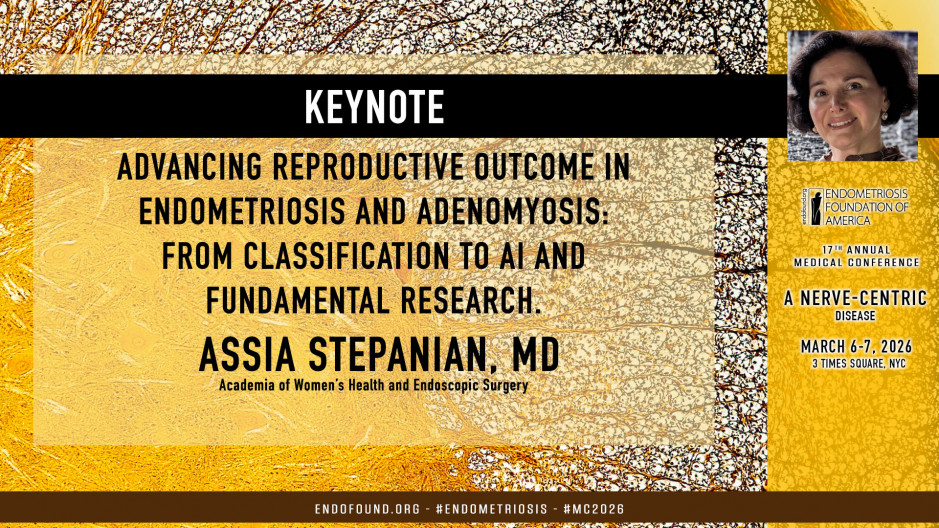
Endometriosis 2026:
A Nerve-centric Disease
Medical Conference - March 6-7, 2026
3 Times Square, New York City
What can I say? It is a huge privilege to be here. It's a huge privilege to speak with the patients. It's a huge privilege to speak with our colleagues, the ones that we respect so much. And I thank very much Tamir for invitation and for Dr. Martin, for your invitation as well, and for this very special words. And I think yesterday there was a comment concerning what is actually life and medicine, and life and medicine is love, is attention to each other, and it's a continuous thinking of whatever we can come up with. The topic of this discussion, and with this I start, is advancing reproductive outcomes in patients with adenomyosis and endometriosis. And we will move the journey from classification to surgery, to artificial intelligent and fundamental research. Really, yesterday you mentioned that the original research was based in 1800s about endometriosis and adenomyosis.
But the research that I also know is for the past 50 years of the life of Layla Damian, my mother, and also her dear, dear friends all over the world. So when I think about adenomyosis or endometriosis, I'm thinking about this beautiful circle, the King Authors round table in which there are seven systems or so involved, seven tissue targets and seven disciplines all composing together for one goal, the goal of understanding the meaning and symbiotic relationships of various tissues and their involved pathologic mechanisms and applying this understanding to the science and practice. Needless to say that endometriosis is seen in people who are in adolescent years, but adenomyosis also became younger. Notice that 16.9% of adolescent ladies already have adenomyosis. 29.7% of highly reproductive age in their 20s already have adenomyosis, and yet we are delivering much later. So there is a very important strategy here to look at the best time to intervene, which is at the time of the asymptomatic time with multiple different programs that can be generated.
So is it endometriosis? Is it adenomyosis? In fact, it's all one. It's endometriosis based on now the World Health Organization classification. And we know that the tissue application of this endometriotic process can be different working here in adenomyosis on endometrial myometrial interface or endometrial mesenchymal interface otherwise. I noticed there were questions about classification a moment ago. And Dr. Martin, I remember your reference to rector cervical endometriosis classification of MUMS classification in some of your publication. What's interesting to me is that process extension. Is this an extension of the disease or is it actually occurrence of the disease? And if you look at this slide, there is an extension from the junctional, from endometrium to junctional zone, to nearing organs without endomyotic process. And with the retrocervical endometriosis classification, we are going to the opposite way. For some reason, the lesions are found. We don't know why.
Yesterday you showed the slide where it was beautiful peritoneum, yet there was endometriosis. How? It wasn't any influence of the ferryptosis or iron oxidative stress. So it continues to be interesting. How does the disease occur? How does it actually extend? You notice classification by Professor Guer earlier, the classification, the Kishi classification, where there is a different subtype that is identified, which is the extrinsic subtype, where there is a somewhat of a diffuse process, not just modular, not just cystic. And that process can influence the surrounding organs as well, engaging them. And in fact, there was an association with the higher occurrence of ovarian endometriomas, higher occurrence of the endometriotic extrinsic process, and also higher location of the lesions in the retrocervical region. I wonder why. In any case, we know that the key is in that transitional special moment, but then what stands behind it is enormous.
What stands behind it is the whole life. We are looking at hypoxia, nutritional, neurologic, immune, genetic, structural, theatrogenic ladies and gentlemen, and functional influences involving the hormonal and immune cells and engaging the gene signatures, somatic mutation that occur as a result or because of the original predisposition of the tissue, influencing the signaling pathways, expressing as a result of alter gene expression, influencing then the cellular mechanism, and then communicating between the cells, recruiting them, if you will, into the pathologic process resulting in fibrosis in general. Today, we had brilliant lecture about adenomyosis by Professor Goa. I'm not going to go into the details of it, but that mechanism truly exists. The microcontraction oriatrogenic influence on the trauma of the tissue can actually result and does result in the microinjury. And that circle is a perpetomobile. It keeps going consistently, and it's fueled by the inflammatory changes that actually result in hormonal changes and different receptors, estrogen receptor alphabet and progesteronic receptors differently expressed.
Again, influencing again, the circulatory pathway and the microcontraction. What is it? Hypoxia also. And another interesting point that we will have the link to later is the adherence molecules where there is a reduction of the eketterin and increase in enketrin. And guess what? So many treatment remedies have tried, and we've heard already from Professor Good that they failed individually, but maybe together they won't. We'll see. So where actually endometriotic lesions are and why is it that endometriosis and endenomyosis is found in non-functional endometrial tissue, like in the non-functional uterine horns. Yesterday, Professor Koenigs mentioned to us that the endometriosis is sometimes found in women who are in adolescent year, prepibertal before the significant estrogenic influence occurs. But what about fetuses? 10 out of 100 fetuses have endometriosis. That means 10% of women have endometriosis in their fetal stage of development before any estrogenic influence actually occurs.
And then it occurred to me that, my gosh, 11% of women have endometriosis. What are we saying by that? That could be quite interesting. So in 2017, Professor Makian and Professor Adamian, it's Adamian's team decided to look at where actually the cells come from and how interesting are the connection between the migration properties of the primordial germ cells and endometriotic cells. And it was found that endometriotic cells actually originate from primordial germ cells. The utopic and ectopic endometrium do that, and they travel from the yolk sac to the gonadal region, and that travel is quite distant. And guess what? It travels through the retrocervical area. So the location of those lesions in the retrocervical area is embryologic, especially when there is no freptosis or other influences on that. And then those cells go everywhere else, but there is more to it. I looked at the study that looked at the mechanism or rather publication, mechanism of transition in other tissue, not necessarily endometriotic tissue, but targeting the premordeal germ cells and focusing on the transepithelial migration.
And again, those adherence molecules that we've discussed, including the Eketerin and including the Nketrin and collagen specific M fibers were included there, establishing that migration is being established by the guidance cues that the cells and the tissue sends them. Remember we spoke about hypoxia, what else? All these different mechanism. And then we are working on this tissue trying to work with ibuprofen, which doesn't work because it's COX-1 inhibition, but COX-2 inhibition actually works and works quite well. Why? Because it does the same thing as this process is an embryologic age and also in expressed women age develop, which increases the expression of eketron and reduces and ketrien. But what is resulting in fibrosis. So the resulting mechanism is fibrosis and reduction of fibrosis is noticed through this treatments. So the interesting thing was the correlation. We also focus on premature ovarian insufficiency in women without endometriosis.
And when you look at those ovaries, they are fibrotic from their cortex standpoint. So again, the same process, because we are all one. We are one united system that came from two cells. So all the processes are united. But then at the same time, there is a simpson theory. There is an influential guidance here, which is targeted by the iron-mediated oxidative stress by ferreptosis. And as Dr. Taylor in his research has mentioned, the resistance to fireposis being, as he calls, the hallmark of the endometriotic process. So influence of the retrograde menstruation is absolutely significant, but not only that, any blood that occurs at that area and can influence the cells working from peritoneum into the lesion. Potentially, we are speaking about neuropeptides, potentially supporting the subperitoneal neurologic tissue to meet together to form these additional lesions. And of course, the proinflammatory cytokines, we've talked about TGF-beta-1 today are highly involved in development of the fibrosis.
So no longer we can look at menstruation as a symptom and symptom alone. We have to look at it also as the significant promoter of the pathologic process and also the process that influences through those connection between the cells called exosomes, influencing the granulosis cell possibility. At the tissue level, we've studied the direct mass spectrometry so that we can identify which tissue is highly involved and not involved with endometriotic process and identified the lack of correlation of the changes in the lipidomics in the peritoneal tissue and endometrium, the healthy endometrium. Same lack of correlation was seen in apoptosis downregulation. And then we came up with the signature and not just came up, we studied 37,000 genes and came up with a signature of five genes that is responsible, at least at this studies, and it was published in JMEG, responsible for the endometriosis development. But look at the function of those genes, at least at the superficial level.
One of them responsible for carcadian rhythm. I was speaking about nervous system here. Some of them are responsible for the hypoxia, and all these general are influenced by hypoxia and all these general mechanisms. And then we are moving to somatic mutation. Let us notice that these mutations are cancer driver mutations. They don't need any help to create oncology, yet they don't. They create fibrosis. I mean, there is some development of ovarian especially cancer with endometriosis, but the difference is 1.2% between normal cohort, between the general population and endometriotic patients. So can we come up with very provocative question and possibly evocogrative question? What is endometriosis? What in endometriosis protects against cancer and can we view endometriotic processes as cancer protective disease formation? Why is it important? Without statement of that, any additional therapies that we apply, especially invasive therapies, can actually jumpstart some of the oncologic processes that currently don't occur because that tissue is influenced by the oncogenes, significant oncogenes, yet it doesn't respond in oncogenic fashion.
So we have to think so deeply with this disease. And of course we are talking about fertility endometriosis on an oocyte quality has been studied for a long time. And I remember that time, I was actually very, very young at that time. It was 1976 when that correlation was found, influencing them with endometriosis influencing the OSIs significantly through the lipid peroxidation damage and also influencing the stern. And of course we spoke about neutrogenic. When we make the C-section incision and when we engage that endometrium up to the serosa, there is a direct introduction. And now we are moving to artificial intelligence. Goodness. To answer all these questions, we might actually need some extra intelligence, and that would be in computer vision. We utilize the surgery, the natural language processing. We utilize that as well in our discussions, the neural networks that are needed to pull it all together.
These are the places in which in reproductive health we utilize artificial intelligence today.
These slides are just how are we using it for adenomyosis? Because so many opportunities through the 3D modeling, and especially one millimeter slices are available today. In this patient with MRKH, you can see the whitish line, which is a white narrow strip, which is the nevia fascia actually. And we identified that there are two layers of the neviar fascia. With the utilization of artificial intelligence, we can dig slightly deeper into why is what we do works. So additionally, we are moving now into autonomous robotic system, and maybe they can give us a little bit more information about the circulation, and maybe some parts of the procedure can be done by the autonomous robotic systems. But at the same time, we need to understand that even by Jensen Huang, who is, as you know, the founder of NVIDIA, the human people in general, but surgeons, of course, in the context of us here, are best in judgment, decision-making, and reasoning.
So this we need to keep to ourselves. We are now living only at the time of artificial narrow intelligence, just moving into general intelligence for a moment. Concerning the surgery, there were surgeries that were shown here related to the endometriosis, but let's talk about adenomyosis surgery as well, because remember that's a single process, just different tissue applied. And this is a spiral technique done by Lela Damian. This is actually her hands doing this surgery. So not only we have and we use the imaging to guide us, but at the same time, we'll also need to sense the planes because that sense that intuition of the surgeon, knowledge of the plane, confidence in the plane and in the healthy tissue creates good surgeries. Endometriosis and adenomyosis united, you will see here the tissue and then application of the light just in a little bit to identify where is the border between the lesion, between the fibrosis and between the actually healthy tissue of the bladder.This is completely navigated surgery.
Let's see if we can play that for a moment. No, we can't. That's okay. Oh no, we can't. Okay. So this is a malformation. This is a uterine horn, and you can see the navigation technology here. And again, in the clenoid and the spiral resection, this cornea is excised completely and the tissue will be approximated. Notice the minimal application of energy, not staying on the tissue for a long time because this is a monopolar energy. Bipolar also gives tons of cogulation. It's not useful here. And then additional tissue is going to be excised as well. And the key is to remember that this is a uterus. The uterus has to perform the function. So our ego in excising adenomyosis completely is irrelevant here. It doesn't help the patient. The uterus becomes a patient in this moment in time.
Then I heard the questions concerning the adhesion barriers, and we've done the models that are actually the mouse-based models for endometriosis and tested this theories on that model using the hyaluronic acid successfully and using these factors that actually suppress the PGF-beta-1. Responsible, of course, as not responsible, one of the leading factors developing the fibrosis. And then it brings us to the different concept. Where are we standing with all this? We are chasing the disease. Maybe we can also chase the healthy condition because remember I told you that exosome communicates with the cell, but it's like in the same fashion. You know how zebra are running and they're telling each other there's lion behind, but there is no lion. Maybe there is not that much danger in actual engagement of the tissue. So the decision of the new cell to become diseased or not diseased is still there.
Harvard's research identified that decision-making capacity of the cell exists. So we need to emphasize, in addition to doing 26,000 surgeries that have been done in the department, we're also emphasizing the support of the healthy cells and nervous system. Remember yesterday to Professor Goa asked the question about sympathetic nervous system versus parasympathetic nervous system and vagus nerve or the beta receptors, adrenergic receptors. What is first? What is second? I would like for us to look at the uterus as the heart. When there is the stress, there are certain factors that starts working. There is a higher contraction of the vasculature of the muscle and the vasculature that occurs and other mechanisms. But also it's interesting how different the tissue is in relation to the receptors.
The diffuse adenomyosis tissue is reached with beta-1 receptors, contractile vascular function. The tissue that has the nodular disease and the cystic disease in that classification of Adamian's classification is reached with beta-2 receptors, which are more immunologic and neuroangiogenic. So the introduction of the lesions was done embryologically, possibly as a theory, embryologically, and then advanced using the other neurologic and other compartments. And then diet, we stated that the diet is needed. And then I looked at what are we deficient in the United States? At least 45% of people are insufficient in vitamin A, 46%, sorry, vitamin C 95% in vitamin D, 84% in vitamin E. Then I had a fun question. Let's just look at how does it affect everything in us, really. So if you look on the left side, it's a very difficult to read slide, but on the left side are different vitamins.
The next blue line is the oxidative stress reduction. All these vitamins have been shown in endometriosis to reduce the inflammation and to reduce the oxidative stress. Then goes the actual size of the lesions. All of them have been shown to slightly reduce the size of the lesions. I'm not speaking about fibrosis here. I'm speaking about the fibrotic nodular lesion. I'm talking about the lesion that we can still affect. We're also forgetting sometimes about the other mutations that exist. MTHFR mutation is seen in 45% of population, and this mutation, C67, 7T mutation is quite potent, especially when it's a homozygous mutation in development of the disease. And what is methylination? It's the somatic mutation influencer. So here we go. So in general, there are several things that I'd like to carry away from this lecture in that understanding that we started, because our understanding is actually the best protection for our women and for their fertility in the future is in that embryological by origin endometriosis is able to migrate and advance possibly extending due to its pleural potential nature.
The systemic factors influence the expression of chromosomal genes associated with endometriosis, as well as the development of somatic mutation. And the gene signature I showed you were cross-validated. The tissue-related factors collaborate with systemic factors guiding the expression of somatic mutations. Surgical precision and surgeons decision-making are critical in achieving the optimal excision and also in protection of the disease and the other organs and tissues. Surgery is currently the only effective method in management of symptomatic nodular fibrotic endometriosis process. Due to its low oncogenic potential, asymptomatic fibrotic lesions are no longer the subject of excisional surgery. The prevention of existing disease progression advancement and prevention and early detection of endometriosis are targets of science and organizational policies, reasonably early reproduction that precedes a reduction in ovarian reserve in patients at risk for endometriosis, not just with, but at risk for endometriosis become the targets of their organizational policies.
Symptoms are no longer viewed only as the subject of treatment, but rather as the factor influencing the extension of endometriotic process. And electroencephalographic findings were actually done in 70s, I remember, in Layla Damien's team by her, actually. And now there are studies that are looking on mapping, which we found the encephalographic changes map them to the location of the disease and to the symptoms. So what does it mean to us exactly is what the studies are ongoing on that. And identification of the causes of non-oncologic expression of driver oncogene mutations may lead to further discoveries in oncologic pathophysiology and may enhance non-oncologic safety of emerging therapies. And then the plans for the young people here, tons of factors, tons of information. Endometriosis is a stimulating information for us. We are devoted to our patients. We love our patients. We want to understand our patients. And potentially through the endometriosis, we will understand much more than endometriotic process itself.
After all, we have to think. We have to preserve the thinking in us and in the future generation, potentially following this beautiful Olympic sport called Orienteering, which says that the human intellect, and that's a champion of orienteering, the human intellect understanding is the capability of human mind to generalize experience, to work with abstract terms, and to make conclusions from given assumption. So again, let's advance this 50 years or more than 100 years, even more, more the merrier. Remember, when I founded Surgery U, the principle was the letter U, and the U stood for university, unity, and you, each individual and our collaboration. Today, Surgery U is viewed and used as the major resource by 193 countries, essentially all countries of the UN, so can we. We continue to unite and put our efforts together and learn from each other. I'm sending you warm hello from my mother, from Layla Damian, and thank you very much.