

Endometriosis 2026:
A Nerve-centric Disease
Medical Conference - March 6-7, 2026
3 Times Square, New York City
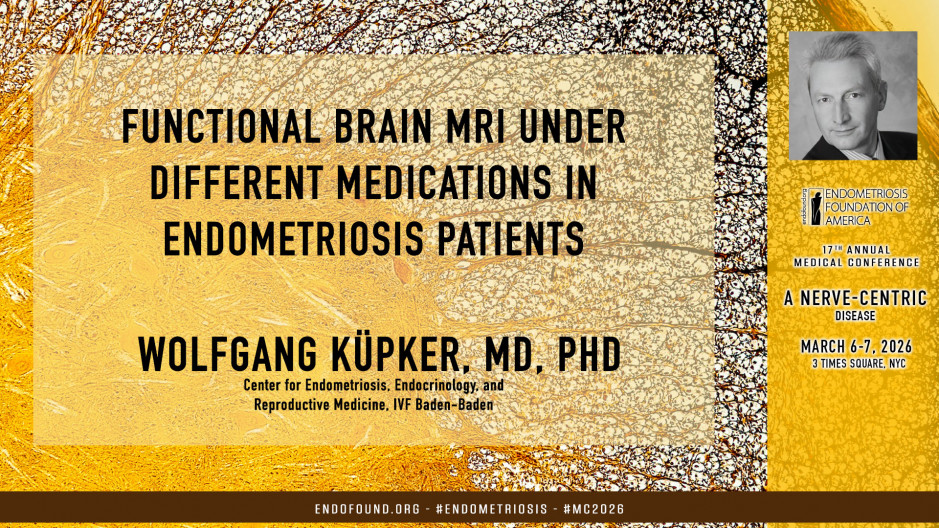
First of all, I like to thank the organizing committee and in particular Professor Setchkin for inviting me to New York City. Once again, it's always an honor for me and a pleasure to be part of this important scientific community. So I got a little bit tired, so we have been listening such a lot of new things. We open up new avenues to understand endometriosis. It's a little bit confusing. I'm confused on a higher level, as you say. My lecture is dedicated to ... Okay, is another approach. So I'm going to show you how classical medical strategies may interfere or affect the brain and the nerves. So what do we know for sure?
This is that endometriosis is a nasty and severe condition and disease that affects more than 200 million women all over the world. And so we really got to understand more and more what we can do for our patients. So what we can do is what I call precision surgery. So I'm a surgeon originally. And I think that precision surgery is of utmost importance, especially in infertility patients. But this is not all the truth. So we need medication in the long run. We have to give our patients medication for or to keep the endometriosis activity down. So what is recommended by our big societies? We all know this as an oral contraceptive progestins GNRH agonist at many, many years and since a few years, the GNRH antagonist.
So what do we expect if we use these medical strategies? It should give us or our patients pain relief, wellbeing, no mood changes, no effects on cognition. And so we know that giving hormones this effect and has an impact on the central nervous system, on the brain, and on the nerves itself. So what do we know from the literature is that progesterone exhibit with relaxation, anxializes. It is claimed that there is a learning enhancement. I think you sleep better with progesterone, but nevertheless, improved cognitive functions are confirmed in papers. Pain relief, of course, we know this and it's anagetic effects. So how? The progesterone and its metabolite allopregnolone activates the GABA receptor system and elevates this neurotransmitter GABA in its activity and elevates serotonin. That calms down. So this is not on the stimulation side, it's on the relaxation side of feeling of our patient.
So if we use GNRH analogs agonists or antagonists, so we got to know how the GNRH and the GNRH receptor system works. So we know this regulator of the HPO axis, but it has vast distribution in peripheral organs and tissues and in the central nervous system. So just look into history and shelly characterized for the first time the GNRH in 1977 and he got the Nobel price for it. So what is the importance of the GNRH secretion, the pulsator secretion of GNH from the hepatomus? It's reproduction, neuroprotection, neurogenesis, indeed cognition, sexual behavior, and aging and has an influence on the aging process.
So I think that the GNRH should be more and more ... Oh, sorry. Got into the focus. The GNRH antagonist, okay, this is a picture of pure vanity, I would say. But it's true. It's 20 years ago when my group could confirm that using the GNRH antagonist has a big success for the wellbeing and the pain relief of randometriosis patients. So I go forward. So what are the effects of an antagonist? It's a pain reduction, no hot flushes in comparison to the GNIH agonist, sufficient steroid secretion, bone mallarization is stable and we could confirm the atrophy of endometriotic lesions. So what we meet or what we met is the therapeutic window, so the stable bone density and no progression of endometriotic lesions because of the concentration of estradiol, which is or should be between 30, 40 and 60 picogram per ml.
A few years years later, Hugh Taylor published this wonderful paper in the New England Journal of Medicine convinceing us that the oral GNA gentagonist beginning with elegonics is a very successful medication for our patients, and it starts the March of victory until now. But what do we have to take into account if using GNRH antagonist or agonist? So what is relevant that the brain itself has got LH and FSH receptors, it's under the influence of local produced estradiol and the ponsatile GNRH. So this is an own pathway within the brain and the GNRH itself seems to play a role to protect us from cognitive declines such as dementia or Alzheimer's. So if this is true, that could be another indication for the use of an agonist or not an agonist, but an antagonist. And what is most striking and important is that the local estradiol in the brain and the GNRH positivity plays a big role in protecting the brain function.
Already Shelly could confirm these claims that the citrullics, it was one of the first antagonist blocks the beta amyloid, that it has got an antidepression-like action that is anxiolytic and it consolidates memory. Okay. So what are we doing now? Oral contraception progestins most widely used in the treatment of our endometriosis patients, mostly after a surgical intervention. So we did a study how these classical hormones impact the brain activity. So the study is still ongoing, we have three groups with oral contraceptives, patients with no hormonal treatment or with the GNRH antagonist. All these patients were pain-free. This is important to mention.
So how did we measure the activity of the brain? We used the MR spractoscopy. And a target area is the singulum. Why? Because the anterior cingulate cortex is acting as a highway for information as a kind of hub. And in the middle of a neural network, it's responsible for the regulation of emotion, pain, cognition, and memory. And what we did, so we measured the most stable metabolite, which is important for the neural activity and to show us or to measure brain activity, there's a glutaglutamide system. So glutamine stands for stimulation versus the GABA system I mentioned it before is for suppression.
All data we gathered were within the normal range, because if you have very, very high concentrations of glotamin, this is mostly a sign of, for example, schizophrenia or very devastating diseases or on the other hand, very low, it's mostly found in patients with depression, but we saw differences. The glutamine index in patients with oral contraception were in the range of 3.9 to 4.6, but patients with no hormones, normal cycling women had higher concentrations in disease like our patient with GNRH antagonist. So they actually did have the highest, most interesting thing. And we correlate that to a questionnaire. So all these patients to tell us all what they feel and what they like or dislike under the medication. So this is a so- called positive negative effect schedule with a scale from one to five concerning pain, mood, cognition, sexual wellbeing. And there was a difference as well.
So on the better side were the patients with no hormones and the patients under a GNH antagonist in comparison to oral contraception.
So what can you learn as a clinician from all of that? Pain reduction is of foremost importance for all our patients and oral contraceptive and progestins. We know this are effective, but the GNRG antagonist is selective and effective under sustained estradiol secretion. And this is different to the GNRH agonists, and this is very important that the GNRH pulsate wave is sustained and this GNRH pulsatile secretion in the brain in concert with a local production of estradiol offers, in my view, a balance harmonic treatment, and maybe the brain metabolism is improved, the question marks are. So the question is, is that the magic bullet? But I think the GNRH antagonist offers a lot of opportunities and safety for our patients. Thank you very much for your attention.