

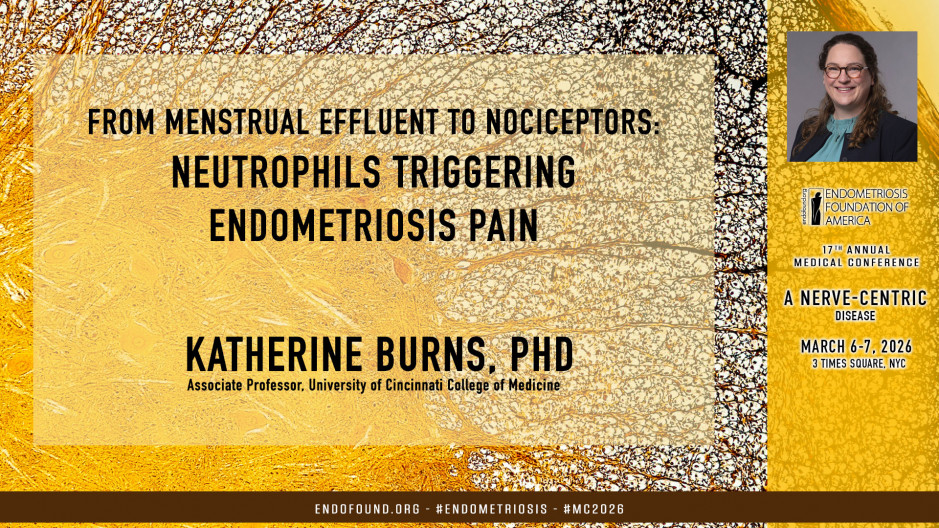
Endometriosis 2026:
A Nerve-centric Disease
Medical Conference - March 6-7, 2026
3 Times Square, New York City
So when Dr. Seckin asked me to bring our neutrophil work into a nerve-centric neuroimmune type of a compilation, I thought, well, this can't be too hard. Let me tell you, it was a whole lot harder than I thought. So I have learned a tremendous amount in the last couple of weeks putting this together. And so any questions, I'm willing to take them and I honor your questions. So I think a big part of today's meeting has really been thinking about how do we reframe the dogma. And the classical piece of the dogma is that the central nervous system is immune privileged and neutrophils are short-lived and they're our first responders. Where in fact, if we bring this into modern terms, the neutrophils actively contribute to the central nervous system, the pathology, and in some context, repair. So why neutrophils? What are neutrophils? And many years ago, I did not know a thing about neutrophils, and so I had to study them.
So they are our most abundant circulating leukocyte. They are rapidly recruited within minutes to hours. They have a relatively short half-life compared to a lot of other different cell types, but they have a bunch of different mechanisms in the sense that they produce a lot of reactive oxygen species, have phagocytosis, and that's all shown over in this figure to the right. So they degranulate, they release a number of cytokines, and then they undergo something called netosis, which is neutrophil extracellular trap release. And those DNA releases, which are shown here, help trap different microbes, release enzymes, and we think play a role in the development of lesions in endometriosis. So neutrophils enter the central nervous system. They cross the blood brain barrier and they break that down. Part of that is due to triggering cytokines via pathways we've heard about today with TNF, IL-1 beta. And then they upregulate cell adhesion molecules, specifically ICAM and VCAM that you see within some of the signaling that allows these neutrophils to get into the brain.
And they also then will secrete chemokines like CXCL1 and CXCL8. So the question is, can this lead to immune amplification and crosstalk with microglia and astrocytes and recruit adaptive immune cells?
Like macrophages, neutrophils are not created equal. A lot's a kind of a misconception about neutrophils that they act very similarly, but a lot of data is coming out on single cell RNA sequencing, which really shows that there's a lot of functional differences and diversity with these neutrophils. They age, they can reverse transmigrate. And in a bit, I'm going to show you some examples of the aged neutrophils and different types of low density neutrophils. So why did I get into neutrophils? Because they regulate angiogenesis. They're modulators of adaptive immunity. They drive sterile inflammation. They are contributors to chronic disease. But the big piece and where I got stuck is that women with endometriosis have a three to fourfold increase in ... Did this just die? A three to four fold ... Yeah, let's try another one. I stopped hearing my voice.
Hello? Oh, it's back. Okay. They have a three to fourfold increase of neutrophils in the peritoneal fluid, and there's also an increase of CXCL8 or also called CXCL8. So the question from here is they were consistently missing from our analysis of understanding endometriosis. I heard a couple people mention neutrophils today, but not many. So that's why we wanted to study them. So we looked at menstrual fluid from women with and without endometriosis. We recruited them via different types of recruitment outlets. I don't have the pieces of our exclusion criteria, but what we did is differential centrifugation, where we actually looked then at neutrophils, macrophages, NK cells, eosinophils, whatever white blood cells specifically are in menstrual fluid. And what I'm showing you with the red arrow is what a "normal happy neutrophil" looks like. So they're two to three lobules and they do their job. So they go and do their phagocytosis and all of the different pieces.
However, if we look at a woman's neutrophils with endometriosis, those neutrophils are quite different. And this shocked us because to this point, so many people had just thrown the neutrophils away and we spent quite a bit of time, very similar to Samir's story, we spent quite a number of years being able to really isolate these neutrophils and make sure that they were isolated carefully because it never made sense to me that if neutrophils are our most popular and most populous white blood cell in our peripheral system, why are they not in our menstrual fluid? So what we find in women with endometriosis is that these neutrophils are quite different. They have many more lobules, they're hyper-segmented, and they also have vacules. And to this day, we still don't know what they are, so we're in the process of trying to study that. So if we reframe endometriosis as not just an ectopic endometrium, not just hormones, not just the immune system.
And years ago, Dr. Taid's group in Canada actually did a very nice study where they compared the ectopic to eutopic endometrium and found a signature of neutrophils within endometriotic lesions. We did a study a couple of years ago in which we treated animals with anti-CXCR2, and anti-CXCR2 is important for allowing neutrophils to be recruited out of the bone marrow. And I'm showing you just a very small example. This is a lesion after 24 hours of induction in a mouse model, and the dark purple are the neutrophil infiltration, and we see that there's a high level of neutrophil infiltration in our animals that were treated with IgG, whereas animals that were treated with anti-CXCR2 have far fewer neutrophils that are infiltrated into the lesion, into the peritoneal cavity, and we actually see a reduced number of lesions that form in these animals. And we already saw today how important the nerve fibers are, the nerve bundles, and looking at this as a neuroinflammatory disease.
So from here, the next step I thought about is how do we integrate this into a neutrophil-centric model? Because the role that neutrophils play in early lesion establishment, they have the release of reactive oxygen species, proteases, which I show here with our TIMP-1, and they secrete VEGF-A. This is a study that we did a number of years ago where we were looking at the lesion gene expression of VEGF-A and what VEGF is secreted into the peritoneal cavity upon the initiation of endometriosis in a mouse model. So all of this comes together, and I ask as neutrophils being the first responders, are they really sustaining a signaling that drives sensitization, and could they be a piece that initiates this cascade? And that's what we're asking today. So back to the menstrual fluid data that I talked about, and neutrophils being mediators and sensitizers of nerves and how they cross the blood-brain barrier.
What we did is go back to the single-cell sequencing data that we have of neutrophils specifically from the menstrual fluid. And what we find, if we look up here more closely, looking at control day one, control day two, we collected menstrual fluid on two days and endometriosis day one versus endoday two. And what we find that there's an increase in TNF signaling in endometriosis, an increase in IL-1 beta. And what I'm not showing you is we've gone through a number of different processes to actually define that these are mature neutrophils over here versus aged neutrophils on this type, which the aged neutrophils are the ones that really are predominant in the differential images that I showed you. And so we're seeing that there's more of a change in these aged neutrophils and what the age neutrophils are able to do, specifically with some of the cell adhesion molecules and then the secretion of CXCL1 or CXCL8.
So from here, does this lower the nociceuceptor threshold to sensitize nerves and cause chronic sensitization? I think that the answer could possibly be yes, from these neutrophils that are moving retrograde and reverse trafficking, as Dr. Seshkin says, into the peritoneal cavity. Another process in what neutrophils do is the neutrophil extracellular traps and the demonstration of the sterile inflammation. So these nets contribute to sterile inflammation, extracellular DNA. They create a loop of TLR9 activation and cause this persistent inflammatory loop. In our mouse model of endometriosis, similar to the study that I showed you where we were looking at the infiltration of neutrophils, we also looked at net byproducts, which are ... Oops, nevermind that picture, which are ELAN or ELA2 and myeloprodoxidase or MPO. And what we find is that in our IgG treated, we have higher levels, but if we block CXCR2 recruitment, which blocks the recruitment of neutrophils, we have a decrease in these NET byproducts.
So we went on then to look at the acellular fluid of menstrual fluid. And what we found is that there is an increase in net cell-free DNA in the menstrual fluid of women with endometriosis. And this significantly increases when we compare the ratio of what is secreted from day one to day two. So back to the idea of these nets sustaining a chronic neuroinflammation signaling is quite possible that this could be happening. We then wanted to think about how do we look at neurotrophic growth factors and what are some of these growth factors that are coming from the neutrophils that may signal to the nerves. So NGF is important in inflammatory pelvic pain and a key pain mediator. I didn't really see any differences. Whereas with VEGF that aids in neurovascular coupling, we actually see that there are some increases in the aged neutrophils in the expression of VEGFA.
We also know that lipids and inflammatory mediators are important because they directly sensitize the TERP-V1 nociceptors. And we find, again, that there are changes in different pockets of these neutrophils, because if we look at the neutrophils specifically, which haven't really gone into much detail, is that there are 12 different categories of the neutrophils, and we're working on breaking those down to see what the actual neutrophils do. And then looking at the activation and the migration to see if that will pull them into more closer to the nerve interaction, we are looking at some of the integrins, ITGAM and select an L, and we find that maybe there is some association, but not really strongly. So I don't know necessarily if we could say that this is able to govern the tissue infiltration and nerve fibers. But what we did do and look then is compare with TNF signaling this cascade of signaling that's important in pain signaling.
So what I did is take the TNF alpha signaling through using cell chat and what we looked at are all the immune cells that were present in the menstrual fluid. And if you look at day one on control with TNF signaling, you see that it signals continuously and throughout all of these different cell types, whereas on day two, looking at what happens with TNF signaling, it's really quite shut down. So the importance of TNF signaling is to have that signaling being shut down because it's a pro- inflammatory environment, a pro- inflammatory importance, and we're seeing that that is shut down. And importantly, there's not much rule of your neutrophils, the age, the transitioning, or the mature. Because this can induce and modulate neuropathic pain, we wanted to see what's happening with the endometriosis samples. And what's very interesting is that already on day one of menstruation in women with endometriosis, this pattern looks like day two of healthy women.
However, if we look at it closely, we now see that our neutrophils are starting to signal. Those neutrophils that are so different and more predominant in the menstrual fluid of women with endometriosis are now one of the main signaling cells in the menstrual fluid, which are driving that level of TNF that may cause a pro- inflammatory environment, causing these neutrophils not to die, not to turn over, and that they could then help with the central sensitization. A pathway that we haven't really learned about today and talked about much is CSF or colony stimulating factor. It's a critical regulator in neuroimmune crosstalk. It acts via its receptor and different cytokines that allow that neuroimmune crosstalk with microglial activation, neuroinflammation, and neuroprotection. And what I found very interesting about this pathway ... Oop, I gave the secret away, is that on day one, there's a lot of signaling from NK cells, and actually that's happening in endometriosis as well, but then you see that it transitions on day two to have signaling coming from your aged neutrophils and your transitioning neutrophils.
Whereas in endometriosis on day one, they're already signaling, they're doing some signaling that would bring in more of the neutrophils and granulocytes. And similarly, what is interesting and more dynamic is that now you have an increased signaling from all of your neutrophils in women with endometriosis suggesting that that cycle is not turned off and is continuing to create that inflammation and to cause additional problems.
So from here, if we think about central neuroinflammation and sensitization, whether this is a neutrophil driven inflammatory process that may prime that response, there is already evidence in endometriosis because we have increased microglial activation, we can see altered brain connectivity, central sensitization, and chronic pelvic pain, and the mechanism that we may throw out there and hypothesize is that these peripheral neutrophil activation or neutrophil activation in the menstrual fluid would lead then to increase in cytokines, vaginal spinal signaling, and a microglial priming, which would lead to, excuse me, chronic pain. So because I'm not an artist, I actually asked ChatGPT to help me with all of what I told it to put in, and it drew me a really cool picture. And what it did, I was surprised because I thought there's no way, and I was really quite surprised. So if we think about a bidirectional amplification loop where we take nerve to neutrophil, where we signal through substance P and CGRP release, we have the neutrophil recruitment and priming, the inflammatory mediator release, which is coming then from some of the signaling in the uterus.
But if we look backwards and look at the neutrophil to nerve, we then have all of these different signaling pathways that are being secreted, activate the different TERP-V1 channels, TERP-A1 channels. You have more neuropeptide release, creates a neuroimmune sensitization that goes back and forth between the neutrophils and then the nerves, which would support that there is the potential for this bidirectional loop and pain sensitization. So thinking about, are there any potential implications for therapies? So one of these are blocking the CXCR2, which we did in our animal. I wouldn't suggest that we do this because I don't want to walk around without my neutrophils, and I don't suggest you do either. Maybe blocking IL-8, there's a new paper from a group, I can't remember where they're from, but they try to block IL-8. One of the things that we're trying to do in the lab is to block the neutrophil extracellular traps, and maybe then you could target neutrophils, the nerve interactions to modulate some of those phenotypes.
Maybe we could have pain reduction and not just lesion size, which we saw from some of the work from JWOC, some of the work from Conoco, some of the work from micro over here. So all of these coming together, working together, may really help us understand where some of this pain is coming from. So in summary, if endometriosis is a neuroinflammatory disease, neutrophils may be upstream of some of this chronic pain. And again, I asked ChatGPT to draw me another image and to look at how the neutrophil nerve crosstalk is driven. And one of the things that I think we can take away from this, not only having the changes in neutrophils in the menstrual fluid as a potential non-invasive diagnostic, it may actually help us understand how these aged neutrophil signatures may correlate with pain and whether we could tell anything by the level of pain, although Dr. Seshkin told us this morning pain is pain, maybe we could tell some of the pain by seeing what we find in the menstrual fluid and the changes in those neutrophils.
So with that, I am actually ahead of schedule, so I realized I talked more quickly than I did practicing to myself. So I acknowledge all of those that have been in my lab, the different funding sources, and the ability to be here today to talk to each of you. Thank you.