

Endometriosis 2026:
A Nerve-centric Disease
Medical Conference - March 6-7, 2026
3 Times Square, New York City
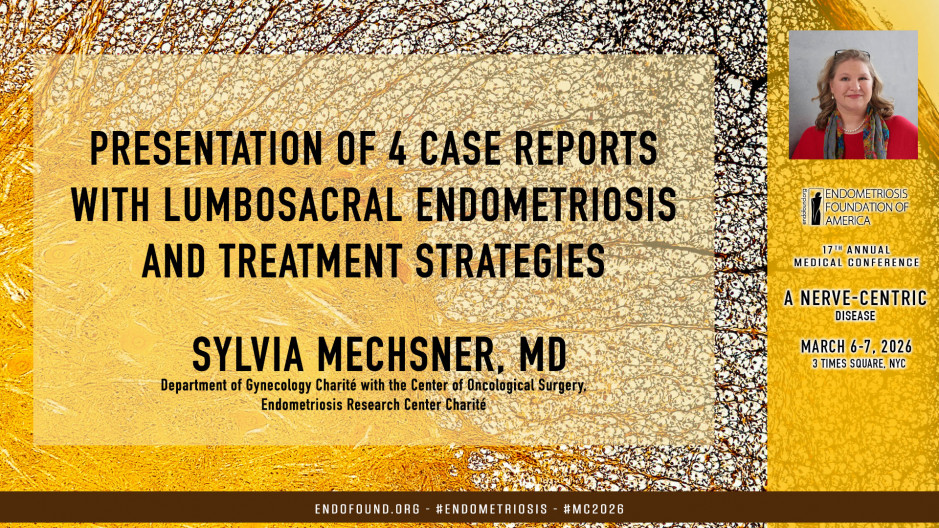
Thank you so much for the introduction. Yes, today, my second speech on this wonderful meeting, I learned a lot and I enjoy it very much is only to give you a presentation of four cases. So nothing very scientific, it's management of patients. Yes, also we treated a lot deep infiltrating endometriosis at Charity Hospital, and it was a big pleasure for me that Vito Quiantera was one of our consultants in the past. And we together did these cases, or he was a main surgeon and I did the assistance because it's many years ago. And we evaluated also in all these deep infiltrating cases, a number of these who has an infection of the plexus actrialis, and that was from 148 patients or nearly 30% had an infection of the sacrals nerves. So of course, when surgery is one route to treat it and we have to need a very high end surgeon and it's a risky surgery.
So when you can do it and you have no complication, the outcome of these patients is also, in the most cases, very well. But sometimes we have also difficult cases and we have to find the balance between efficacy of the surgery or also risk for morbidity in these cases. So in not always all patients, they are afraid of risks and not all of them want to have a surgery. So we have to make a very good explanation about the risks, about the outcome and what's going on and so on. So we really might need to find a balance between this common ... So the patient has to make a decision after good information. And I want to share four cases with you. So the first and the second one, the first one had no surgery for endometriosis. The second one had a surgery in between of the period of treatment in our cancer.
The second case, the blue case, had already a surgery before and a recurrent disease, and the third case had no surgery. So she declined the surgery. And I want to go through these cases from the clinical flu.
So case one, it was a 34 years old lady. She was lucky. She had already one child and she was diagnosed in 2023. And she was also a physician, so she felt there was something wrong in her pelvis and she was a neurologist. And then she asked for an MRI that was easy to get for her. And there was mass found, infiltrating mass found, especially on the S3 route. Finally, so she asked for a diagnostic laparoscopy, not in our hospital, and they find from the laparoscopic site only a parectal nodal, the hint of the iceberg, something very obviously. And they took also biopsy from this area, but they did no excision of this big mass. So it was a typical rectal vagina lesion with pelvic wall infiltration, a very big one. So they took only the biopsy and stopped the surgery, but they didn't understood the complete problem.
So her symptoms were not so strong. So she had only slightly right gluteal pain, dysmenorrhea, but she recognized paresthesia in right leg and foot. She had only sometimes, not always, only sometimes. And she had a bowel dysfunction, little bit cyclical diarrhea, flutterence discectia. So that was not a worse case of endometriosis symptoms. That is the area of affection of the bowel and also of the escheatic nerve. So it was a big nerve. And then at the first idea, we started with a hormonal treatment. So, and that was at the beginning, a little bit tricking to find the reach window to drop down the estrogen level. We have to balance a little bit with GNH analogs because GNA's antagonists were not available at that time. And then sometime we added also aramatase inhibitors to drop down the estrogen level. And now she is fine. We found a balance with antagonist now and transdermal E2 replacement, and she has no side effects.
And after four months, we found also regression of the lesion in the MRI. She had a very good improvement of all symptoms, and finally she declined a surgery after counseling on risk. So now she is fine. So we see her regularly, but she has no problems. Yes. The second case, so she was 27 years old, no children so far. And she had already known a diagnosis for endometriosis 10 years ago. And then she had a recurrent disease or unexpected deep infiltrating lesion, and she underwent surgery in another hospital in 21. They did radical deep infiltrating lesion excision with bilateral hypogastric nerve neurolysis in this area. And at the beginning, it was an improvement of the symptoms, but she declined to go on with hormonal treatment. So yes, she developed a lot of recurrent pain, right? So the escapic pain radiating down to the leg, stress dependent.
She suffered also from dysmenorrhea, dyspyronea. She had a severe functional limitation. She was unable to sit her cycle to walk, and she had to lay down. So she was unable to work and so on. So we did MRI scan and found an infiltrative rectovagina nodal also with infiltration of the plexus actrialis. And yes, so what to do because she underwent already this extensive surgery before, and now she has the symptoms again. This is the MRI scan of this lady. So yes, what we did, she declined to have hormones because she had side effects with progestin only and also with combined oral contraception. So we can understand that with such severe side effects, it's not that they don't like to go on with these kind of medical treatment, but now she is so in pain. And from my side, I said to her, okay, resurgery means that she will have a high risk of bladder dysfunction, of course, because she had already on both sides, a hypogastric preparation and excision and so on.
And so we decided to start with GNAH receptor antegonist relugalicity. So in 24, I lost the four. And yes, that was very amazing because within one month she became amenorric and then she was able to discontinue all anergetics. She had a significant decrease in leg and pelvic pain, and now she's under control. She don't need ... She is, of course, with this hormonal medication, but she has no further symptoms. The third case, so she was 32 years old, no pregnancies before. She had already one surgery with a confirmation of endometriosis because of an endometrioma on the left side, so on the left side, and they did the excision of the endometrioma, but they don't find anything else. It was another hospital. But after the surgery, she recognized progressive neuropathic pain on the guinea femoral distribution, but on the right side. And in the first second, when she came, I thought, okay, they did by accident nerve fiber damage during surgery because that was closed after this first surgery.
But we did also ... So let me tell further what she has. She recognized also paresthesia, intermittent cyclical leg weakness, walking, restrictedness. So pain, the pain was on the right hip radiating to thicks and knees and lumbar spine, so it was more than only damage of peripheral nerve, I thought. So she suffered also from dusmenorrhea, but not so many other typical endometritic lesion symptoms. The MRI we did showed a massive invasive muscle infiltration on the right iliopsource, wrapping the L4 nerve root, and also an infiltration of the femoral nerve on the right side. By exhibitent, we found also hydronephal on the right side, and we found hydronephrosis on the left side. So they miss during surgery the ureter lesion. So also neurological examination showed some pattern of quatriceps, priorities, absent patella reflex and dermatome sensory loss. So that's what really severe cave. If you see here the extension of the retro or paravertebral mass in the MRI scan.
And in this case, we had an interdisciplinary board also with our sarcoma surgeons. And finally, the board decided or gave the recommendation not to do this high risk surgery because there was absolutely a damage of the femoral nerve and a risk of loss of this function. So we started and she agreed. So we started Dynagest and we observed rapid leg pain improvement. It was amazing. It was really amazing. She went on with this, but then she interrupted because of seeking pregnancy. She underwent five unsuccessful frozen embryo transfers. Then she decided to stop the family planning by conceiving by herself. Of course, the symptoms came back, and then we decided to do the surgery for the ureter. So we did a ureter part resection with end-to-endinstomosis to fix the problem of the ureter on the left side, and we didn't touch the paravertebral endometrism, and there was also nothing to see from the abdominal side.
So then now we started again with Dynagest. She is fine again. She managed daily activities without pain medication. She had only mild occasional symptom persist, and finally she adopted a baby, and she's fine also with the family situation. The last case, she came also at the age of 27. Now she has a baby at the end, but not at the beginning. She was diagnosed in 2016, and she came already with an impressive problem of her leg. So she had an antalgic posture with functional leg shortening already, and she had dysmenorrhea and persistent osteotic pain always, or cyclical, but very strong. She had already progressed a foot drop at this time, and the imaging showed cystic mass infiltrating the osciatic nerve. And yes, from the neurological aspects, she had already muscle atrophy of the piriformis and obturator antennas and also partial perinal nerve lesion. So that was also a very severe case when she came.
This is the math. Here you can see it's a very cystic mass. And in this case, we started also at the beginning with Dianogest twice a day because to reach therapeutical aminora, the cyst decreased a little bit, but the symptoms get very, very better. And we started, of course, with physiotherapy and everything, so she was fine for a while, but then she wanted to have a child, and then she had to discontinue the contraception, of course, or the therapeutic amenorrhea. And at this point, then we decided to do the surgery. Vito Kiante did this surgery. He came from Italy back in our center only to do the surgery together with me. And so it was a real endometrioma on this ischiatic nerve, but was infiltration of this one and he had to remove also small fibers of this nerve. So initially after surgery, she was complete, so she was pain-free and could elevate the leg, but over a couple of days, it comes a little bit worthening of foot drop and sensory loss.
And she had also this developed also this decubitus at the leg. So, and that took one year until it was then healed completely. Yes, she had ongoing deficits, neurological deficits, but she is fine with the pain and they can handle everything. Finally, yes, she started again with Dynogen and that was also big surprise. We don't find any intraabdominal endometriosis. So that was a case. The only case I know that we had only a complete retroperitoneal endometriosis, no single spot in this pelvis. Okay. Finally, she interrupted against the treatment, and then she became pregnant, and now she gave birth to Julian, and she is very happy that we were able to manage this. So this is a evaluation of these cases, and as you can see here, so this treatment option, we have to think about hormonal treatment. It will improve a lot, and maybe we can avoid a surgery.
And of course, surgical excision is, of course, often a good option, but we have to discuss this careful, and we can, instead of this, do both or a combination or only hormonal treatment, you can try it. But of course, we need to add also multiple treatment options like pelvic floor relaxing exercises, physiotherapy, osteopathy, co-analgetics are important that we think about it and we added also interventional pain strategies are good option or also neuromodulation. I think I'm also great fan of neuromodulation with, for example, spinal cord stimulation. And so we have to give the patients a personalized treatment strategy and then we will find a solution. Thank you.