

Endometriosis 2026:
A Nerve-centric Disease
Medical Conference - March 6-7, 2026
3 Times Square, New York City
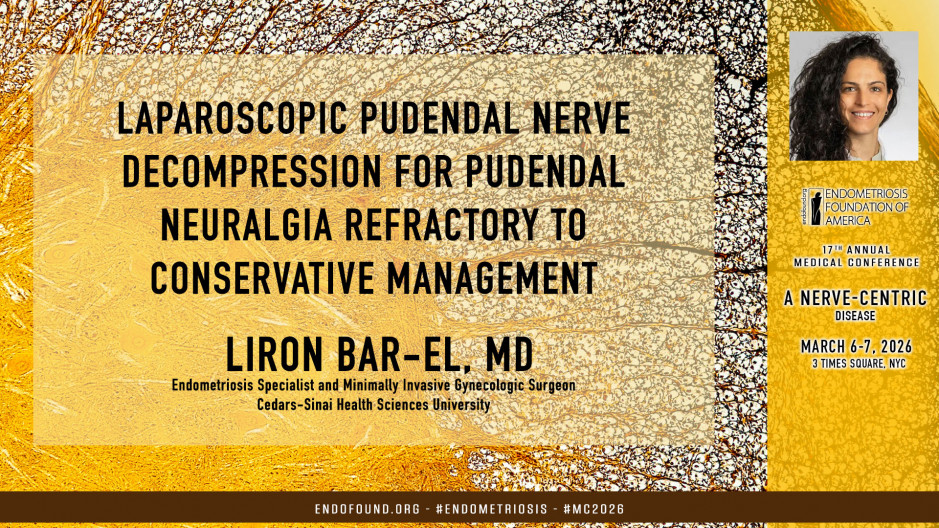
Thank you so much. Wow. What an honor to be here. And Dr. Sutchkin, what a beautiful conference. I think it's one of a kind. So thank you for the introduction. So as you said, I'm an endometriosis and a complex gynecologic surgeon. And a part of my practice, I treat people with pelvic pain, with chronic pelvic pain. And a lot of the times, actually, most of the times it's due to endometriosis, but not always, or sometimes it's pain that is left after endometriosis treatment. So today we'll take some time to talk about pudendal neuralgia and what we can do when nothing else works. So I have nothing to disclose myself, unfortunately, but I want to acknowledge Dr. Ashley Gubos that have trained me at the Cleveland Clinic to do this and all the amazing speakers that I'm so honored to speak amongst that either trained me directly like Dr. Satchkin, Dr. Velela, Dr. Nimrov, and Dr. Romanda will be speaking soon, or also trained people that trained me like Dr. Lee and Dr. Pasover.
So thank you again for making this happen. So pudendal nerve entrapment syndrome, also known as Alcox canal treatment is relatively under-recognized and a lot of times misdiagnosed as other disorders of pelvic floor or just dismissed. Historically, the prevalence of this disorder was quoted as one to 100,000, but recently we know that it's closer to one to 6,000, and about 4% of patients with chronic pelvic pain will end up having a diagnosis of pudendal neuralgia if they see someone who would recognize it. So patients would usually present with unprovoked genital pain, irritation in the distribution of pudendal nerve, which is the yellow area in the picture. Symptoms can include burning, shooting pain, stabbing pain, and even numbness at the clitoris, at the labya minora, at the perineum and the anus. A classic description of the pain would be that they can't sit. They can't sit. And I would always ask them, "When was the last time you rode a bicycle?" And they would say, "Oh my God, I can't ride a bicycle." Because when you think about it, sitting on this bicycle seat is sitting right there where the pain is.
So that is one of the clues of prenendal nerve or neuralgia or nerve syndrome. Some patients will describe a subsensation of a foreign body in the vagina or in the anus, and usually the pain will be progressive. They can start with no pain in the morning, but then it will progressively get worse, but the pain would usually not wake them up in the middle of the night.
Superficial dysporonia can happen if they also have valvodia, but usually deep dysporinia is not typical. And that usually would happen if they have other pelvic floor disorders or endometriosis. So let's review some of the anatomies. So the pudendal nerve arises from the anterior division of sciatic nerve roots S2 to S4. It exits the pelvis through the greater sciatic foramen between the piriformis and the coxesius muscle, and it travels between two ligaments, between the sacrospinous ligament and the sacrotuberous ligament, and it goes right underneath the ischial spine. The nerve then reenters the pelvis and travels in the ALCOX canal that we talked about. This is the canal. It's basically a fascia of those two tendons right here. And there is a creased cross collagen configuration of this canal, and that is supposed to give it some elasticity for when the vasculature of the pudendal nerve widens and the volume increases like Dr. Pasova talked of before.
But in some situations, like trauma, like anatomic variation or fibrosis that may be caused by endometriosis, this canal becomes more rigid and constricts and entraps the nerve and the vasculature. So technically I think of it as the carpal tunnel of the pelvis, right? Carpal tunnel, we have the same constriction of the median nerve. Same here, and we don't know why it happens to some patients and some not, but we know how to diagnose it and how to treat it. So it's important to start with the correct diagnosis and choose the patients correctly. So we, in our practice, start with image guidance, a diagnosis with a block to the pedantal nerve, and a positive diagnosis will be if we have a 50% pain decrease following the block. So once we confirm it's indeed the penetal nerve, we start with lifestyle modifications, pharmacologic interventions, pelvic floor physical therapy, which is very important.
But if all of those don't work, then we offer surgical intervention. Now, the intervention is basically to decompress the nerve under the sacrospinous ligament right there, which you can see it's transected. Right here, you see the pudendal nerve. In this view, the vasculature does not exist, but then we transect the ligament to release the entrapment.
So there are several approach on how to do this. One is the perineal approach. You enter through the vatriana muscles and release the entrapment of the nerve. Another one is the transglutoral approach that was described by Rogers Robert, I think at 2007, where you go through the glutam muscle. But when you think of patients with chronic pelvic pain, especially in that distribution, recovering from these surgeries is not fun. So today with the groundbreaking help of Dr. H, we can talk about the laparoscopic approach to this procedure. And we obviously didn't invent this. Many of the speakers here probably are doing them themselves, but we can go and step by step and see how it's done. So the first thing is the port placement. We want to choose where to put the ports. Usually in laparoscopy, we go lateral to try to avoid the inferrapy gastric nerve, but actually here we'll go more medial.
So we'll have a straight shot into the very narrow pelvis. Then we identify the obliteral umbilical artery and we enter the retroperitoneum just lateral to it. We travel down along the operator muscle, medial to the operator nerve, but lateral to the lymph nodes because we don't want to injure those. We find the levadoini and the tenderness arc, and we travel all the way to the insertion of the coccyxious muscle. Now, that's where the ischial spine going to be right here. And if it's hard to recognize, we can always do the digital exam because we can all feel the spine transvaginally and we find the spine right there. So now we find the coccygeous muscle connecting to the ischial spine. Once we find it, we can transact that muscle and then we gain access to the sacrospinous ligament right here. Underneath the sacrospinous ligament will be the neurovascular bundle of the pudendal nerve and obviously vessel.
So we'll start transecting the ligament. And I agree with Dr. Suchkin already said yesterday about meticulous use of energy next to nerves. So we really take very, very small bites with the least energy we can while keeping hemostasis, because the nerve is right underneath there. And here it is. So we first find the nerve and artery right there under ... So this is the spine. This is the reflected ligament, and we find the artery in the nerve. And when we continue dissecting more laterally under the spine, we will find the pudendal nerve, which you can see here. All right. So now that we find them, we start releasing them from all the fibrosis underneath. And endometrial surgeon, we like to do ureterolysis, right? We release the ureter from all the fibrosis and all the attachments of the ureter in the pelvis. Here we do the same thing.
We do neurolysis. We clean and skeletonize the nerve and the vascular bundle to make sure it's not entrapted.
And then we want to also make sure that it's not stuck on then inside the ALCOX canal right here. So we would dilate the canal. We sometimes also unroof it, cut a little bit of the ligament above to make sure that the entrapment is not in that area. And lastly, we would dissect it more proximately. And the one sign that we recognize is the return of palsation sign. I want to see that the pudendal artery returns to have pulsation, because during the surgery, usually there's no pulsation because of the entrapment. So once we see that it's pulsating again, we know that we probably released all the entrapment, and that's what we're looking for at the end of the case. And here it is. This is the end product. We see the pudendal nerve vein and artery, which you will see in a second, free from any attachment, free in the entrance to the canal, the sacrospinous ligament is reflected, and this is the conclusion of the surgery.
To end the surgery, we also close the peritoneal layer so there won't be any adhesions into that space, and no one can tell that anything was done there. So what are the outcomes?
In the literature, we see that symptom improvement starts about three to six months after the surgery, but maximal pain relief happens after 18 months. And we tell it to the patient, so they won't expect an immediate response. And the improvement or success is defined with pain relief of at least 30%. And remember, these are patients that nothing, nothing helped. So 30%, they will take it. But honestly, most of the patients get to 60 and 80% pain relief, which is what we're actually aiming for. But although we talk with them about long-term pain relief, there are some cases that have more of an immediate relief. So this patient, it's not her, but one of our patient had already pain reduction, actually pain-free in PACU, and she called us after the ride home, and she told us, "You know what? I was able to sit in the ride home and it was bumpy and I didn't have pain.
How is it possible?" I think it's a little rare because probably her entrapment was more acute and so there wasn't so much nerve ischemia and injury, but it's not the only case. I found some publications of this publication doctor about 50% pain reduction within two weeks, so not to expect to, but maybe to hope. And so today we kind of touched on laparoscopic predominant nerve decompression. It's not that we have to jump into surgery with every patient, but if we run out of options and nothing works, we can do it and we can do it laparoscopically. And one last thing that I added last night after Dr. Sutchkin's picture, remember the video of the endometriosis underwater that kind of flopping around the wind. So I want to show you how it looks with the ultrasound. It's a different topic, but now in endometriosis, we get better and better and better in diagnosis with ultrasound.
This is how Dr. Sutchkin's lesions are going to look with ultrasound when you have enough peritoneal fluid. So you can actually see superficial endometriosis in ultrasound. I think that's the future of diagnosis. You can see it here as well. These are exactly those buds. Yes. So just putting it out there because we're talking about endometriosis. Thank you so much. I