


Unbeknownst to the live studio audience and to more than 10 million viewers tuning in at home, Meghan Linsey sang on a 2015 episode of The Voice with the flu and a fever of 103 degrees.
“I had to perform. There was no changing the schedule. And I could do it because I had endometriosis and was used to pushing through stuff like that,” Linsey said. “It’s hard, but when the time comes, you say, ‘Okay, this is what it is,’ and you just go. That’s been the theme of my life.”
That theme—of strength, resilience, and a refusal to let endometriosis take center stage—has shaped Linsey’s career.
Linsey started writing music and performing at fairs, festivals, and bars in her native Louisiana when she was 15. Her big break came in 2009 when she was 23 and formed half of the country music duo Steel Magnolia. That year, they won CMT’s Can You Duet, signed with a major record label, and saw their debut single, “Keep On Lovin’ You,” peak at No. 4 on the US Billboard Hot Country Songs chart. Now, more than a decade after placing second on The Voice, the 40-year-old writes and records music from her Nashville home. She releases a new single every four to six weeks while continuing to battle endometriosis symptoms that emerged when she was 12.
“I knew my very first period was abnormal because it lasted so long and hurt so much,” Linsey said. “My mom took me to the doctor, and they wanted to put me on birth control. We didn’t want to do that, so I sucked it up.”
She continued that approach, powering through pain for years.
“I took ibuprofen and figured out pretty early that heating pads and hot baths helped, but the pain really became normalized for me,” Linsey said. “People would tell me it was just a period and to stop being a baby, so I dealt with it.”
In 2010, Linsey was on tour with Steel Magnolia in Denver when pain from a massive cyst nearly debilitated her while performing. She made it through the show but could barely walk afterward.
“I ended up going to an OB in Denver, and she said, ‘You have to have surgery tomorrow. You could lose your ovary if you don’t because the cyst is so large.’ But I was so young and afraid to have surgery in a different state without my mom,” Linsey said. “I ended up flying to see a doctor in Baton Rouge near my hometown, had surgery there, and then flew out the next day to continue the tour.”
She never considered postponing any shows.
“We were touring 200 days a year, and it was really hard to get on stage in the midst of that and meet people afterward, but I was having a moment in my career where I had to harness that momentum or it could all go away,” Linsey said. “It may not have been the smartest decision, but I kept going.”
As time went on, additional symptoms like chronic fatigue and brain fog appeared, along with more cysts. After a show in Los Angeles, one ruptured.
“I was in bed with a heating pad, vomited, and took ibuprofen,” she said of her remedy. “At that point, I still didn’t know what was going on. Even after the surgery [in Baton Rouge], nobody mentioned endometriosis. I still thought it was part of a normal period for everyone.”
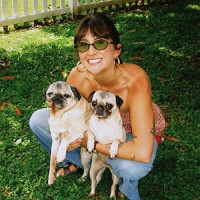
Not until about five years ago, after speaking to her friend Leslie Mosier, did Linsey learn about endometriosis and think she might have it. Mosier is an endometriosis patient, EndoFound’s social media manager, and known to many as the manager of internet sensation Doug the Pug. She had successful excision surgery in 2022.
“Our pain and everything else we’d been going through were so similar, so I was kind of waiting for Leslie to have her surgery to see what she thought I should do,” Linsey said. “I was in a fetal position and vomiting all the time during my period. I couldn’t get out of bed or even move. I had to do something about it, and her surgery gave me the push I needed.”
Linsey read about the disease, perused scientific studies, and joined several endometriosis social media groups for support. But doubt still lingered in her mind, a common reaction among those with symptoms who have been questioned or gaslit for years.
“My biggest fear about surgery was them going in and not finding anything,” Linsey said. “There were times when I would send Leslie a voice memo and say, ‘I’m just sending you this so that I remember how much pain I’m in at this moment,’ because when that pain goes away, you think, ‘Maybe it wasn’t as bad as I thought.’”
Linsey overcame that fear in 2023 and had excision surgery. Endometriosis was deeply infiltrated in her reproductive organs and bowels, though the surgeon was able to preserve the reproductive organs—crucial to Linsey in case she wants to try to have a child.
“I was also just glad that she found endometriosis,” Linsey said. “It meant there was a reason for everything I’d been through.”
While the surgery provided Linsey with instant relief, the pain returned aggressively about a year later. She is on a low dose of tirzepatide to help with inflammation. Otherwise, she’s managing the pain and other symptoms the way she did before surgery.
“I have an amazing OB, and we are talking about it now to figure out what makes sense,” Linsey said. “Do I have another exploratory surgery? Maybe another excision surgery? It’s hard to know what to do because there’s no definitive answer.”
While Linsey considers her next move, she continues to create music.
“I’m very blessed that I work for myself and am not on a label or touring, so if I have a day where I feel like I need to be in a fetal position with a heating pad, I can do that. But it’s still hard.”
She said endometriosis has not derailed her career because she hasn’t let it.
“I refuse to let it,” she said. “I definitely could have. There have been times when I’ve said, ‘I don’t know how I’m going to do this,’ but somehow I do it every time. I’m always amazed at what I can do.”
That’s a sudden realization for most endometriosis patients, who are widely known for finding a way. It’s a message Linsey shares with the many young women who reach out to her through social media. She also tries to instill confidence in them so they can get the help they need and deserve.
“There is always so much doubt that comes with this. It’s hard to know what’s normal if this has always been your normal,” Linsey said. “Don’t doubt yourself, listen to your body, and really advocate for yourself. I didn’t ask to be this strong, but it kind of comes with it. Just keep pushing through.”
*Patient stories submitted to EndoFound.org are the patient's views, not necessarily those of the foundation. All testimonials are from real patients, may not reflect the typical patient’s experience, and are not intended to represent or guarantee that anyone will achieve the same or similar results.