

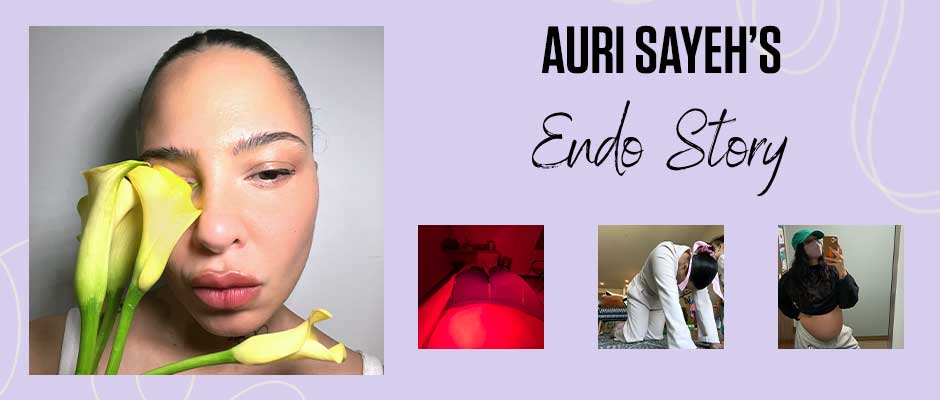
Most stories women share with EndoFound about their endometriosis journey include surgery to remove the disease or their continued quest to find the surgery they need.
Auri Sayeh has chosen a non-surgical, holistic path—and it’s working.
The Brooklyn resident has had symptoms—namely, painful cramps, heavy bleeding, and severe blood clots—since her first period 27 years ago, and she was diagnosed with stage IV endometriosis 14 years ago. However, she’s never had surgery to remove it and hopes she never will.
“I’ve been practicing Chinese medicine for the last couple of years, which is the highlight of my story because it’s changed my life,” Sayeh said. “I do acupuncture and drink herbs and teas. I changed my diet to cut out foods that cause inflammation. I don’t drink cold drinks to keep my body as warm as possible. I don’t take pain medication anymore. It’s all been working for me.”
From a young age, Sayeh had little guidance on how to handle her painful and heavy periods.
“My parents were divorced and I was living with my father when I had my first cycle, so nobody really talked to me about it,” she said. She believes her late mother, who died of heart disease six years ago, also had endometriosis, though they never discussed it. “She had a hysterectomy when she was 38,” Sayeh said. “And I remember when I was growing up seeing her in a lot of pain and always bleeding heavily at her time of the month, so I just thought that was normal.”
Throughout her teens and early 20s, Sayeh relied on four or five ibuprofen every few hours, multiple heating pads, and a day or two off from school or work each month to get through her periods. Doctors couldn’t find anything wrong and offered no remedies for her symptoms other than birth control, which Sayeh didn’t want. It wasn’t until age 26, while living in France, that she finally chose to get a diagnostic laparoscopy after an embarrassing incident in Amsterdam.
“I was sitting in a chair getting my nails done. I had white jeans on and didn’t know I’d started my cycle,” she said. “When I got up, I was covered in blood.”
Despite being diagnosed with stage IV endometriosis, Sayeh refused surgery to remove the disease. The fact that she had the diagnostic laparoscopy was a significant accomplishment for her.
“It may sound crazy, but I’m just so afraid of surgery, and I have a really bad reaction to anesthesia. It makes me really anxious,” she said. “I know a lot of people have surgery for endometriosis, but I was at peace not having it and doing what I could naturally.”
Sayeh continued with her way of life until she was 34, when she wanted to have a child. Knowing that endometriosis could cause infertility, she began focusing on her nutrition. She read a book about optimizing her chances of getting pregnant through a diet that could improve the quality of her eggs and reduce inflammation, and she followed it to the letter.
“I became pregnant naturally at 35,” Sayeh said, “and my daughter was born very healthy.”
When Sayeh’s periods returned after her pregnancy, so did her symptoms.
“I had terrible cramps and heavy, heavy bleeding with blood clots about the size of an egg,” she said. “I was in bed with heating pads, and with that came a sense of hopelessness.”
That’s when she was introduced to traditional Chinese medicine. She was living in California when someone recommended she try acupuncture. Sayeh’s insurance covered it, so she tried it.
“Within three or four months, I experienced such a drastic change in my health. My body felt less inflamed and my bleeding was less. I still get my cycles today, but they aren’t nearly as heavy, and I know how to manage them,” she said. “I realize I’ve changed the way I’m living, which endo does to you, but the more I experience and read about Chinese medicine, the more it makes sense. And why wouldn’t it? A whole culture of people has been doing it for centuries.”
This natural, holistic way of life has had a profound effect on Sayeh that extends well beyond her own health. The creative director and brand strategist is now considering a career change.
“I’ve decided to go back to school to become an acupuncturist and Chinese medicine practitioner,” she said. “I think with the way the world is right now, we don’t need more brand strategists. We need more doctors and people who can help others with their health.”
Sayeh realizes the endometriosis inside her is still growing and may become too much for her to naturally handle one day.
“I’m not opposed to reconsidering having surgery at some point if I know it will improve my quality of life, but I’ve found something that works for me, something that has changed my monthly symptoms,” Sayeh said. “I know that my way is a different take, but I’m going to keep trying to manage it naturally and live with it rather than try to make it disappear.”
To learn more about how Sayeh incorporates traditional Chinese medicine into her daily life, visit https://aurisayeh.substack.com or instagram.com/auriellesayeh.
*Patient stories submitted to EndoFound.org are the patient's views, not necessarily those of the foundation. All testimonials are from real patients, may not reflect the typical patient’s experience, and are not intended to represent or guarantee that anyone will achieve the same or similar results.