

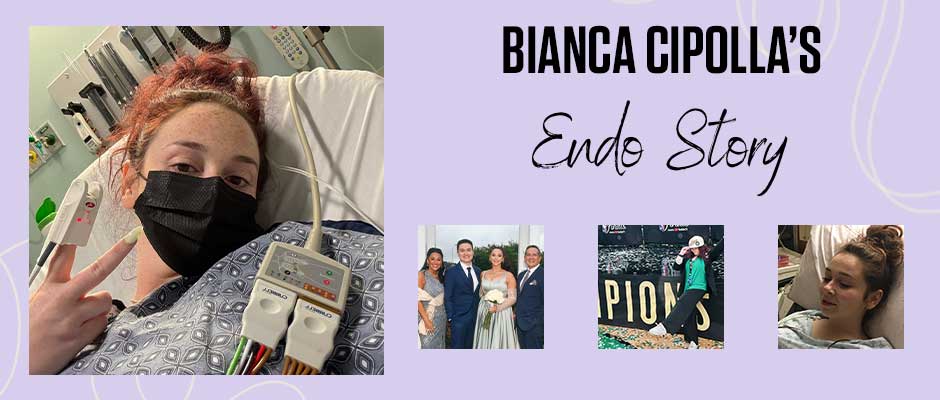
In only her second visit to a gynecologist, just a few months after getting her first period, Bianca Cipolla was told that she may have endometriosis. However, it wasn’t until last year—after 12 years of pain and suffering—that she was officially diagnosed, thanks to the assistance of AI.
“When I decided enough was enough and didn’t know what else to do, I typed my symptoms and everything else that had been going on into ChatGPT, and the very first thing that came up was endometriosis,” Cipolla said. “I remembered that that’s what they told me when I was 14 years old.”
That first period for Cipolla as a young teenager was debilitating. The pain would return for a week at a time with her period every month, causing her to miss school entirely or curl in a ball in the nurse’s office until she could muster the strength to return to class.
“My first gynecologist was at the same practice my mom went to. They did imaging and said everything looked normal, but to let them know if it continued,” Cipolla said. “After a few months, when nothing was getting better, I went back and they said, ‘It sounds like you have endometriosis, so we’ll treat it as such,’ which to them was continuous birth control. As a 14-year-old who knew nothing and trusted my OBGYN, I said, ‘Okay, sounds good.’”
While the birth control suppressed her periods and reduced the pelvic pain to a somewhat manageable level, other symptoms arose, including severe headaches and daily back pain.
“I went to neurologists, physical therapists, orthopedists—they diagnosed me with everything,” Cipolla said. “They would say, ‘You have chronic migraines. Take this medication for it,’ or “Oh, you’re double-jointed. Do this physical therapy and take some Advil.’ It was appointments and pills and one thing after another throughout high school.”
When Cipolla started college, the effectiveness of the birth control weakened. Consequently, she began experiencing heavy bleeding each month and pain that felt as if her appendix had burst.
“That’s when the ER visits started,” Cipolla said. “It was breakthrough bleeding, debilitating pain, and throwing up from the pain, and every single time was the same thing—ultrasounds, CT scans, HIDA scans (for her gallbladder). I was kept overnight or for a few days and was always told everything was normal. I stayed on the birth control and nothing got better. That went on all through college.”
In 2021, a year after graduating—summa cum laude, no less, despite her continual medical issues—Cipolla experienced a new symptom: pain when eating.
“I had a really bad episode where now everything I ate was bothering me,” Cipolla said. “I couldn’t eat without pain and cramping. I ended up in the hospital for three days to get all types of testing done, and they said I should see a GI doctor. I said, ‘Well, how about the bleeding I’m having?’ They said, ‘Breakthrough bleeding can still happen on continuous birth control, and that lines up with your cramps,’ and they sent me on my way.”
The GI doctor did a colonoscopy, endoscopy, and an ultrasound of Cipolla’s stomach. He concluded that she may have IBS and put her on several medications, including one that caused rapid weight gain. Cipolla held out hope for four more years that something would eventually change, but her symptoms only worsened. She had the worst three months of her life last spring.
“From March until May, the bleeding was every day. Before that, when I bled, it was a week max, but this was every single day. And the pain was so unbearable that I couldn’t keep any food down at all. Even water made me nauseous.”
During those three months, Cipolla made five visits to the ER, two to urgent care, one to her primary care physician, two to her OBGYN, and two to her GI doctor. She was tested for more issues than she can recall, and all came back negative. Doctors suggested her problem could be anything from urinary tract infections to anxiety.
“At my last ER visit, they said they thought I had a pelvic infection, even though tests didn’t say that,” Cipolla said. “They gave me an injection, and I had a horrible reaction to it.”
That’s when she turned to ChatGPT and was convinced that she had endometriosis. She took her opinion to her gynecologist, a different one than the one who prescribed birth control when she was 14.
“She agreed that birth control is how endometriosis is treated and that since I’d been on the same one for a while, I should try a new one,” Cipolla said. “I told her I didn’t want to do that and asked if there was anything else we could do. She said, ‘We could do a diagnostic laparoscopic surgery, but I highly doubt you have endometriosis given your symptoms and how sudden they seem.’”
Cipolla left without surgery, continued her research, and found an endometriosis support group on Facebook. The members encouraged her to see an endometriosis specialist. Cipolla did in May.
“The day I went in for my appointment is the day my body just gave up,” Cipolla said. “I couldn’t walk anymore. They had to get a wheelchair to get me into her office.”
The specialist believed, just looking at Cipolla, that she had endometriosis and wanted to get her healthier before doing surgery. She prescribed Cipolla medication to stop the bleeding and got her to a point where she could eat and drink consistently without issues. Cipolla finally had surgery in January of this year.
“The endo had spread to several areas, including my bowels and bladder, and she also found adenomyosis and pelvic congestion syndrome,” Cipolla said. “The endometriosis was only stage II, but I’ve learned that the stage doesn’t necessarily correlate with the pain. With the adenomyosis and PCS on top of the endo, it was three layers of pain.”
Cipolla still has some pain and cramping and knows she may experience flare-ups, but she said she feels much better as she continues her recovery. As a premium sales representative at TD Garden for the NBA’s Boston Celtics and NHL’s Boston Bruins for the past two years, she had to take sick days monthly before surgery due to the pain, missed all of February following surgery, and has been working remotely this month, but she expects to return on site by the end of the month. While nursing herself back to good physical health is a priority, her mental health is equally critical.
“Last summer and into the fall, there was a really long stretch where my mental health was in shambles,” Cipolla said. “When [the specialist] said, ‘Yes, I believe you have endo, we’re going to do surgery, and you’re going to be okay,’ I was trying to believe and trust her. But being told since I was 14 by every doctor under the sun that everything looked normal and that it could even be anxiety, it was like I was living in an alternate universe. I wasn’t trusting anything or anyone anymore.”
Part of her mental recovery has involved helping others with symptoms.
“I feel like I have a responsibility to tell my story and bring awareness to it. I’ve been spending time just talking to people and telling them to push for answers,” Cipolla said. “As women, we’re often told that we’re dramatic or have anxiety that can cause pain, headaches, or bleeding because our bodies are stressed out. That is, for lack of a better word, bull$%!&. It’s so easy to say all those things rather than figuring out what’s wrong, and that’s just heartbreaking. We’re made to feel like we’re crazy, and that’s not the case. Always trust yourself and advocate for yourself. Pain that causes you to miss school or work is not normal, and when you feel it at that level, you need to speak up and see a specialist.”
*Patient stories submitted to EndoFound.org are the patient's views, not necessarily those of the foundation. All testimonials are from real patients, may not reflect the typical patient’s experience, and are not intended to represent or guarantee that anyone will achieve the same or similar results.