

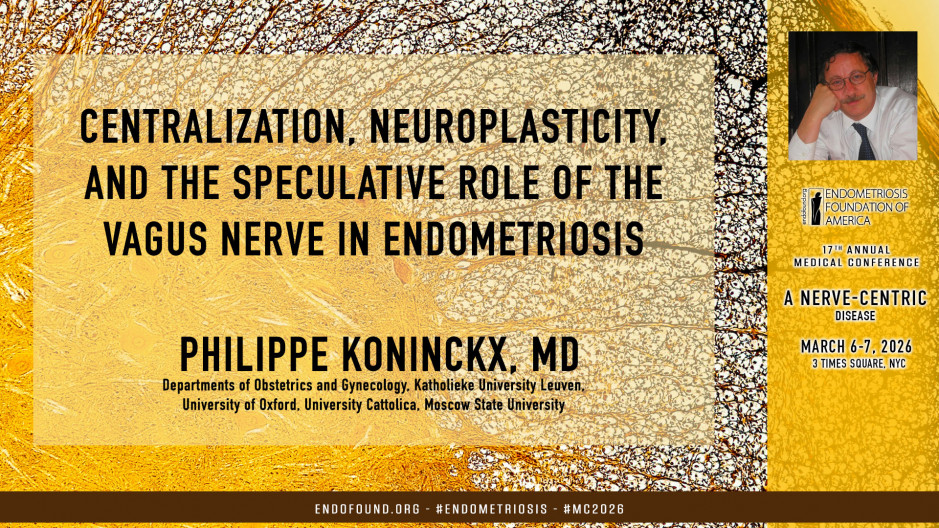
Endometriosis 2026:
A Nerve-centric Disease
Medical Conference - March 6-7, 2026
3 Times Square, New York City
First of all, I have to thank for the invitation. I am really unhappy that I'm not there to talk with, to say hello to my friends, to Dan Martin to Sanway Asia. And Tamer told me, you can be a little bit provocative and that's what I'm going to try to do, to shake the tree a little bit. And to say, as an old clinician, what can I tell to the young researchers? What's wrong within the materials that was already asked today? I would say it in another way. It's after 100 years, we don't know the pathology, the prevention, the therapy. And one of the causes I think is evidence-based medicine, what has been, and then the medicine of the average. I'm going to explain this in a second, going to very quick. Limitation of evidence-based medicine, it's not suited for rare events because the seniors has to be too big.
It's absolutely not suited for multivariate events. And all our clinical decisions to diagnose the surgery are always highly multifactorial, which means for the clinic it's not very useful. And at the end of the day, we have guidelines which are so limited and not very useful. And if they say something, they are yes and no answers instead of being sigmoidal, which is individualized clinical decisions.
We are always looking at the average effect in the average woman, which we know is wrong on average. And to get a long story short, what is oral contraception? In order to have a minimal effective dose in the normal woman, the median woman, you have to have much higher three standard deviations higher and then much higher to be sure. We are doing at this moment a trial in Sicily to say that one eight of a dose is probably more than enough for more than 50%. And that is something what I wrote when I was young in the 70s. Risk of thrombosis with oral contraception are the dangerous pills or are the dangerous women. And I try to repeat this because this is where I would like to go for endometriosis. Experience is missing. And when I gave the presidential talk in Dubai a month ago, I said, "For surgery heuristics, we know much better how to play to train a footballer than to train a surgeon." In fact, it's not really the wild west because we learned from each other.
We share experience and we learn from each other. And then the endometriosis model, we talk about immunology and pain and endometriosis. But in fact, this is a whole concept with the brain and the bone and immunology. And when I, having time at this moment, I look at traditional Chinese medicine, you see that traditional Chinese medicine almost keep it all together, try to have a holistic view. And to cut a long story short, what I'm going to tell about the vagus nerve, for me, it has some resemblance about traditional Chinese medicine. The first thing is, they said it's the old Greek mansainasano, but it start with random. Let us hope that it be like that. But this is something which is all there. We did not understand it very well. And today we begin to understand that we have this kind of thinking with our bowels, the brain connection and the nervous virus.
This is my first conclusion. First of all, all the limitations we have as an endocrinologist, imaging people, scientists, surgeons on. It means that we have a tendency as the only apart. Evidence-based medicine did good things, but is very limited, cannot handle a lot of things, and it's absent for the majority of our decisions in the guidelines. Evidence-based medicine, there's a lot of bad things. There's no best statistics, and they ignore non-evidence-based nodule. Hurristics experience, individualization, holistic thinking. And then what I would say, and this is the second part of the talk, there is so much we know, but we don't want to know. This is the previous position before puberty. Come back to this second, countercurrence and the medium microbiota. The nervous system, premenstal tension, microbiota, mesothelio cells reflects ovulation and compensatory hypertrophy. Too much to tell it all, but just look at the principle.
This is the old idea, ritual mantra and in previous post women, you get implantation and then you get antimetosis more and more severe. Something I really would like to change, it's there before puberty. Very nice. They're beautiful. The most beautiful presentation paper, I know about this. It's coming from Moscow about with all the arguments that is there before puberty. And if it's there before puberty, genetic. At that moment, all the rest is already a consequence. And infertility is a consequence of the predisposition, not of the endometriosis, but therefore certainly associated. Firstly, but if it's mainly a predisposition, if it was there from the beginning, I think we have to look at this in women immediately after puberty or even before puberty. And then it's logical to emphasize prevention, how to modulate epigenetic transmission, how to modulate epigenetic expression. And then maybe I am getting passionated about the nervous vagus and microbiota.
Countercurrent systems, I think most of the surgeons know it, but nobody talks about this. This is the first part effect in uterus. And if you give a treatment in the vagina all day, at 30 years old, you get concentrations in the myomedia, which are 10 to 100 times higher. And I'm just remark from the upper vagina to the porch of Degras, you have three, four, five millimeter. All this is very close. You have a countercurrent system between the ovarian vein and ovarian artery running together for long distances and you get concentrations which are at least 10 times higher. So I ask the question, what is a normal concentration of the uterus? And then you know the premenstrual syndrome. Progesterone is reluctant and hypnotic. It's even in rodents. It's a somnified. If women commit a murder or have a car accident much more before menstruation, you have some progesterone allergia.
And then the strange thing is when you do hysterectomy, it disappears preventional syndrome, but you have a normal cycling ovary. So I'm just thinking, what is this? Is this uterine secretions or is this a nervous vigus? One thing is clear clinically it's only vaginal treatment which is functioning. And then I say, look at deep endometriosis where it's localized in the poetry douglas or close to the bowel. So I have my guess today is that the microbiome of the rectum of the large bowel or the upper vagina, this is causing the genetic epigenetic changes which induce the endometriosis. And then you have the whole study of the peritoneum. Those flat large cells, which by the way, inhibit completely the transmission of gas like CO2 like and all. But I'm just, when you look at these cells, touch them, whatever, a little bit of CO2, within seconds you get a cellular retraction.
And then I ask, is this nervous or is this a cellular retraction? And then within minutes you have acute inflammation and so on. And this is very recent. If you look during menstruation at the reactive protein, it doubles, which means to cut a long story short, if you go from these flat cells, now these cells which are bulging, exposing the basal membrane in between, of course you have more implantation of tumor cells, probably also more endometriosis. Also, this explains what endometriosis is on the right side of the diaphragm and not on the left side. This is one of my hobbies. It's there, the ascending infections and the microbiome. It's on the tail of the sperm cells. They have a lot of bacteria touched, which means stop the sperm cells, stop the stem cells to reach the peritoneal cavity. And we know already you have 50% less ovarian cancer and the materials, it's not proven if this is a prevention of infertility.
And then we have the nervous virus. The nervous viagus, I can be very short. So Vago had a very nice presentation on this, what it does. I like this with the bones. The nervous viagus is brain microbiota and immunology. It's a cluster together. You have the pain in the nose receptor is the activation of nerve receptors. How does it work? There's no answer today. My hypothesis today, it's still the nervous viagus. And then you have reproduction, ovalation, uterine contraction, prevention syndrome, uterine contraction. It's there. It's very important. Poorly studied is a reason for pain and ovalation reflects ovulation. Many mammals are reflects ovulated. The women also, but not always. This I can skip the nervous virus and the inflammatory of anti-inflammatory pathway. Also, the mechanism is, I think I can skip this, but just to shake the tree a little bit, the nerves vagus and breast cancer.
Breast cancer, you see it stimulated more growth, more metastasis with the sympathetic nerve, and the vagal nerve does exactly the opposite. Very nicely demonstrated. And this is driving growth of the breast cancer and you have the return effect. After all, the sympathetic effect is direct, the vagus effect is indirect because of interstinal variant integrity, steroid metabolism, not going to get into the detail, but it's very clear it's multifactorial and maybe stress prevention. Today, it just beginning of what we do. Heart rate reliability, this is for the discussion, but this is a way of monitoring the ratio of the sympaticles and the paracent particles. Ovulation, innovation is very well there. We know that in women with PCO, they have lower nephros virus activity. When you do a varotomy, you induce, you have changes for puberty, you have changes of ovulation. And then this is something I am looking for instances a long time for the varicotomy.
If it's ipsillateral, you have one hour to cut. If on the other side, you have four hours to cut. It means it goes the signal to the brain and comes back. And then you have the loop syndrome. For those who are younger, loof syndrome, everything looks like an ovelation, but it's not there. And the oside remains within the ovary. This was my PhD in 1980. And in Lou syndrome, you do not have the shedding of all these follicular content in the penitenual cavity. And just normally you have concentrations of estrogens and progesterone, which are 100 to 1,000 times higher than in plasma. Very well studied in the early 80s and then forgotten. This is clearly endometriosis and protesterone resistance. If you have in these high concentration progesterone, still a growing endometriosis, they have to be a strong progesterone resistance. This is we coming actual today is that it's associated with having very low doses of contraception.
And my hypothesis today, this is nervous virus. Nervous viagus, again, it's there. The microbiome and the nervous virus is something which I think we begin to know pretty well. The peritoneum in the genital tract, these are things which we begin to understand. I think the group of certain way, the reduced viral vagal tone immigrant altardomyosa, he explained this already this morning, but you have pain reduction of almost everything, osteoarthritis, fibromyalgia and vascular skeletal pain, chronic pain. And what interests me more is the ischemic reperfusion, which means all the adhesion formation after laparoscopic surgery. This is a slide I got from some way where you also have an effect on bleeding. And then nervous virus and pain, we're coming to the end. It's probably contributed to counteracting adaptive plasticity. We know this very well from menopause. When a woman has hot flushes and they give estrogens, the next day she has normal estrogen.
It takes three months before the fleshes go away completely, which means there is some cerebral reorganization plasticity, something that takes time. And my speculation is that we have mainly centralization of pain in endometriosis, because the huge area of the peritoneal cavity, 12 square meters, and the nociceptors which are specific, 90% dormant, how to stimulate the nervous virus, music therapy, non-invasive transollicular simulation, respiratory, hum, and chant, and then meditation, tai chi, all these things. But you see this is something that eastern medicine has known since a long time and don't expect an effect in two weeks. We know from hormone replacement therapy and hot flashes, it takes three months before it's done. The second thing, what I think is important is the microbiota, and I think the microbiota is the reason why the deep endometriosis are close to the bowel or to the vaginal phonics. We know very well that endometriosis is associated with microbiota, which I published out of genetic epigenetic, whether this is bacterium or HPV, that's not important, but infection is important.
Remember this, the nervous viagus, remember what the brain forgot. This is why childhood experience are still effective when you are adults. When I told this to my wife, it's very clear when you have something which is associated with emotion, you remember much better. Memory is tied to emotion, the gut feeling and the nervous virus, and then you can say it's a direct and plastic and ... Okay. The details are not important, only the principle. So I have two conclusions. There's a lot of evidence that the sympaticles never virgins balance affect pain, inflammation, transollicular nephrovirus stimulator reduces pain inflammation, probably also affect biomicrobiota immunology. And it's tempting to speculate that this is the reason why abdominal pain tend to centralize and it's tempting to speculate about microbiota and the pathophysiology of deep endometriosis. Therefore, consider, these are my conclusions, consider predisposition. And if you believe in predisposition, emphasize prevention, and maybe we should have no manceration at all.
There's another discussion whether we should abolish menstruation in all, consider upper vagina for treating the uterus and consider the nervous virus. Keep an open mind, women are complex. And if you have a complaint, always look at the individual woman, stop thinking evidence. And I heard today placebo therapy, but if the placebo therapy means that the nervosagus becomes activated, then it's a good therapy. I have seen with trials, double blind placehebo controlled in placebo, women who needed for pain. Infection with morphine were almost completely normal. So I think the nervous vagus, we begin to understand a few things, but it's going to be very important. Just to finish, this is something which we are doing at this moment. Dr. Senwego, who is there, if you would like to contribute to this. Thank you for listening.