

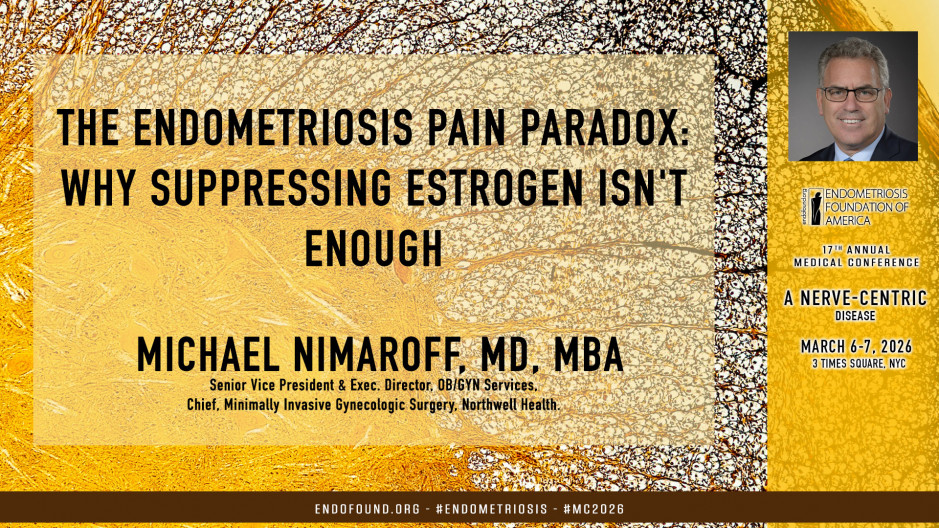
Endometriosis 2026:
A Nerve-centric Disease
Medical Conference - March 6-7, 2026
3 Times Square, New York City
First of all, thank you for the invitation this morning. Dr. Setchkin and Endometriosis Foundation and Dr. Martin, always an amazing program. My talk's going to be, I'm going to say a little bit for more for the clinicians, the practicing surgeons. And just clearly, it's interesting, and I've always thought, and again, when you prepare a lecture, it's always great because you always learn and hear, it just reminds me how complicated endometriosis is and endometriosis treatment is, and actually why there's not one approach. I don't believe we'll ever have one approach to treating our patients with endometriosis because there's just varying symptoms, varying pathology. Obviously the ages of our patients are different. So it's certainly very complicated and that's why we need this meeting is so great.
My disclosures are not related to the talk. And what we want to just try to ... I'm going to go through this quickly. I think the slides, is everyone getting the slides? So I'm going to go through a lot of these quickly because of the time. But I think it's really interesting how estrogen suppression, although obviously we think obviously one of the main theories is obviously this is related. It's certainly related to obviously retrograde menstruation and hormonal stimulation, but why estrogen suppression alone often fails. Identify some immunologic, and again, you had some, I think, some really interesting talks, I'm sure, this morning that covered some of this. But looking at some of the emerging therapies and looking at patients, and I always say this about many conditions, but specifically with endo, it's all about really personalization, individualizing the treatment for the patient based on their symptoms and their findings.
But again, as the paradox talk about is really that so many patients who experience really fail hormonal suppression. It does still work in many cases, but it often fails, even fails after BSO in some patients. And after GnRH agonist/antagonists, it can also fail at times. And certainly there's recurrence rates after surgery and no consistent correlation with the disease stage. So it's really interesting. So if it's an estrogen-dependent disease, why doesn't removing estrogen necessarily work? Why doesn't surgery always work?
Obviously there's some good reasons why I think we can understand why this is true. So endometriotic lesions express estrogen receptors and actually have their own aromatases, overexpressed endometriotic lesions. And so even without ... It explains potentially why even without ... We remove stimulation, but the lesions themselves still can produce its own estrogen, some of the effects of that. But suppressing intros in lesions, atrophy, pain resolves. It just doesn't always work. But certainly our arsenal, so much of our therapies, and certainly even post-surgery, are involved with hormonal suppression, obviously whether it's birth control pills, progesterones, GNRH agonists now, and GNRH antagonists and aromatase inhibitors, et cetera. And so the traditional model, and again, it's always just as a reminder, because again, truthfully, not being the scientists in this area, but how estrogen actually stimulates and helps, and the whole local estrogen production actually recruits macrophages. There's that whole part of the whole immunologic spectrum of what goes on in lesions and actually causes some of the growth and stimulation of the nerve endings and increased nerve supply to those areas and to the lesion is probably part of the reason why there's such increased incidence of pain.
Again, we already talked about what the hormonal suppression, the original current treatment regimens are, and it all aim to systemic or local estrogen treatment to suppress exposure, but it just, again, just doesn't completely work, and certainly a high failure rate. Not that it's wrong. And it's obviously, again, it's often first line, but explains the paralocal estrogen production can be targeted with aromatase inhibitors, et cetera, but yet pain still can persist and does persist. So moving on, what about progesterone resistance too? And this gets another factor, but certainly in endometriotic lesions, you see increasing ... There's progesterone resistance and what that leading to, which again, it's leading to, again, increase in overall in that whole immune response, and then going down that same cycle of this really being potentially more immune modulated rather than just that local destruction and potentially why again, we continue to have pain despite hormone suppression.
Again, just not going to go in detail on any of these, but again, just again, looking both at the estrogen receptors and progesterone resistance compared to normal endometrium and endometriotic lesions, and again, this is the scientists that all cover, look at this. But again, progesterone receptors are deficient progesterone B receptors, and that is actually the act of form. So they're deficient in endometriotic lesions. And this is, again, why, again, the hormonal environment and lesions is far more complex than just simple, just about estrogen excess. So no consistent correlation between pain and severity. The stage of disease, even early stage disease can cause debilitating pain. Peritoneal lesions, color activity doesn't reliably predict pain. Even DIE correlates better with pain, but lesions and volume still poorly predicts both the intensity of pain. So if estrogen drives lesion growth and lesion growth drives pain, it should exist that suppressing the hormonal suppression should work, but again, at times it doesn't.
So beyond endometriosis, and we get to even talking about even surgery, so we have the estrogen-driven proliferation. There's peripheral neurogenesis, neuronogenesis, neuroinflammation, immune dysfunction, fibrosis, peripheral sensitization, central sensitization, cross organsation. And we know, obviously, and there's this psycho neuroimmune dysregulation. Again, certainly there's a whole another pathway for why patients suffer pain despite the therapies that we are undertaking. So again, definitely with this disease, there's just not one way. If we go through some of this, just really brief, and again, I think some of this has been covered, but we have nerve fiber proliferation of nerve fibers. And again, these nerve fibers persist even after estrogen suppression. So again, understanding why, again, even with suppression, we potentially still have pain. There's anonomic nervous system dysregulation, and again, all this together, the combined conditions do not respond to suppression. So once again, there's also a lot of, let's say, similar symptomatology and we'll say sort of collaboration, but between things like irritable bowel, interstitial cystitis, you name it, pelvic floor dysfunction.
So we obviously see concomitant states in patients who have endometriosis. And again, pain fiber reprogramming and the structural and functional nerve changes aren't immediately reversible with estrogen therapy. And this is, again, the problem. So a lot of the whole immunologic response and the nerve fiber, but pain fibers in particular, proliferation again leads to that state where again, suppression, it's already too late. And then there's this whole inflammatory millu that's causing this cycle. And so obviously it's all about breaking the cycle. And so certainly early intervention is important. And again, thinking about this not just with one way, and again, time's short, but I'll just quickly go through just a couple more. This again, immune cell dysfunction. And again, this sustains lesions and pain, again, even independent of any estrogen proliferation. And then fibrosis, again, another big, big part, obviously, in a subset of patients that fibrosis and this disease causes pain through actually mechanical mechanism independent of estrogen and inversible with hormone therapy.
And certainly when there's more fibrosis, certainly where surgery is likely required to relieve that, the fibrosis and scarring. And again, again, these are important. There's hypersensitivity to pain that develops because of some of the psychiatric comorbidities also that are developed in many patients. So it's a very complex process. So putting it together, it's not all just about, even though it may initiate a lot of this with the whole local estrogen production and endometriotic lesions and progesterone resistance, but it certainly leads over time through these various pathways to a different approach. And again, and why we have to look at how we approach and how we treat patients a little bit different. So it's hormonal, it's anti-inflammatory, it's neuromodulation, it's surgical, there's the needs for physical rehab, psychosocial behavior, so multiple different approaches that we have to have in our own tarium. And it takes obviously a multidisciplinary team to take care of a lot of these patients.
And again, some of the other pharmacologic approaches that we have, and without going into this, but there's obviously so much that's coming down the road that obviously will benefit our patients as well. So just to just finish up so I'm stay on time here. So one last day, why surgery addresses what hormones cannot. Excision and ablation, important for deep infiltrating endometriosis. It removes the fibrotic tissue. But again, even surgery alone also obviously has recurrence. There is recurrence and failure even with surgery at times. So conclusions, future takeaway, the message, it's not simply consequence of estrogen-driven lesion growth, the pain is complex and multiple reasons for the symptomatology. And again, our treatment approach has to be really, really looked at in a multidisciplinary way. And we, fortunately, like I said, we'll have certainly more and more treatment options in the coming years. And I think I'll stop there, but really, thanks very much.