

Patient Day 2026
Mapping Pain: Pelvis to Brain
March 7-8, 2026
3 Times Square, New York City
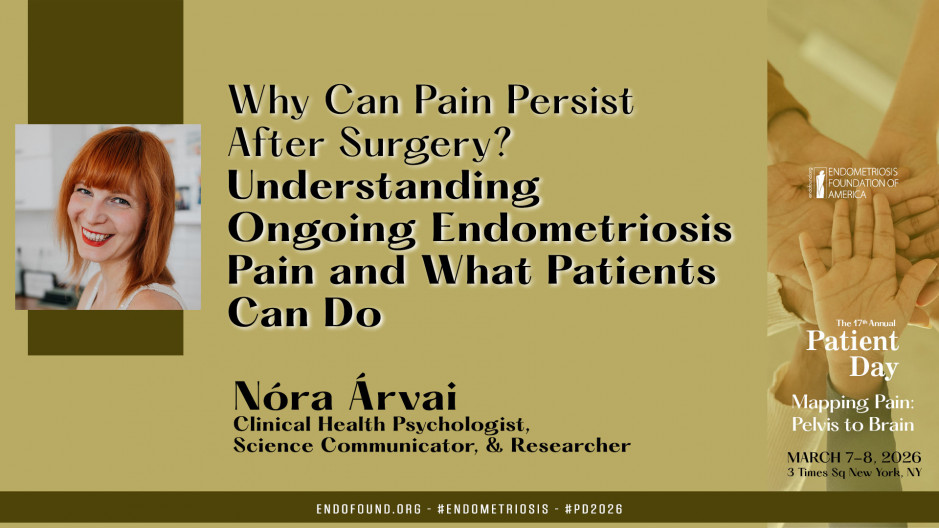
Hi, thank you for being here. I'm so excited to be able to share my thoughts and some scientific evidence about this important topic. And I'm really sure that this will help many women living with endometriosis. So before we dive deeper, I would like to share a story with all of you. It's about a woman and I think you all know her. She is in her early 30s and for years she is living with severe pain. She's going from doctor to doctor. Sometimes the labor come back completely negative. Everything is fine. Imaging is fine. So finally, after all these years, she's going to a specialist and have a diagnosis eventually, endometriosis. So this demon finally has a name. So now we know what we are facing. And because the specialist talking about surgery, finally she feels hope for the first time since all that years. Because surgery can means end of suffering, end of pain.
What happens? When she undergoes surgery, she undergoes the hospital stay. She undergoes all that days when she can't work. She prepares emotionally, she prepares mentally. And after the surgery, the doctor seems to be very satisfied. She's very satisfied with the procedure. She said everything went well. There is no residue, no endometriosis anymore. So what happens when the pain still persists? So Caroline already introduced me, but I would like to talk about my background because it can be important. Actually, why I started to learn and research this topic, ongoing endometriosis pain after surgery. My background is clinical health psychology. So it means that this is a clinical health psychologist is kind of like crazy creatures. They're working in hospitals and clinics, and they are working and helping both chronically ill women, mostly with endometriosis in my case, and also with the medical team who are helping these women.
So what is really interesting is that how it's possible that patients and doctors who have the same and common shared goal, patients just want to feel better and just want to feel like healed and doctors just want to heal them. How communication between these two parties can fall short. So actually, we all know the reasons. I don't want to delve deep into that, but a clinical health psychologist is like a bridge, a translator between through these two parties. And I remember I was still a young clinical health psychologist when I find myself between a doctor and a patient. And the patient was literally crying and she told to me, "Nora, he doesn't take me seriously. I have deliberating pain. I'm six months after surgery." He said everything went well. He said he removed all the endometrial dis lesions, no residue, no complications.
He went ahead. He asked for new images, new scan, new MRI. Everything came back perfectly. So the doctor kind of upset because the patient is crying, but the doctor also feels like, "You don't believe me. So you think I made a mistake here?" It's kind of like you can think like it's ego, but it's not. Because remember, this doctor really compassionate about healing and he feels absolutely upset about that he wasn't able to help. He wanted to help. So I'm between these two disappointed parties and I'm trying to translate between them that both can be right. I try to make them remember that they are not enemies. Sometimes they are laughing at my silly techniques because at this point we were literally watching the video of her operation like moment by moment. And the doctor explained, "Look, before surgery, there was endometriosis. After surgery, look, there is no endometriosis.
So your pain cannot be real. And here I stop him. Please don't remove the patient from the expert status. She is the expert of her body. If she experiences pain, you can't remove her reality. Pain is pain. Whatever the reason, maybe we don't know the reason at this point, but pain is pain and has a real effect on her life." In this mood, I had to make them remember that they are not enemies. And actually, I remember I was still really a youngster. I made them imagine a golden bubble and I invited them both to step inside that golden bubble to remember that they are a team. There is no healing without doctor and patient being a team.
These are the topics what we will cover today. I was kind of a bit generous with all these topics, so I will be shorter on some than the other, but I really wanted to talk about what kind of type, what a pain type, pain phenotype exists in endometriosis and why patient can be very different. And how many patient individuals, it's how many experiences of pain. It can be a very complex spectrum. So you can read all that. There is somatic, visceral and neuropathic pain. And what we will focus about today, it's neuropathic pain because this is the pain kind of phenotype, which doesn't really react to traditional painkiller techniques. So pain is a complex experience. Here you see ridden the biology of it, but pain also is emotions. So what you feel about that pain, and also it's a cognitive process. So what you think about that pain, how you feel, how much you can control it, what do you think about how much it will last and what you can do about it?
It all describe the pain, the individual experience for the woman living with endometriosis. So what recent research can say about endometriosis pain? It's very important that endometriosis is still unfounded and unresearched, unfortunately. I just read yesterday that male boldness is more funded than endometriosis research, and I found it really funny and sad at the same time. So why neuropathic pain is really important? It's because it's not just a rare pain phenotype. We used to think that when we will give a painkiller and after the surgery, pain won't exist. So we remove the tissue, the damaged tissue we remove during the surgery, the endometriosis. So it's very logic that after the surgery, there won't be any pain, right? But even though there will be a bit like because of residue or because of some complications, we will just give some painkiller and everything will be fine.
So many times when women living with endometriosis experience that they still have pain after the technically, medically successful surgery, they hear that from friends and family that maybe it's just all in your head. So you are already healed, so maybe you are just hysteric, maybe you're stressing too much, maybe you are focusing on it too much, like just move on. And the problem is that the more we hear this kind of message from family, friends, and sometimes even from trained medical professionals, the more we teach our nervous system where actually the pain is produced, that we are in danger. We are in danger because nobody believes us. And if nobody believes us, we are completely alone to deal with that pain, that debliating pain.
Why safety is really important? It's because I would like you to ... Yeah, maybe the best metaphor to explain that. Imagine our nervous system where the pain produced like a fire alarm. So when you are in an environment where there are a lot of fires, you try to set that fire alarm really precisely, very sensitively, right? Because you feel you are in danger, you feel that anytime it can be a fire. When you live under these circumstances, every time when there is a fire, you say, "Oh yes, there was a fire, so I was right." So I have to set this fire alarm even more sensitive just to even feel a bit more safe. Our nervous system works exactly the same way. The more we live in an environment where pain can happen, and unfortunately we all know that living with endometriosis means that pain can happen at the beginning, mostly at the time of the period, but later, actually without medical attention, it can be even anytime during the period.
We will set up our nervous system, of course, not intentionally, but we will set up our nervous system to tell us in time that pain will come. So just in order, we are prepared and we can deal with it. Our nervous system has one goal. We are safe or we are in danger. Pain in an evolutionary point of view means danger, danger to our health or danger to our life. Pain means threat around. Okay? So when our nervous system is like a fire alarm set very sensitively, very aware, our nervous system can create a huge answer even to small stimuli. So the more times we experienced pain from endometriosis at the past, the easier we can experience pain in the future, even to smaller stimuli. And actually, I just described central sensitization to you before we get there. This is my kind of red flag.
I always create the presentation and then I never look at it again. I just talk. But I really hope you can find this useful and you can read it. Actually, yes, we won't have time to go over all of it, but I can provide it to the stuff here and you can ask for it. I'm completely fine with that. You're welcome.
So yes, I just prescribed you the nervous system sensitization, and this is one of the main reason why pain can persist even after a medically successful surgery. So I want to emphasize that I'm talking about medically successful surgery. So no complications, no problem during or after the surgery. Okay? That's a different story. We are talking about an ideal situation. We already talked about the previously experienced pain, so how it can lead to sensitized the nervous system, but we have also other reasons why pain can persist after a successful endometriosis surgery. So you know that when you suffer from endometriosis, you don't only experience pain as a symptom. There are a lot of secondary symptoms like chronic fatigue, right? We just learned about that since yesterday, that endometriosis is a full body disease. You can have migraine, you can have IBS, you can have various symptoms, and all that, the same way, if you experience them a long time before, many, many times, your nervous system already learned that it's part of your life.
So it's really hard to get rid of them, right? It's hard to get rid of them even if the main reason it's gone long time ago, because endometriosis is a full body disease. Just to remove the lesions itself, it means that yes, the main reason is removed, but not all the reasons. So this is really important to understand. And another reason why pain can persist, that sometimes patient feel that, okay, I'm just so fed up. I'm going from doctor to doctor, I don't eat this, I don't eat that. I'm following really strict diets. I'm going to the alternative doctors and I'm spending all my time and I'm reorganizing all my life. So everything is about endometriosis. I'm just fed up. I'm preparing to surgery, so I will let the doctor solve it and I just want to have a rest. It's understandable. Really, I'm an endometriosis patient myself too, so I've been there, done that.
It's not to blame anyone. It's just to mention another reason why pain can persist because at this point, after the surgery, we feel like, okay, so I just want to have a rest. I just want to eat that cake. And I didn't eat that cake. I didn't eat diarrhea. I didn't eat sugar since months or years. So your body is not used to digest that anymore. So imagine if you start to eat that because now you can. Of course, your body don't know how to deal with that. This is another reason of pain. And the problem is that the more reason of pain, the more source of pain we collect, again, it's easier to stuck with that pain even after a medically successful surgery. And the last reason it seems to be less important, but it's not. And especially as a clinical health psychologist, I have to emphasize that this is another real reason.
So just because I mentioned it the last, it doesn't mean that it's not important as much as the others. Medical procedures, the diagnosis, even after years of running from doctor to doctor, hospitalization, anesthesia, talking about disease with family, friends, and colleagues, it can be a trauma. It can be a trauma even if everything goes well. And imagine, for example, if you have kind of like a boss who likes to put pressure on you, so you have to think about to go back to work as soon as possible, you start to stress about that. Or maybe the medical team, your doctor had a bad day that day and he said something he shouldn't say. It can be a medical trauma also. It's proven that medical trauma can lead to worse treatment outcome. Okay? So this is really important also. So now actually we understand now how pain can persist after medically successful surgery.
We learn about all the reason. Now I want to briefly explain to you what you can do as a patient to not to have to face this difficulty. First of all, I would like you to understand that if you experience pain after surgery, it doesn't necessarily means that something is wrong, okay? Because imagine that your body had to deal with endometriosis maybe for months or mostly for years. So just because they removed the lesions, these lesions meant internal breathing, even if it sounds really bad, it meant blood in places where there shouldn't be blood. So it created in the environment, in all those tissues, serious inflammation. Inflammation won't go away in a blink of an eye just because in dermatriosis it's not there anymore. So the inflammation can persist for one to three months. It's very various how long it can persist, but it can persist.
So a bit of pain still can be there after the medically successful surgery. And if patient understand this and they have realistic expectations, they won't stress about that pain. And here is where we've been. If they don't stress about the discomfort after the successful surgery, we have better chances that this pain will go away and we won't stuck with it. The other possibility, what you can do as a patient not to have to face this difficulty, if you gradually start to go back and do all the activities, what you can do, even if you have a supportive partner, a husband or a friend who wants to help you and who wants to make this tea and wash the dishes and all, as soon as you can do something and you are clear to do something by your medical professionals, you have to go back and do that stuff.
You have to sit up and then you have to wake up and then have to walk just to make your nervous system understand that you are capable, that you are able just to relearn how to be healthy again. This is very important also. It seems to be really easy or really evident, but sometimes we just enjoy that little bit of more attention after all that months of years of suffering. So please don't wake up and do all what you can do as soon as you can do it. And I also want to encourage you to be a so- called empowered patient. It means don't try to be a good patient like the way that you don't want to disappoint your doctor that you still have pain or any kind of symptoms after the surgery. Dare to ask questions, but never forget that you are a team.
Never forget what I mentioned at the beginning, that you have shared a common goal and try to ask all those questions with respect, but ask them. Always ask them and be take an active role in your healing. So you can read some of the questions I suggest to you. Of course, form it in your own words so you don't have to use the exact words what I suggest, but it gives you an understanding what I mean when I encourage you to be an empowered patient. So at this point of this small presentation, the main focus for me today is to give you real and practical methods, how you can relearn to be healthy again after the successful surgery. So it sounds like kind of like spiritual, but it's not. It's really, it's like science. So you can teach your nervous system to feel safe again.
You can teach your fire alarm that he doesn't have to react if somebody smoke a cigarette 10 streets away. Okay. It only has to react and show you that there is danger if there is actual fire. You can teach your nervous system. You can regulate your nervous system with easy somatic experience, somatic exercises like grounding or orientation. We will do that together. It's very important what kind of language you use. So I suggest you not to use even the word pain, like you can use healing noise or anything like that. Try to use a positive, suggestive communication and even easy and really simple breathing techniques can help. So now I would like to invite you to try these methods with me if we still have time. And I also would like to gently suggest that we stop the recording here, the live recording, because these experiences can be a bit intimate or personal.
So I would like, we agreed with Caroline that it stays here with us. Thank you for all the online attendees for the understanding.
Okay. Thank you very much. So what we will do now is please, if you feel like you can close your eyes, but you don't have to. And I would like to invite you to place both of your feet on the ground. This is grounding. I would like to gently invite you to feel how strong you can feel your feet on the ground. You feel supported. And now shift your focus from your feet to your body, to your back, and feel how much you are supported by the chair, how much you are contained. It's like a gentle hug. You can just let your body rest. You can feel your feet on the ground. You can feel the safety of the chair like it's hugging you. I would like to invite you to take a big, deep breath through your nose and exhale through your mouth.
Try to make this exhale as long as you can because when we are in danger or breast is like really short, sometimes it's in the shoulder like we are running from the tiger, right? When we message, when we signal this to our nervous system that our breath is deep and slow, we immediately send a message to the nervous system that we are safe here and now we are safe. And now I would like to gently invite you to open your eyes if you let them rest for a while and really, really slowly, actually a bit annoyingly, slowly, kind of like boringly look around, try to discover this room so slowly like you really want to remember every tiny detail tomorrow. You have to describe somebody how this room looked like, why it's important. This is orientation actually and why it's important all this slowness. It's because when we are in danger, what we would do, if we would be in danger here, we would look like just for an exit, right?
We would like really quickly leave. And when we have the luxury of being this slow and to experience and to connect with our environment that slowly and calmly, it means and it teach to our nervous system that we are safe. And lastly, I would like to invite you to close your eyes again and to imagine a part of your body where last time you experienced a bit of discomfort, you don't have to work with your biggest pain right now, okay? Just a tiny discomfort. I would like that you imagine that you can breathe with this part.
Try to breathe with this part of your body. You can imagine the air like a beautiful golden thread, which is coming to this body part and hugging it and energize it. And when you exhale, you can imagine that you exhale the discomfort itself. You can give a color to this discomfort. For example, I told you that I'm also living with endometriosis. So when I have pain, I imagine like a vivid red color and I exhale it. But when I exhale it, I try to imagine that it's less and less vivid, less and less red. So it makes sense that at the end, it's just a beautiful pink color just to teach and signal my nervous system that there is no pain, there is no discomfort, and there is no danger anymore. Okay. Thank you so much. Thank you so much for joining me in this experience.
And I see that we don't have time anymore. I use all the time. Yeah. I don't know if we have time for questions or just one question. Okay. We have time for one question. Does anyone have a question?
I really love this presentation, so thank you. I guess my question is, are these techniques grounded in the mindfulness practices that are often used also to help with people with high anxiety?
No, it's not a mindfulness. These techniques are grounded in somatic psychotherapy and somatic experiencing. Actually, they are not that far. So as you may sense, there are some, the breathing techniques, for example, they are both used in mindfulness and somatic experiencing. Yeah. Thank you so much for your kind words. And thank you all for joining me here today. I wish you very painless recovery and good health. Thank you so much.
What is our session called? Thank you so much. Fantastic. So Andweni was kicked out of the call.
All right. So thank you all for being here. Again, my name is Carolyn Mayer. I'm program director for community health programming at EndoFound. Our next session will be a little bit different than some of the others today. It's going to be a community-driven listening session. We are looking for your input on some content and a Keystone video that we're looking to create through Empower, which is our flagship endometriosis education program, and to share throughout the foundation or throughout the activities that we do. So this will be very interactive. It'll also be asking a lot of your thoughts and opinions, though we do have some anonymous ways that we're doing that as well. However, that being said, we do not mind if you would like to step out. It's for those who are just really, really interested in sharing their thoughts and experiences input. We want to create the best possible video that we can.
And so we'll get started maybe in a couple minutes. Thank you.