

Patient Day 2026
Mapping Pain: Pelvis to Brain
March 7-8, 2026
3 Times Square, New York City
Good afternoon, everybody. Let's get to watch his. Oh my God. I have a lot of energy, so this might be a lot of energy from me. Some of the most energy that will be ... Okay, let's get into it. There's a lot being spoken about today and I wanted to make sure that we leave this experience as people who understand that we are experts in our bodies. So I want to start by understanding who is in the room. I like when a lot of people ... I'm a performer. I've performed to rooms of one and I've performed to rooms of 10,000. So I already know the difference. There is none. The blessing is that when there's one person, I can see them as well. And when there's 10,000, I have to prepare to be seen by so many hoping that they recognize the details. You know what I'm saying?
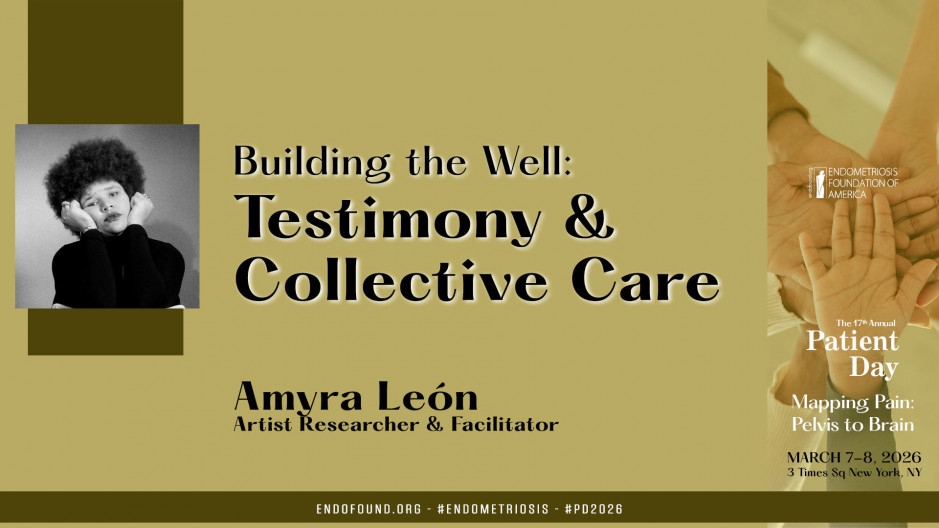
And so in this room, we get to be masters of our own bodies and we get to invite ourselves into the details. I want to know, we got any doctors in the room? Good. No, I'm joking. And we got patients who has endometriosis in this room that they know. Okay. Okay. Okay. And who is anybody a caregiver as well as someone with endometriosis? Okay. And anybody have a caregiver who helps them with their endometriosis journey? Okay. Ooh. Y'all, we're going to start raising our hands a lot more in the coming season. Okay? So my name is Amir Leon. I'm going to close this door because I have significant amount ... No, they will. Ain't that great. My name is Amir Leon. I'm from Harlem. I am going to get into my testimony and all the things, but I think I'll just start so that you're not staring the whole time I speak at this image.
The name of this experience that we're about to go on together is called Building the Well: Testimony and Collective Care. What does that mean? A lot of words going out. Anybody know any information about how a well is made? You dig a hole, right? And what happens when you dig that hole? The water is there. And then what do you got to do? Keep digging. What did you say? Clean up the mess from digging. Okay. You might think this is not important. I'm telling you it is. Okay. And what about testimony? What do you think of when you think of testimony?
Court. What else? Your story. Anything else? Healing. Okay. And community. What do we think about when we think of community? Huh? A group of people together. What else? Support. What else? Love. Okay, that's a good question because what do we think of when we think of love? How would you describe that in this room? Connection, acceptance. Okay. I know there's going to be more moments where ... Look, get ready. I'm pushing buttons here. I'm asking questions. Your responses matter as much as mine, right? Because the truth is I'm a patient. I only have a microphone because I hit up the foundation instead of some things to say. But my invitation here today is to recognize that none of us define the same thing. A well is one of the first ways in which we began to recognize we can gather water beyond the rain. With the rain, we can't capture the sky.
So it's about how many vessels you got or how big your vessel is to receive water. But something about building a well is really empowering because it says that the land on which I'm standing on, there very well may be water beneath my feet. And so if there's a drought of information coming from my environment, but on the land on which I stand on, and in this case, my body, there is a well of information beneath my feet. And if I have moments where endometriosis makes it so that I cannot stand, right? So in that case, it becomes that, ooh, there may just be water beneath my knees or water beneath my hip or water beneath my body. You get me. And so while we're waiting for science to catch up with us and for funding to catch up with us and for our doctors to believe us and for our families to trust us as stewards of our own body and believe us and for lovers to believe us or to leave us, we have to allow ourselves to recognize that I am the well of information I've been waiting for.
And we are in a very important moment with endometriosis, not because of social media, but because we're all being empowered to leave our homes, whether we're comfortable or not, whether we've been diagnosed or not. There is an opportunity right now in this space where we got doctors and patients at the same time. What else do we know about a well? Historically, this is a place where people gather. It's a place where people have to receive something and often where somebody will leave a little bit of information, talk a little shit on your way home. Oh, what'd you hear at the well today? We got some different ... Now they call it the water cooler. Okay? Some of y'all go to the office and somebody had to bring in the big jug in the beginning of the month to make sure that everybody had water. But in historically, we would've gone and collected our water.
And that's, I think, what the issue is right now with endometriosis is that there's a lot of water. I can turn on my faucet and I see water running out right away and I don't know that there's lead in it, but I'm going to trust that water because the faucet gave it to me. It gave me water, right? Again, it rains. For me, I think about a good doctor is like, ooh, when the rain comes and actually brings the water out, brings the plant ... When the plant finally comes to blossom right after, the likelihood of catching a good doctor in your bowl when you go to collect the rain is very, very, very, very, very unlikely. But the opportunity to understand yourself begins each and every day that you are occupying your body. And so I want us to become the best stewards of our body so that we might be able to become the best stewards of how information about this disease is passed through our communities in passing, not just, "Oh my God, we're all sitting here in a room talking about endometriosis and I know the doctors are a few feet away.
I'm going to go ask a doctor a question today. That's what I came here for. " Beyond that, what happens? How many of you were diagnosed within the first year of having pain?
Two to five years of having pain. So we got three people, five to 10 years of having pain. So we got two people for two to five. We got eight people for five to 10, 10 to 15 years, two, three, four. Okay. So we got four with 10 to 15, and now we going 15 to 20. Okay. And we got three there. What does that do for us? That means that if we stood in a circle, we would have different ages of diagnosis. We'd have different ages in which our pain began. We'd have different awareness of what physiologically might have been happening in my body. When I was 14 versus when I'm 34, very different things happening in my body, which means there's very different things I can offset the pain towards. You're 14. Well, you should have been playing that much sports or you shouldn't have been eating all that candy or you shouldn't.
Now I'm an adult and I'm eating right and I'm doing my thing. Okay. Now what are you offsetting it to? At each age, we're able to offset these symptoms, which means at each age we need to be encouraging each other to speak about what we are experiencing. You understand? And so right now, there are many ways to get water. You can turn on the faucet. You can go down the street. You can buy a bottle of water, which I don't recommend the one sitting in plastic all this time. God bless us. That is what's mostly available, but that energy of what then contaminates the water while we're waiting for it, okay? And what contaminates our opportunity to understand ourselves is usually the interruption of being able to express our reality. That makes sense? You with me? Okay. So this image here, which is a series of images, as you can see, I got diagnosed with endometriosis two years ago, but I'm a touring musician.
I was having seizures on stage. I was doing 200 plus shows a year and having seizures on stage maybe 50% of the time. And I didn't care. My band, they were trained to keep playing. If I have a seizure, the last thing we need is an audience to start frantic anything. So my band knew my symptoms. If I sat down or I turned around towards them, they knew. Play until I walk off stage. Play until the stage manager comes to get me. All of my strategies were around the illness instead of wellness. And so my question to y'all is, what does wellness mean to you?
For real question, not rhetorical. When you think of wellness, what do you think of? Optimum wellbeing. Mental, physical, spiritual wellbeing. What does well mean in that circumstance for you? So a holistic experience of what? Because it's still wellbeing. So being what? Okay. Health is a part of well ... You get what I'm saying? We got to keep sitting with ourselves because we'll go to the wellness center and leave sicker than we walked in because we don't know what wellness is for ourself. What is wellness? Okay. So waking up and knowing I have this, it's in my control. So that's a level of control over what's happening, whether it's disease or environmental.
Okay. Yes. And do you believe that it's possible to be sick and well at the same time? Yes. Good news. That's good news. And do you think it's possible to be well and sick at the same time? Okay. No, people are like, "Wait, didn't..." It was a trick question. But it also, for some of us, it's the way that our minds work. Do I think of myself as ill first or seeking wellness? Always. You get me. And so, okay. So if we understand that wellness, when I think about building the well, it's two different things for me. I'm a poet. So I like to think of how language can be used in different ways, which is why I'm asking you a lot about how language operates with you because one of my favorite ways of looking at how language can be a misfire is I love you, but I love you to somebody who was raised in an incredibly violent situation might look like violence being enacted.
So love to them is harsh and requires certain criteria. But if you're surrounded by somebody who's raised in an environment, can't say a loving environment because that's different between all of us, but raised in an environment where they had what they needed to eat and they had what they needed to be dressed and what to be warm, then when you say, "I love you, " to them, it's a different thing. You put those two people in a room and they never ask what the definition is. You have one person throwing punches and the other person offering everything that they have. You get me. And so how do we allow ourselves to say, "Let me define what this is for myself." And so after all these definitions, anybody want to tell me what endometriosis is?
Full body disease, what up? Debilitating disease. It's powerful. It can put you into menopause quicker. Mysterious. Ooh, the death of your birth journey. Oh, I was like, "My God, today, sis." Okay. No, but we're talking about it. You said death and rebirth journey for those in the chat. Death and rebirth journey. Absolutely. Okay. I'm not going to be the person to give us a definition of endometriosis, but I think the thing that we're all finding out here is that you can age out of the definition you were raised on, age out of the definition you were given a diagnosis. You can absolutely not have at all the debilitating pain or the death that comes with endometriosis and still have it. And so what we're learning is that the definition requires us to continue talking to each other about what it is, not just with scientists, but amongst each other.
And so my hope is that when I think about building the well, this journey here, all these images were taken for myself. I'm an artist. I already do all those things. I make music videos. I tour the world. I write books and plays. And so I already know about the power of what a story can do. But for me, when I finally got the word endometriosis, I Googled it and there was a bunch of stuff coming up. And I was like, "So you're telling me I've never even heard the word? What do you mean?" I was like, "I'm an adult. I've been fucking how long? Okay. You told me all about the condoms and the bananas, but you didn't tell me that endometriosis was a thing that I should keep my eyes open for. " You know what I'm saying? I felt like I was like, somebody tricked me a long time ago into not continuing to research my own health.
And so how do we make sure that the trick don't happen after we get diagnosed? How do we make sure that we don't have to make people in our communities wait for a diagnosis to be believed? Because it happens. It still happens with ... I've been diagnosed and now it's like, "Oh, well, I've had four surgeries and you've had three and well, okay, let's all relax. Nobody's is more extreme or we can't have a conversation about what the extremity means in our community as patients until we understand that we have to be patient with one another to really understand what this disease is and how we move forward collectively." And so I made these images. I was really unwell. They told me that the surgery would last two weeks, that after I had my laparoscopy, it would take two weeks to be healed. It took me seven months.
I could not function at all. I was bleeding everywhere still. I was so unwell that I took my little, my ass. I went to Brazil and I said, "I need to go find out if a different environment will allow me to be unwell in a better way because New York's not it. When I can't walk, I can't take the train, wasted all my money on these car apps." After all of the medical bills, all my money was on Uber. And then so it was like, okay, and I have no access to fresh water. So I also can only experience chlorine, shower water, these moments where I don't ever get to experience my body in a weightless way. And so I figured I didn't know how to swim yet, but I was like, "Where can I go where I can be weightless and just bleed too much and not exist as too much for the people in my life?" And so I went there and I was still unwell, but I swam every day or I floated every day until I learned how to swim.
And what I realized was that I needed to grieve the part of me that did not know that there was something growing inside of me, even though I knew it. So I knew it, but they didn't believe me for 20 years. So then I had to grieve that. And I was like, "How can I grieve that? " I'm like, "I still look the same. I got this whole surgery and if I don't lift up my shirt, you don't see nothing because if you look into my house, you'll still see blood everywhere. So how do I reconcile this? " And the death and the rebirth is what I said. How can I do this for myself viscerally? And so as you can see, I decided that I had to shave my head. This is two years ago, so I'm back. I'm back, I'm back. No, but it was this moment of like, as a black girl, I've never cut my hair.
I was very protective of my hair, but I also realized how much violence existed in my hair and how many times when I was having seizures, the doctors wouldn't place the EKG, the electrodes on my head, they would be like, "Ugh, we got to really just try and put it anywhere that we can. " And I'm like, "Should I shave my head for this test? Are you sure you're going to get it? Oh, you probably don't have epilepsy anyway." The nonchalance, but also the violence of is my hair getting in the way of me getting the care that I need because this is a little ... And so then when I wanted to shave my head to have this moment so I could just see myself as a different person after surgery, it was like, am I doing this because they're not willing to work with me?
Am I doing this to have an easier time when I go back to the hospital when I get home? Or am I doing this because I really have to actually see someone new in me?
And so the entire project came together for me. This is the first time actually anybody's seen it in person. I took these images two years ago. As an artist, people were like, "Why would you hold onto all this? Oh my God." But as a person, this was made for me to testify to myself. How can I testify to me that this is what I was going through? I don't just need other people to believe me anymore. I need to reconcile that I believe it, that this is a disease that I can live with that won't demand of me a certain death or a certain way of imagining, but also it's something that I, for myself, I needed the blood to be seen. So many people didn't believe how much blood I was losing and because I was a black or I was denied transfusions multiple times, they were like, "You're not light enough.
You would be lighter. You would be more pale if you were losing as much blood as you think you are. " Okay, let's collect it then. It's like, "What do you want me to do? " And so the point is, is that I became the well for myself. After I got the diagnosis, I started looking up absolutely everything, but it wasn't impressive. A lot of the things didn't make sense to me. So I started asking myself, what are my symptoms? What symptoms have been made into different things? We got a bunch of people in here who has endometriosis. Can we call out some symptoms? What symptoms did you have?
So yeast infection before every mensis. Okay. Vomiting, severe back pain. Pinched sciatic nerve since the age of 11, immobility. Was there a certain leg? The left leg. Fainting. Extreme fatigue. Brain fog, migraines. Flu-like symptoms. Was there anyone in here with everything that you heard who had all of those symptoms? Okay, let's raise our hands high if you had all of those symptoms. Okay. And is there anyone in here who had none of those symptoms? On birth control, you had none of those symptoms. Which birth control, if you don't mind me asking? Which one? Any of them. Okay. So again, it's important that we find out what the overlap is because for me, as a writer, people used to chalk up my symptoms to the way I described them. I used to tell everyone the taste of metal is on my tongue. I feel like I just licked a metal pole, y'all.
And they would be like, "Oh, that's so poetic." And I'm like, "No, every time I drink water, it tastes like I'm licking an iron. I really feel like there's ... What is this taste in my mouth?" And then I woke up from surgery and they gave me a little water. They were like, "Drink some water." And I was like, "Oh, water." I haven't had water in 20 years. It's tasted like I was licking a pole. Okay. So I want to look at something. I think right now what I was trying to ... Hi, everybody. Welcome. Come sit, babe. Let me make sure on time because I talk and I enjoy it. So I got 10 minutes because we started at 2:10. We make it work. We make it work. We make it work. Okay. So, okay, you get it. All about me. 20 years, finally got diagnosed.
I had to run to the ocean to figure things out. I highly recommend floating. Highly recommend learning how to swim if you don't know how to swim. That's been the best thing in the world for me. But this idea of building a well together, okay, to build a well, we need our details, right? The soil, like I said, the soil that we are standing on right now is fertile ground to build this well. Our friend earlier said to build a well, you got to dig a hole. With endometriosis right now, with other diseases, we can go get our bucket and walk over and get some water from the well right away. It's already made. It's built. There's people gathered there having conversations. They even left it undetended. For endometriosis, we're standing on fertile ground to build a well. And so it's actually imperative that we start digging here wherever it is that we are.
So for me, it was about me recognizing I needed to see my own reflection differently. I had to get really acquainted with things that they wrote off and say, "That was a symptom, that's a symptom, that's still a symptom. This is a symptom and really honor what that is. " But then the second I was able to perform again, every single show that I perform at, I mentioned endometriosis, who knows this word? Here's some of my symptoms. And I kept mentioning the taste of metal on my tongue, the taste of metal on my tongue, the taste of metal on my tongue. From saying the taste of metal on my tongue, six people in my life were diagnosed in two months. They had surgery within three months. We had a hysterectomy, a spleen removal, an ovary removal, all people that I knew, that I love, that I toured with, that I live around the corner from.
So in my own community, through me talking about my specific symptoms, not trying to adhere to any other definition, my specific symptoms, six people in my own life were diagnosed with the same disease at varying stages. And so what I want us to be empowered to do is to know that research, we're not just looking for funding for research, but we're also not foolish to be exhausted in this moment. We got $26 million in funding last year and maybe 28 million this year, and we're at the beginning of the year. And that might sound like a lot. There's a Congresswoman petitioning to get 50 million to move forward, right? And it's like, "Oh, we've got to get 50 million." And that comes from a space of scarcity. Endometriosis does not need $50 million a year to move forward. We need a billion dollars in funding to move forward a year annually.
And that sounds crazy to us because we know that this disease doesn't have any funding, but we can look at ... And I don't have a lot of time, so I'm going to condense this part. I got too excited asking y'all questions. But the thing that's really important to know is that this disease is in a right position for us to make sure that as patients, we become the stewards of our own information, that we become able to be confident in what we do know about ourselves. No one can describe who you are or how this disease lives in you better than you can. Whenever I'm going to get a scan, I always tell myself, they're going to show me what I already know. They're going to show me what's already true. I get to decide how long it stays that way when I get my MRIs or when I get my anything, right?
And so really quick, we can look at how many people here know who Larry Kramer is. Larry Kramer was an amazing activist and playwright who started ACT UP. How many people know what ACT UP is? ACT UP was an incredibly successful and is an incredibly successful activist group of artists, thinkers, researchers, and mostly patients who have HIV and AIDS. And it cataclized funding radically. In 1981, AIDS first hit the scene, not really first, but that's when it was reported. And then there was no funding. 1982, there was $3 million of funding from zero the very next year. 1983, there was $21 million in funding, which is where we are decades into having endometriosis be more explored. We're only in our 20s in the millions of funding. But then by 1988, there was $700 million in funding for AIDS annually. And that was because artists came together, patients came together.
There was plays on Broadway at the same time as there was commercials on TV, at the same time as there was teachers in school talking about this. At the same time, there was all of these conferences happening, but it went from zero to 20 to 700 million. And today as of 2025, there was three billion from the US alone put into funding for AIDS research and not just research. They recognized really early in the AIDS epidemic that sustainability and staying alive was as important as researching the disease that was killing everyone. And so I just want y'all to understand that where we are standing right now, where you are sitting right now is the perfect place to dig a well. Your information, your reality, your symptoms. We can Google every day, but the definition will change for this disease again and again and again and again.
And so the more that we allow the definition to change, the less we'll rely on the definition to make change. And so I need y'all to fall in love with the reality that, baby, we're still here. We're still here. We still got water in us because it's what we're made of. And so the well is not just where we dig and where we wait for the water to come up, but we got to protect the water that we find there. We got to protect our testimonies. We got to protect our ability to speak for ourselves, and then we got to carry whatever we can. Right now, in this moment, I've had a cane every day this week. I got really strong so I could be here without my cane, not for show, but because I trust my body. Today I could leave it there. And we got to know the difference when we have to leave certain things there so that we can show up in our lives differently.
And so what can we learn from the AIDS epidemic and the creation of ACT UP? It has to happen everywhere. We can't just have scientists talking and we can't just have patients talking in this context. We need to be able to show up in the cafe and see somebody who's rubbing their head and say, "Do you have a migraine? How are you? Are you okay? What you feeling today? Does water help?" Because I passed out at a cafe and when I woke up, a woman asked me, "Are you on birth control?" And it changed my life. Nobody had ever said that that might be the source of me passing out. And so how a testimony in passing can change the life of everyone around us and how the testimony that we have with ourselves, if we allow it to change, will be the very thing that catechizes what's possible around us.
And so I don't have much time. They're going to make me stop. All the people is here now. I wish I could do it all over again, but what I want to invite y'all to remember is let's build the well together. Where you are is what? The perfect place to start digging. Your details is your shovel. The water is when you start sharing your details. You get me and the land is all He's ripe to start this testimony. You don't have to speak like I do. You don't got to have all the words and you don't have to be diagnosed to start talking.
But also, what does talking do to funding? I need us to leave here with a bigger imagination than anyone else is telling us to have. It is abysmal that we only got 26 million. It is my goal that in the next ... I want to see in the next three to five years, I want to see a billion annually. And I know it's possible because I've seen it and we don't have to go too far back. If I can look at the AIDS epidemic and say from 1981 to 1987, we went from zero to 700 million a year, and now we're at three billion a year, not just once. Then I can look at my Congress people and everybody who's around me saying, "We need a couple more million next year and say, Why are we going to go from 26 to 50 when we need to go from 50 to 800 million?
Why are we going to accept that? And why would I even speak like that? And why would I talk to the smartest person in the room and still tell them to think less of what they need to accomplish what we need? We have to get an understanding around the fact that us sharing our details, whether it's one-on-one, online, we have millions of likes online. The Endo Foundation is testament to that. Millions of re-shares, millions of comments. Reddit forum after Reddit form after Reddit form of discovery, and we only got $26 million, but millions of shares. And that's the reminder that we got to take this offline, build our wells in person, build them in your household, even if you're uncomfortable. Talk to your partners, whether they're men, femme presenting or not. Talk to your people. Talk to your best friends. I force my friends to Google endometriosis once a month.
If you love me, go ahead and educate yourself because I can't keep telling you why I can't walk. Look it up. And so again, wherever you are, however you are, you are prepared to speak. If you cannot speak, I invite you to fall in love with the sound of your groaning, the sound of your screaming, the sound of your begging, because sometimes I am left begging my body to come back to me. And so when you fall in love with that sound, you'll slowly start morphing it into language. And again, if you can't speak because of your ability or because of the language, then start painting, start drawing, take a self-portrait, do something so that you might see yourself as the water that you are and the solution that we need. You know how many people have had hysterectomies because they were told the disease would die?
And how we now, because we speak out loud, know that that is not the solution for a disease that builds itself. You get me. And so in our testimonies, we start despairing myths. In our testimonies, we start welcoming people who are afraid. We start welcoming people who might not have the same health insurance. We start welcoming people to dream bigger than us. This is not my body. This is our body. And I promise you, I'm going to see a billion in our funding reserved very soon, but it's only going to happen if we start telling people that asking for change when we need to make it. I can't ask for something that I have to make. You get me. Y'all okay? Y'all here? Are y'all alive? No, but are y'all alive? Okay. Can we just take a deep breath? It's my time. But my name is Amir Leon.
I'm from Harlem. I was diagnosed after 20 years and I'm very grateful to be here and I'm very grateful that we're all alive and I care about your details and I hope you do too. Let's just take a deep breath before we walk out of here. Okay? Let's take a deep breath.
And let's do it two more times. And again. And I'm going to do one more. I'll move the mic. I'm going to invite y'all to scream with me. I'm a singer. I get paid to scream at people for a job. I love it. I do highly recommend. But I'm just going to invite y'all to scream with me even those who are online. I'll take questions and you can email me and all that whenever you want. I'll be around here today and tomorrow so y'all can talk to me. But this next one, I want us to take a nice inhale. Whenever I inhale, especially as someone I've been in the hospital a lot, I'm sure a lot of us have. When I inhale, I remember that my breath is doing something. It goes and it takes what is not supposed to be and it exhale those toxins, right?
And so on our next inhale, I just want to invite us to take whatever we need to let go, the assumptions, the anger, the rage. And I'm going to invite y'all to scream with me. And I'm talking about for real. Don't play me. Don't make me make you do it twice. Okay? But let's take a nice deep breath and scream like you're in the middle of the woods, baby. You can clow your eyes. Nobody cares. I don't. But scream because we have to allow ourselves to release this rage so that we have a vacancy within ourselves for the water that we are collecting. Okay? Are you all ready? You're going to take a nice deep breath first. Don't hurt yourself. Taking a nice deep breath. You ready?