

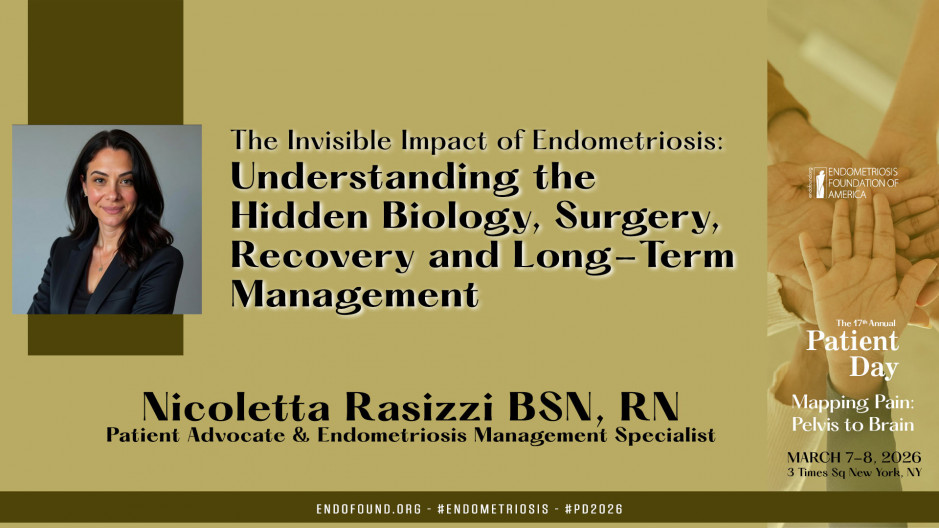
Patient Day 2026
Mapping Pain: Pelvis to Brain
March 7-8, 2026
3 Times Square, New York City
I'm loving this right now. So many people. It's amazing that we're all here and how much I've seen through the years how much the endometriosis foundation has grown. And events like this reminds me of something very important. For a long time, many people living with endometriosis felt like they were navigating this disease alone. But when you walk into a room like this, you realize something so powerful and that is something worth recognizing that we're not alone. I would like to also express my sincere gratitude to Dr. Setchkin and the Endometriosis Foundation, which continues to create spaces like this where patients, advocates, providers, researchers, scientists can all come together. Over the years, we have watched this movement grow from small conversations about misunderstood disease into an effort focused on awareness, research, and education for patients.
Sorry. This kind of progress happens because people are willing to advocate, speak up, and we want to push medicine forward. I wear two hats. I am a registered nurse and also someone who has lived with this disease for almost 40 years. I feel old when I say that out loud. I didn't learn about this disease from a textbook. I learned it from living it. From missing school, pushing through work days while my body was screaming. From being told this is normal, when I knew it wasn't. I have had five surgeries due to endometriosis. Some recoveries were smooth, some were not. After one of my surgeries, I had to live with a colostomy for about four months.
And what shocked me the most wasn't the physical recovery because I had to go through what I had to go through. It was the silence after the surgical procedure. There was no roadmap, no guidance what to eat, when to eat, how to calm my gut, how to rebuild strength, how to support my immune system, and how to stabilize my nervous systems and emotion. I had to start figuring out many of those things on my own. I had to learn that recovery wasn't just about pelvic area. It was about my entire body. And that's when I realized something critical then, that it wasn't just a painful period.
What it is, as we've been speaking about, is it's an inflammatory, immune-driven, whole body condition. If we only treat what we surgically remove and don't address what years of inflammation has done to the entire system, symptoms can persist or it can return. After my surgeries, I did feel relief, but I also experienced flareups, fatigue, digestive crashes, hormonal swings, and I kept asking myself, "Why is this happening if the lesions are gone?" Then it hit me. Surgery removes disease, but the body still has to recover from years of biological stress. It affects the immune system, nervous system, hormone signaling, gut health, and cellular energy production. That's a lot. That experience changed the way I looked at surgical recovery for endometriosis. That's why symptoms go beyond the pelvis, such as brain fog, mood swings, my poor husband, food sensitivities, inflammation, pain that shifts, and energy that crashes.
It isn't random. It's a body that has been in survival mode for so many years. This is also why proper lab work is important. Not just basic labs, but deeper evaluation. Anemia panels including ferritin because low iron impacts delivery and healing. Vitamin and mineral levels affect mitochondrial energy production. Thyroid panels, hormones, inflammatory markers, and sometimes we even test for viral loads, which help us assess how bad the immune system is when a person's not feeling well. These labs help us understand what's happening on a cellular level. This is because your symptoms are physiological and biological. They're not imaginary. When I didn't have guidance, I started studying my own patterns. I learned how certain foods increased inflammation. The timing of meals mattered to my digestion. That stress could trigger flares. I learned that my nervous system needed calming just as much as my pelvis needed healing.
I had to change how I lived. And not just how I treated my pain. Sorry.
That's the part no one talks enough about. It's ongoing management. And this is the gap where many patients fall into. The surgery may be technically successful. The lesions are removed. The pathology confirms the disease and surgery goes well. But months later, some patients, they still feel exhausted, inflamed, sensitive, digestive symptoms may persist. Sleep may be disrupted. Energy may still be depleted, but that doesn't mean surgery failed. It means surgery treated the anatomy and endometriosis affects much more than that. Before we talk about the systems involved in recovery, I want to clearly acknowledge something very important. Excision surgery remains the gold standard of the first line of treatment for this disease. For many patients, it's life changing. Removing lesions and adhesions along with restoring anatomy is often the most important structural step treating this condition, but removing disease does not automatically restore the systems in the body that have been under stress for such a long time.
Those systems may still need support in order for the body to fully recover. And that is where coordinated care becomes so important. It's not replacing surgeons, it's not replacing gynecologists, it's not replacing other providers, but working alongside them to support the body before surgery, after surgery, and long-term care. At our office, we approach supporting the body and recovery through what we call functional medicine, which means we look at how the body's systems interact rather than treating symptoms in isolation. We provide custom formulated IV nutrient therapy and science-backed medical protocols. Managing endometriosis requires a team. It is impossible for one healthcare provider to do this alone. That's why we formed a very unique group. Therapies such as acupuncture help regulate the nervous system and improve circulation. Fascia release therapy, release tension patterns and connective tissue that can develop after chronic pain or surgery. Shockwave therapy can stimulate tissue repair in areas affected by inflammation or scar tissue.
Medical massage and structural release therapy help relax protective muscle patterns and supportive lymphatic circulation because a strong connection exists between endometriosis and both the peritoneal cavity and lymphatic system, and that should not be ignored.
Many patients benefit from pelvic floor therapy, which retains muscle that may become tight or dysregulated after years of pain. For some individuals, working with a sex therapist can be an important part of recovery. Helping patients and couples navigate intimacy and pelvic pain. Integrated coaching helps patients regulate the emotional stress that chronic illness can create both before and after surgery and the disease itself. Each of these approaches supports the same goal. Helping the body move out of survival mode and come back regulated. One of the most important systems we have to address is the nervous system. Chronic pain changes the brain. It increases sensitivity, keeps the stress response activated, and over time, emotional stress can begin to show up as physical inflammation. The brain, immune system, and nervous system are communicating constantly. When the body has been under many years of inflammatory stress, that system can become dysregulated.
The nervous system can remain in a constant state of fight or flight.
And when that happens, the immune system can remain activated as well. This is part of what we call the neuroimmune connection. And it helps explain why endometriosis does not only affect pelvis. It can influence digestion, energy, sleep, hormones, pain sensitivity, and overall resilience. That is why emotional support and nervous system regulation are not optional parts of healing. There are biological stress tools. When patients begin to understand this connection between nervous system, the immune system and inflammation, something important happens. They begin to realize what they have been feeling in their bodies is real. The fatigue is real. The pain sensitivity is real. The digestive changes are real. And the emotional overwhelm that sometimes comes with chronic illness, that's definitely real.
When the body has been under inflammatory stress for years, every system in the body tries to adapt, and those adaptations can show in ways that patients often struggle to explain. Another important piece that we've noticed in our office, managing is understanding what happens on a cellular level. We evaluate iron stores, including ferritin, which is critical for oxygen delivery, energy production, immune function, and tissue repair. Many endometriosis patients that we've seen in our office, I have to say, their ferritin a lot of the times is low. Even when standard labs look normal. And when ferritin is low, oxygen delivery to tissue is reduced, which can contribute to the fatigue, slower healing, and persistent inflammation.
Another reason endometriosis can be so complex is that the lesions themselves can actually produce their own estrogen locally. How crazy is that? This means the disease can contribute to drive inflammation even when hormone levels in the bloodstream appear normal, which is why, as all of us know, endo patients, sometimes our bloods look normal. Understanding this helps explain why treatments often require looking beyond standard hormone tests and supporting the body more comprehensively. We also evaluate genetic patterns that influence the body, how the body processes nutrients, inflammation, and hormones. One common variant is called the MTHFR gene, which affects how the body uses certain B vitamins involved in detoxification, metabolism, and nervous system signaling. When this pathway is impaired, the body may have more difficulty clearing inflammatory compounds and metabolizing hormones efficiently. So let me explain. You know how when you're prescribed HRTs and a lot of us are even acne, you feel anxious, depressed, you get bloated, you're just not feeling like yourself, brain fog, there could be a possibility you may have this gene.
So understanding this allows us to personalize treatment, including how we support the detoxification process, prescribing the hormones in a specific way, and therapies such as low dose naltrexone. The goal is not to change your genetics. The goal is to support the pathways your body relies on so it can move out of survival mode and back toward balance. For many women, learning this can be incredibly validating because for years we have felt like our bodies was working against us. But what we often discover is that the body was never the enemy. It was simply trying to function under biological stress. It just didn't have the support to manage it. When we understand the underlying pathways, the genetics, the nervous system, the immune system response, we can finally begin supporting the body in the way it needs all along.
For many of us, the hardest part of this disease was never just the pain. It felt like we had to figure it out alone, but I want everybody to just take a moment and look around the room. Look at everybody. So many of us here and so many people who are here that supports us. We're not alone. The future ... I'm sorry. The way endometriosis has been managed in the past is not the way it will be managed moving forward. We are shifting from fragmented care to coordinated care, from reacting to flares, to minimizing them, from simply surviving, to managing strategically. This is no longer just awareness for endometriosis. This is a transformation of medical care for this disease.
If you would like to learn more what I discussed today, I went more in depth because I know as an endo patient, I love to do research. Been doing it for many years. So there's a lot of information in these two QR codes, okay? And before I leave today, I want to remind you of one thing. You're not broken. Your body's not broken. It adapted to survive years of inflammation, stress, sadness, and with the right support, it can adapt again. The time toward managing stability and regulation is here, and that future is something we are building together. Thank you.