

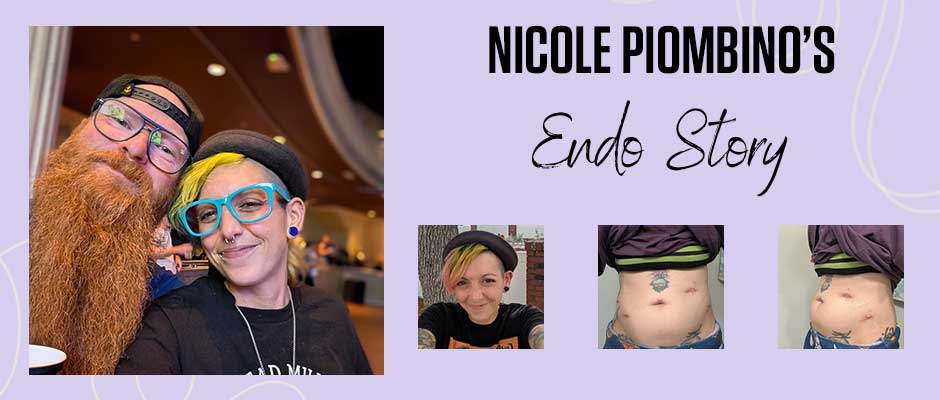
Nicole Piombino left countless doctor appointments screaming with frustration. Listening to her describe what she went through while suffering from severe endometriosis symptoms will make anyone want to scream with her.
“I went to every specialist you can think of,” she said. “My OBGYN sent me to a GI doctor, who referred me to a hematologist. The hematologist sent me back to the GI, who sent me to rheumatology. I waited for that appointment for a year to hear them tell me I had to go back to the GI, who sent me to my primary care doctor, who sent me to a urologist. The urologist sent me back to my gynecologist, who sent me back to my primary care provider. And this entire time I was carrying a binder showing what everyone had done before. The circle wouldn’t end.”
Piombino’s main symptoms—pain, vomiting, and heavy, continuous bleeding—started when she was 11. Birth control provided some relief, which she started taking at 14, but its effectiveness wore off by college.
“When I was 21, they did a D&C to try to stop the bleeding because I was always on my period and it was incredibly heavy,” Piombino said. “That helped for a little while, but then everything went back to the way it was. I was doubled over in pain, and all they kept saying was, ‘Keep taking the birth control. Keep taking the birth control.’”
She followed that advice until 2015 when, in her mid-20s, the birth control stopped working again. She was also going through super tampons every hour and lost her insurance. When Piombino secured new insurance, she found a new OBGYN. This new doctor performed Piombino’s second D&C. It didn’t work.
“I was passing huge blood clots within 12 hours of that procedure,” she said.
When Piombino changed insurance again, she was able to return to her original OBGYN, who mentioned for the first time that endometriosis could be causing the issues. Piombino agreed, having done her own research on the disease before that appointment. The doctor did surgery and removed some endometriosis while also performing a partial hysterectomy that left just her ovaries intact. Piombino believes, based on the doctor’s notes, that the endometriosis was likely removed through ablation, a method that usually does not provide good long-term results.
“I was great for about six months, until I started having extreme pain in my upper left side and was throwing up after just a few sips of water,” Piombino said. “That’s when they started sending me to all those different doctors and specialists.”
Piombino didn’t think her situation could get more dire, but it did.
“I was super sick,” she said. “I weighed 93 pounds and looked like I was pregnant. I was in pain and had to sleep sitting up. And I was still going to work full-time.” Piombino is a self-employed hair stylist in Florida, a job that requires constant client contact and standing all day.
Her circle of doctors eventually landed her back with her OBGYN, who did surgery again in 2021. The surgeon found endometriosis had adhered her colon to her pelvis and was covering her ovaries. The ovaries were removed, completing a full hysterectomy.
“After that, I was doing okay and able to exercise, but the problems started again six or seven months later.”
The tour of doctors continued. Despite telling them that she had endometriosis, they didn’t know how to help her or who could. “I still had the binder with me for every visit,” she said. “It had all the surgeries, photos, pathology—everything to show them what had been done.”
To make matters more challenging, her OBGYN moved out of state.
“I called her partner, who was still there and aware of my case, and she said, ‘Nikki, you are completely out of scope for us. You’ve had a hysterectomy and need extensive care, and we can’t give it,’” Piombino said. “I called every gynecologist in the area, and they all said that they wouldn’t help me because I’d had a hysterectomy.
“I continued to get worse,” she continued. “I had heart problems. I had rheumatology problems. I was still in pain. And every doctor I saw kept telling me I was crazy. No matter how many times I showed them this binder, they wouldn’t help me.”
Through an online endometriosis support group, Piombino found a gynecologist in Tampa, nearly four hours from her home, who specialized in excision surgery. She had a four-and-a-half-hour surgery this past March, which revealed endometriosis and adhesions in several places, including her colon, ureter, pelvic ligaments, and iliac artery.
“When I woke up, the doctor came in and said, ‘You were 100 percent right. It was bad,’” Piombino recalled. “I said, ‘Thank you. I know. I’ve been arguing that with doctors for years.’”
The surgery was successful. Piombino hasn’t felt this good since elementary school. She’s back at work doing what she loves—though she never really left.
“I actually worked more days but shorter hours because I couldn’t work for as long as I used to, and I went back to work after each surgery 24 to 48 hours later,” she said. “When you’re self-employed and have bills to pay, you can’t move clients. What choice did I have? I just put on a smiling face and did my absolute best.”
Piombino said her story isn’t special. She knows there are women all over the world with similar symptoms searching for answers. But she hopes sharing her story helps them find those answers sooner and motivates them to keep fighting for themselves.
“When somebody comes in with an extensive surgical history, you’d think it would be taken more seriously, but it’s not. There’s a lack of education and understanding in this field, and there’s nobody to advocate for you except for you,” she said.
“I tell any chronically ill person—don’t give up. Don’t take somebody’s word on something until you’ve read the things yourself. If you don’t understand something, find someone who does. If you don’t keep a binder, keep one, and bring it to every appointment. And if somebody won’t listen or doesn’t believe you, find someone else. You might have to go far, maybe out of state. But for every time you’re crying in your car and asking the universe, “Why me?” just keep going. It’ll happen. There is someone out there who can and wants to help you.”
*Patient stories submitted to EndoFound.org are the patient's views, not necessarily those of the foundation. All testimonials are from real patients, may not reflect the typical patient’s experience, and are not intended to represent or guarantee that anyone will achieve the same or similar results.