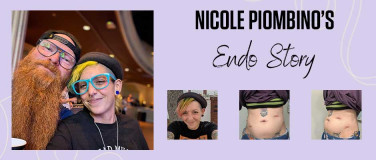


I experienced endometriosis symptoms as early as 14, but at the time—and really, for about the next four years—I didn’t think much of it. In health class and when speaking with doctors, I always heard the same thing: “Cramping and pain are normal with your cycle.”
I didn’t question it.
One reason was that I was always able to manage my symptoms pretty well. My most persistent symptom then was cramping in between periods, and I recall missing school a few times on the worst day of my period, but my schoolwork wasn’t affected. I performed in the marching band’s color guard without any issues. Rarely did my period affect my day-to-day life.
Another reason was that girls around me talked about having really bad periods, which sounded much worse than what I was experiencing. I didn’t have heavy bleeding. I wasn’t lying on the bathroom floor in pain. I wasn’t taking Midol every day. Constant cramping and occasional sharp pains before using the restroom around the time of my period were as bad as it got for me. I never even mentioned any of it to my doctor because I figured it was normal and there was nothing they could do.
When I was 18, things escalated a little bit. The pain increased, especially on my left side, to the extent that it sent me to the ER more than once. An ultrasound revealed an ovarian cyst. They monitored its growth over the next several months and finally removed it when I was 19. It turned out to be a cystadenoma, a benign tumor. The surgery was quick and simple.
In retrospect, what stands out to me now is that when I returned two weeks later for my follow-up appointment, I told the doctor I still had constant cramping. In addition, I had some irregular bleeding, which I figured may have been a result of the surgery. He said, “Well, you might have endometriosis.” I didn’t know much about the disease at the time and asked him if he’d have seen it during surgery. “Not necessarily,” he said—and that’s where that conversation ended. He didn’t look more into it or send me to another doctor, so I didn’t worry about it. Being in college, I wasn’t chasing that diagnosis or on a mission to figure things out. I was more worried about focusing on school and enjoying undergrad.
Within weeks after that appointment and still in pain, tests revealed that another cyst had formed. Several doctors had told me that, unfortunately, cysts were probably something I’d have to live with and deal with, so the pain became normal to me. I switched my birth control at that time to one that limited my periods to about once every three months, which helped relieve some of the pain. Looking back, though, it probably suppressed my symptoms while the endometriosis continued to progress. Anytime I did feel pain, which was still on the left side of my abdomen and, eventually, on the right side, I just told myself it was a cyst and moved on—until last year.
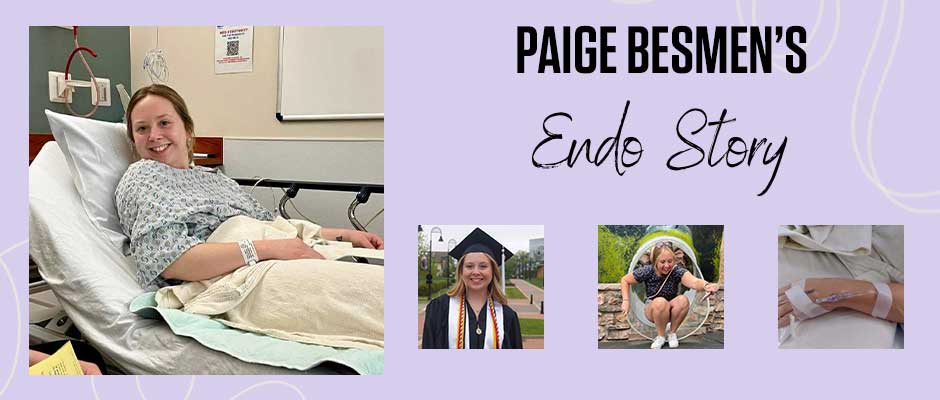
I graduated in May 2025 and got a full-time job I loved. However, unlike in college, where I was always active and mobile, my work required me to sit at a desk all day. That’s when the pain sank in. It hurt to move. I developed extreme fatigue. I couldn’t do simple tasks outside of work, like clean my house without the pain increasing. I tried reminding myself that it was just a cyst, but that wasn’t working anymore.
I saw my gynecologist in October for my annual checkup. When she asked me if anything was going on, I told her no. I was still programmed to believe that my symptoms were due to cysts that I had already been told I’d have to live with. But when the pain continued after that appointment, I went back a couple of weeks later for an ultrasound. That’s when my gynecologist, in consultation with other doctors, determined that I may have endometriosis.
I met with a surgeon she recommended to go over my history. After reflecting on my symptoms and what my daily life looked like, and with encouragement from a co-worker who convinced me that none of what I felt was normal, I told the surgeon everything I’d ever felt for years, including pain when I had a full bladder, shooting pains before going to the bathroom, extreme fatigue that left me completely drained, pain with excess movement, and nausea from the pain.
This past March, at age 23, I had excision surgery. They found the disease in several places, including on both the left and right sides underneath my uterus, which explained the majority of my pain. I was diagnosed as being in late stage 2. I’ve felt a little better since the surgery, but it hasn’t been total relief. I still have flare-ups and pain, and I’m working with doctors to determine where to go from here.
When I reflect on all I’ve been through, I realize this disease has affected so many aspects of my life, especially my career and relationships.
When my symptoms spiked after I started my new job out of college, I had to use sick time as soon as it became available. By the time I had surgery, I had two sick days left and had to cut into vacation time. Despite having a job I loved, I knew I had to find another one that better supported my needs and offered the flexibility to work from home during flare-ups. I was fortunate to find one, and I enjoy it, but I shouldn’t have been forced into that decision.
Endometriosis has also caused me to cancel plans numerous times and limit activities that I knew would make my symptoms worse and prevent me from doing what my friends were doing. There were times when I’d sit in an Epsom salt bath before a night out just to try to make it through. Or times I would fight back tears at a dinner table because I didn’t want to be honest with my friends and family about how bad I truly felt.
Most of all, endometriosis has affected my relationship with myself. I’ve had to go through the phases of mourning what my body could no longer do and learn to live with a chronic illness. Coming to terms with a diagnosis like this is difficult and something I wish more people understood. It’s not a period problem or a gynecological problem. It’s an inflammatory disease that can trigger a full-body nervous system response. Since my diagnosis, I’ve found that a lot of education is needed about endometriosis. That’s why I’m sharing my story, and I hope others with this disease will educate those around them. It can make a world of difference in how the disease is supported and understood.
I’d also advise those who think they may have endometriosis to find a doctor they can trust. My recent doctors never once downplayed my symptoms and were absolutely amazing through the diagnosis process. I realize how lucky I am to have been diagnosed so young, and within five years of my symptoms becoming more severe at 18. But when it comes to women’s healthcare, we shouldn’t have to rely on luck.
For anyone living with chronic pain because of endometriosis or something else, I see you. I feel you. Your experiences are valid even without a diagnosis. Advocate for yourself, and don’t stop until someone listens.
*Patient stories submitted to EndoFound.org are the patient's views, not necessarily those of the foundation. All testimonials are from real patients, may not reflect the typical patient’s experience, and are not intended to represent or guarantee that anyone will achieve the same or similar results.