

Patient Day 2026
Mapping Pain: Pelvis to Brain
March 7-8, 2026
3 Times Square, New York City
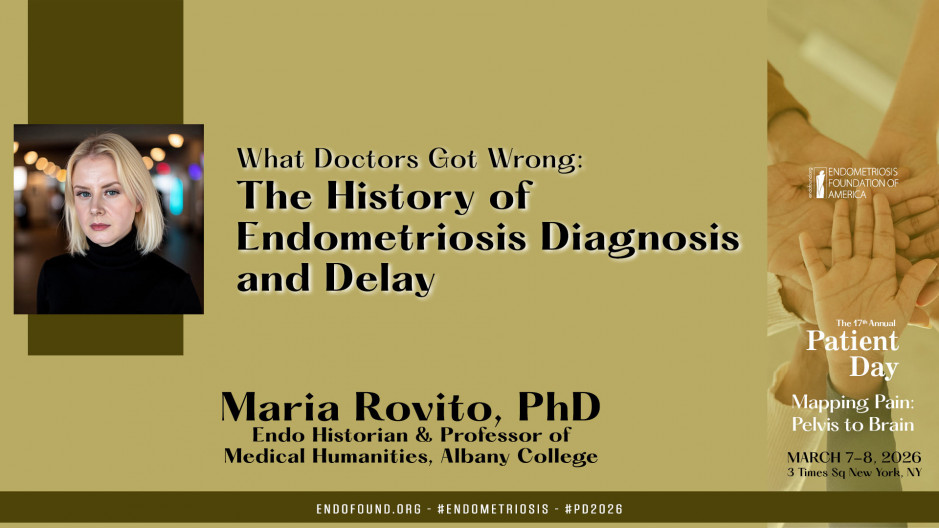
So how are y'all doing? So as she said, I'm Dr. Rovito. I teach pre-med students. I teach PharmD students back in Albany. And what my research is in my PhD is a lot of history, gender studies. So when I talk about figures like Samson, because that will be in here and physicians after him, I'm not really talking about the scientific things about the implantation theory. I'm talking about the historical implications of it. I also want to say that because historians, we use words that were used at the time of these medical case studies or journal articles. So I look at a lot of 19th century, early 20th century. They do use the word woman. So when I use these words, I am not excluding trans and non-binary people with endo. I'm just using the words that these physicians used. All right. So let me start here.
Okay. So the medical history of endometriosis research has inherently linked reproductive capabilities to the disease rather than chronic pain. As Simone de Buvar poignantly states in the second section 1952, woman, very simple, she is a womb and ovary. The history of endometriosis and illness that affects about 10 to 11% of people assigned female at birth is rife with medical authorities commenting on reproductive abilities and physical and psychiatric state. The professionalization of medicine based in a male understanding about the human body stems from the problem of the androcentric thinking of the scientific method. Since medicine has always reflected the typical viewpoint of white men ... Yeah, I'm sorry. Calling that out. I don't even care. Just I don't care. All right. Whatever. Conditions. All right. Yeah. So I do joke around when I lecture. Yeah, that's why I have a good rate my professor score.
No comment. All right. Conditions that affect women and people of color have largely been glossed over in medical research. The patriarchal control of medicine is therefore seen in many aspects of treating endometriosis in the present day. Endo pain also affects women's self-perception and sense of identity. The expectation that women are supposed to deal with it leaves many women feeling ostracized, belittled, inadequate, and undesirable. So wait, let me go back. Oh, no. Okay. You're fine. All right. So I'll talk about Samson. Sure. Societal attitudes towards endometriosis are also reproduced in gendered expectations regarding women's roles in relationships in the family. Women are conditioned from birth to act as good girls in order to please men and others around them. This primarily involves women with endo pushing through severe pain during sexual intercourse in order to satisfy their male partners, but also performing gender tasks such as cleaning and child rearing despite debilitating pain.
Women with endo often experience chronic pain, but are still expected to maintain their roles as caring and self-sacrificing partners, mothers, and daughters. Simply put, women view themselves as worthless and unfeminine if they are unable to physically satisfy men. Yay. Women self-censor in order to maintain the appearance of the good girl so they are not viewed by their physicians as anxious, dressed or frustrated. Instead of prioritizing treating pain, medical professionals equate women to their reproductive bodies, thus assuming that the main priority in life is to sexually gratify men and deal with infertility and reproduce children. Physicians who categorize these women as good girls expect that they will follow treatment advice without question and not challenge the dominant authority of medicine. So these difficult women, therefore, include those who directly confront physicians about their lack of education and dismissive attitudes towards women's pain. Historically, medical professionals view these women as hysterical, reproductive bodies rather than women seeking agency.
All right, so here's the Samson part. Okay. So we know endo, it is defined by chronic pain. It was the implantation theory that Samson proposed throughout the 1920s. He began in 1921, but the coinage of the term endometriosis was in 1925. And he stated ... All right. Here's the thing about Samson because I looked at his records when he was at Albany Medical Center. He says that the implantation theory is just a theory and that if the implantation theory is wrong, then that theory should die with him. All right, that is from Samson's mouth.That's not me. So no hate, I'm just the messenger. Right? Okay. So the implantation theory of Samson argues that we know endometrial tissue flows out the fallopian tubes and attaches itself to the surrounding organs, right? Most commonly the ovaries, the tubes, rectum, perio, rectum area, bladder, all that stuff, right?
So the thing with MIGS, or sorry, Samson, is the cure for not having this endometrial fluid flowed out every month was pregnancy. And the problem with that is we get into a little issue when we get to feminism, right? Okay. So let me talk about a physician who then used Samson's theory to comment on not great stuff. All right. Zofinson Meigs, he was a professor of surgery and the chair of the gynecology and obstetrics department at Harvard Med and he's mostly the figure that I examined in my book. So he devoted his research to determining how infertility in female patients with endo affected women's docility and anxiety over the future of the white race. Okay. Yeah. So he's a eugenicist. Yeah. Joseph Vincent Meigs from 1932 to 1955 constructed a narrative about endo that the disease was a result of feminism, women's economic freedom ... No, listen, this is ... Yeah, I'm not even joking.
This is like real. Yeah, no, it gets worse. Yeah. And desire to join the workforce rather than become mothers. That was 1949. All right. So based on his work at private clinics in Boston and then Boston General Hospital, he determined that endo was a consequence of delayed childbearing by white upper class women who engaged in feminist practices, educational opportunities and financial independence. Yeah. By investigating infertility due to endometriosis at a time when women were earning their liberation, Meigs linked the disease to deviations from traditional gender norms and household duties. Infertility, he thus framed as a failure of being a woman. That was a real quote from him. "As her ovaries and uterus were being destroyed by this new enigmatic disease." I'm sorry, I can't talk. "Due to these lifestyle choices, women with endo were forced to suffer with pain and infertility as he positioned that women's liberation caused a "lack of the production of the best children of the nation." So he was primarily responsible for constructing endo as a disease of infertility rather than a disease of pain, as previous research was concerned with the extreme suffering caused by this illness.
So that was 17th century physicians. There was a really good article about it. Email me later. So there's a lot of political implications of his work. So he was the first to theorize the implications of infertility and the status of women due to this disease. So his original research was a lot about hysterectomies for cervical cancer. He began studying Sampson's work in the 1920s to the 1950s.
He was noted for his hospitality in generous bedside manner, but that doesn't really matter when you're a racist. To him, I don't really care. I don't care. Yeah. Yeah. So to him, endo was a riddle that needed solving, but his views toward women and the cause of endo directly contradicted what first wave feminism fought so hard for only a few years earlier. In a published editorial on the demographics of patients who were diagnosed with endo under his care, he argued that private patients, primarily white, educated, upper class women who could pay for their own care, were being diagnosed at a higher rate than public patients who were typically lower class and women of color. He argued that the true implications of endo were not chronic pain and dyspneoria, a. K.a. Period pain, as so many physicians proved in their research, but rather a social crisis induced by the failure of the upper classes to have as many children as they should.
So he states, "However, endometriosis is true importance in his effect upon the problem of reproduction. From the previous studies of word patients versus private patients, it seems that the successful and educated stratum of society is most affected, and this should be very important to us." So the gynecologist he observed should encourage young white women with a disease to reproduce as quickly as possible. And he was the belief that we're not doing surgery until you have children first, and he was very against the use of contraceptives for white women. Yeah. Okay. He was very concerned about the future of the white race. So other scholars at the time were also commenting on the eugenics and the great replacement fear, including someone called Lutheran Stoddard. In 1920, he published a book called The Rising Tide of Color, which influenced Mig's. And Mike's argued that first wave feminism caused the decline in white birth rates as women became more educated and gained agency of their reproductive choices.
So according to Muggs, yes, real quote, "The most superior minds of the nation came from white upper middle class families engaging in traditional gender roles for women." All right, so here's another quote. "It is our duty to reproduce ourselves for according to many investigators, only an occasional man of women of large intellectual stature springs from the uneducated and supposedly not so intelligent class. It is from us the really educated that most of the superior minds develop. "Yeah. All right. Endometriosis, the blame was placed on the women who were diagnosed with the disease, right? As he contended that endo was a form of punishment for delayed childbearing by superior and intelligent women. All right. So he believed that in order to solve this riddle of endo, which people still see it as this riddle and enigma today, right? Feminist lifestyles had to be abandoned, not only for the health and wellbeing for these women, but also the wellbeing of a nation on the conclusion of World War II.
Future generations were dependent on women's abandonment of education and their careers in favor of early and frequent childbearing. He not only blamed feminism and women's education for the increasing rate of endo among private patients, but also alcohol and tobacco, restrictive diets, self-interest, economic conditions, the instability of marriage, and the corruption of children.
So the birth rate among the upper class versus the lower class ... Yes, I said that. All right, very cool. All right. So the birth rate among the upper class versus the lower class caused him great worry. So he cited Malthus's 1798 study on the increasing birth rate of the British Isles and decreasing food supply. So this is especially used during the Irish potato famine. He was troubled ... So Mike's was troubled by the lack of children that college educated women produced. So he analyzed the women who graduated from university in 1923 versus women who had not gone to school for more than four years. He observed that the college educated woman had increased rates of endo versus the woman who had not finished their schooling. So university women of the class of 1923 had approximately 1.66 children each, while women who did not have more than four years of schooling had approximately 4.33 children each.
He surmised from this data that education and feminism were at fault for infertility. So from this medical view, women who had multiple children were able to stop their menstrual cycles for long periods and utilizing the menstrual regurgitation theory. And I'm not saying this series is wrong. I'm just saying it was used to justify eugenics and racism. All right. I'm not getting into the whole Wasampton correct thing. This is just the historical implications of Samson. All right? So he concluded that there was less of a chance for endometrial tissue to escape the fallopian tubes and grow on the outside of the pelvic organs. So in his opinion, endometriosis was given more chances to multiply and spread throughout the body.
So the rise of first wave feminism gave way to increased endometriosis research as women were being urged to return to being homemakers after World War II. Many gynecologists thought the United States endorsed MIG's prescriptions, which today appear to amount to white genocide theory. All right. Do I have ... Ooh, I'm sorry. All right. So the Philadelphia gynecologist, Margaret Castek Sturgist also pointed to women's liberation and education as a cause for the disease. So she says," The increase of endometriosis today, and especially so in the private patient class, points to economic and social trends of the modern woman. A year later, the Philadelphia physician, James Robert Goodall, would also blame education and delayed childbearing for the cause of the disease. Good old stated, "I consider endometriosis a product of our civilization in that late marriages and still later conceptions are the rule, owing chiefly to economic stresses.
It would seem that prevention and the susceptible lies in earlier marriages and earlier reproductions." The same year, Meigs' colleague at Harvard, Walter Holmes, he also advocated for early marriage and procreation. He said, "We're allowing young women in the private patient class to avoid pregnancy. This in turn is conductive to sterility and endometriosis." So endometriosis researchers today point out that the assumption that pregnancy cures endo was a faulty conclusion at best and medical abuse at worst. So many gynecologists today still believe MIGS and ... All right, do I have the lobotomy slide next? No. No, I'm not even joking with you. There's alibotomy thing in here. Yeah, I went over that. Okay. Yeah, let's talk about the lobotomy. All right. Yeah, this is only about, I don't know, 70 years ago. All right. So the physician, Bertram Silverstone, also argues for psychiatric treatment of endo in his contribution to Mike's book, Progress in Gynecology in 1950.
So Silverstone suggests the highly invasive but widely used at the time prefrontal lobotomy to control women who suffer from pain. So Silverstone writes, "Prefrontal lobotomy does not interrupt the pathways of pain, but in some way not yet understood, appears in many patients to relieve that aspect of pain, which we commonly describe as suffering." So the pain's not gone, it's still there, but at least we're not complaining about it. Yeah, I'm not even joking that's what he said. All right. I know. Yeah. Instead of solving or recognizing the organic nature of chronic pelvic pain, he suggested that the best way to deal with anxious women is to cut off their agency completely through surgical means. Yeah. As he argued later, it has long been recognized that these patients are usually sensitive and emotional and that they thus need psychiatric care rather than gynecological treatment. He then later noted that the lobotomy may provide blessed relief for those sufferers who are unusually agitated and disturbed by the thought of impending death.
Yeah. So essentially that was ... Right. That was the worst thing I found. Yeah. Okay. Yeah. Okay. So now the implications of all this today is a bioethics professor. I'm not going to lie, I see this all the time when I teach, so let's just talk about it, right? So today, the learned ignorance that medical professionals in the greater public present towards women's pain also stem from the unspoken truth about womanhood and pain. That pain is normal and to be expected, your pain can't be that bad. Menstruation is supposed to be painful, which is particularly directed toward young girls, which pisses me the fuck off, and women and girls are being hysterical if they complain of this pain. Actually, when I said the word fuck, please post that on the internet.
Yeah. Okay. So because of MIGS, right? This led to decades of treating endo with pregnancy, and these physicians came to believe that fertility and men's sexual satisfaction are more important to treat than chronic pain. So honestly, just for y'all dealing with this bullshit today, you don't need to force yourself to censor your feelings and experiences in order to appease others around you. Women are constantly forced to bury their thoughts and emotions about their pain and trauma, particularly in terms of misogyny surrounding medicine and menstruation. All right, I got 30 seconds. All right. So the only way to demonstrate power over physicians and endometriosis itself is to force medical professionals to listen and care for our needs. So we do in fact know what our bodies are saying rather than letting physicians dictate to us how our body should operate. So honestly, speak up and act out and allow yourself to publicly show your anger and your feelings are the starting point for creating change for the future.
Yay. I got seven seconds. All right. Thank you. Oh, wait. So, okay, so this is like chapter two of my book. There's even worse things in here, like studies that compared black women with endo to monkeys. I got flyers, if you're interested, just ... Are we taking pictures? Okay. All right. So yeah, just check it out and thank you.