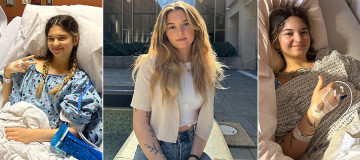


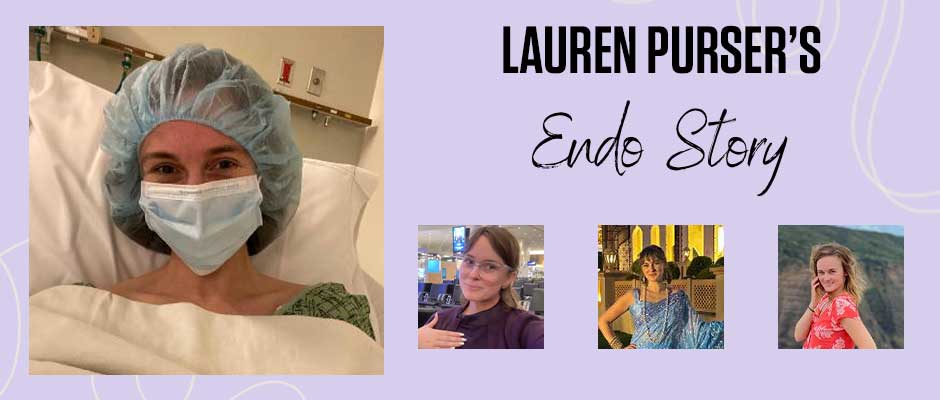
Lauren Purser’s first period two decades ago at age 13 was a nightmare. It wasn’t just painful—it lasted for several weeks.
“My mom took me to her gynecologist, and they did a test to see if I had a blood clotting disorder,” Purser said. “When they couldn’t find any evidence of it, they gave me a packet of birth control pills to regulate my period and sent me home. Nobody said anything about endometriosis or anything like that being a possibility.”
Purser remained on birth control in high school and into college, recalling that it stopped the extensive bleeding and enabled her to “somewhat function.” While she still experienced monthly pain, she assumed all women felt it at that level. She pushed through it, rarely missing school and never vomiting or fainting—though she vividly remembers two episodes that, in hindsight, demonstrated the birth control was a mask and not a remedy.
“While on my period one day during my senior year of high school, I was at my grandmother’s house curled up in a ball on her bathroom floor and shaking from being really cold,” Purser said. “She put a space heater by me and kept checking on me to see if I was okay. I could see in her eyes this feeling of helplessness. She wanted to do something, but she didn’t know what was wrong, and neither did I.”
Purser’s second episode was in her early 20s when she was returning from a vacation in Europe. Her period started while she was on the plane.
“After we deplaned and were in immigration, I went into the bathroom but could barely walk out. I was almost on my knees crawling,” Purser said. “An airport worker who was pushing a wheelchair saw me and knew something wasn’t right. She helped me get into the chair and wheeled me to the front of the immigration line to get me through it. I was able to drive home, but I thought, ‘Wait—I shouldn’t have to be in a wheelchair just because it’s the first day of my period.’”
Purser became a Delta flight attendant at age 23. That may not sound like an ideal career for someone experiencing those symptoms, but she was determined to make it work.
“From 23 to 27, I wasn’t on any birth control or medication, but at no time did I have to stop working. I just pushed through the pain because I had to,” Purser said. “On a plane, there was nowhere to escape.”
She had an IUD inserted when she was 27, which nearly ended her period completely.
“It was nice in a way because I wasn’t having my super-heavy periods anymore,” she said. “But again, looking back, it was masking the growing symptoms of endometriosis.”
In 2022, when Purser was about to turn 30, her health deteriorated quickly.
“I was visiting family for the holidays and told my mom I had so much bloating and my stomach hurt all the time. She said it was probably nerves because the holidays were always stressful for me, and I figured she was right,” Purser said. “And even though I had just gone in for my annual gynecologist exam, I didn’t mention the constant bloating because I didn’t think it could have anything to do with my reproductive organs.”
Soon after, having just moved to San Diego and into a new apartment, Purser began experiencing severe pain in the right side of her stomach.
“I was in my first week of living there, and my landlady was watching me unable to stand up straight. I was bent over with stomach pain and horrible pain in my rectum,” she said. “She gave me Tylenol and a heating pad and offered to drive me to the ER, but I told her I was okay—I just needed to sleep.”
Purser went to sleep but woke up in the middle of the night still in pain. She stumbled into the bathroom and fell unconscious. After coming to and on her way back to bed, she knocked over a lamp and fell unconscious again.
“That was really scary,” Purser said. “I knew I needed to do something.”
When she came to again, she called 911 and was rushed to the hospital, where tests revealed a large mass on her right ovary. After a 10-hour stay and a prescription for an antibiotic, she was told to see her gynecologist as soon as possible for further evaluation. Being new to the area, Purser didn’t have one yet. She called several that day.
“I couldn’t find one who had any availability for three months, and I had a six-day shift coming up, so now I was worried about missing work and not having money,” Purser said.
She posted about her predicament on her Facebook page, where a woman suggested a gynecologist. Purser called and got in at noon that day.
“She did a quick physical exam and said, ‘I’m pretty sure you have endometriosis,’” Purser said. “I’d heard about endo once or twice in my life and always associated it with infertility, never with pain. She told me that she’d have all my tests done in the next two weeks and that I’d be ready to have surgery in four to six weeks. It happened that fast.”
The gynecologist also asked her if she wanted children. Purser told her she did not and that she’d been considering having her tubes removed.
“She said, ‘Well, this would be the time to have them removed,’” Purser recalled. “In that 20-minute appointment, I found out I had an illness that I knew virtually nothing about and was going to be able to have my tubes removed. I also remember she had a sticker on her laptop that said, ‘Endo is real.’ I knew I was in the right place.”
Purser had robotic excision surgery in February 2023.
“She expected it to last one to two hours. It took about four because I was in stage IV,” Purser said. “I had rectovaginal endometriosis, deep infiltrating endometriosis in my bowels, and endo on my right ovary and in the pouch of Douglas.” The mass on her ovary was the size of a baseball.
Purser was walking the day after surgery and returned to flying two weeks later.
“My surgeon said that she couldn’t tell me if I’d ever need another surgery, but overall, I’ve been pain-free for more than three years now,” she said. “No pain medication. No IUD. No birth control of any kind. It’s been pretty amazing. I’d never had a doctor ask me questions or listen to me like she did. She was very personable and kind, and she was the first to ever mention the word endometriosis.”
Purser said she downplayed her symptoms for far too long and urges everyone to listen to their body.
“I think one of the main reasons I did that is because in our society, women are not encouraged to take their pain seriously. We’re often gaslit or dismissed. That’s why self-advocacy is crucial,” Purser said. “Don’t stop with one doctor. If you’re dismissed or misdiagnosed, keep going. I wish I didn’t have to say those things, but you have to keep going. There’s hope, and there are good doctors out there with treatments that will help you.”
*Patient stories submitted to EndoFound.org are the patient's views, not necessarily those of the foundation. All testimonials are from real patients, may not reflect the typical patient’s experience, and are not intended to represent or guarantee that anyone will achieve the same or similar results.