

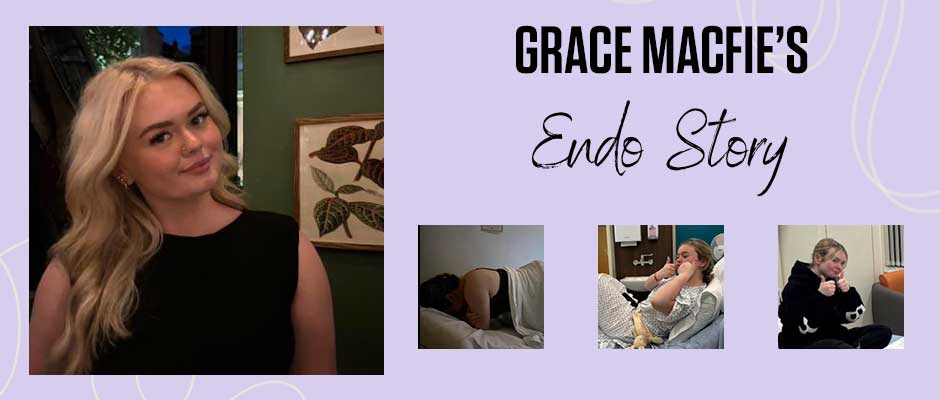
Those with endometriosis often share a familiar pattern: their symptoms begin with their first period, doctors dismiss their concerns, and they eventually learn they have the disease through surgery. All three are true of Grace Macfie’s story, but with an unusual twist:
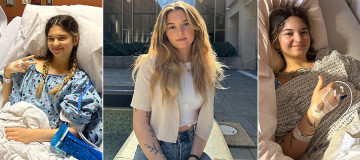
She was just 14 when she had excision surgery in June.
“We didn’t hesitate to do it because we thought it was the right thing to do,” said her mother, Samantha Macfie. “It’s a big thing that you don’t want your child to go through, but we couldn’t carry on as we were. We needed to know what was in there and why she was in so much pain.”
Since her diagnosis, Grace, now 15, has been on a mission to raise awareness and educate young girls about endometriosis. The York, England, resident has been featured on the BBC, in People magazine, and on several podcasts and social media platforms. She reached out to EndoFound to help further that mission.
“The amount of messages I’ve gotten through my TikTok page from girls my age, some a bit older and some a bit younger, saying, ‘What do I do? I’m in so much pain’—it’s just so sad,” Grace said. “This is why I’m so passionate about it.”
Grace knew soon after her first period at age 11 that something was off. Along with extreme pain, her periods were heavy and occurring twice a month.
“But nobody thinks that you have any gynecological issues. They just think you’re unlucky,” Grace said. “The doctors said that because I was so young and the periods had just started, they needed to get into a normal rhythm.”
While her twice-monthly periods soon settled into a monthly cycle that lasted roughly nine days, the pain and heavy bleeding continued. Grace pushed through for two years, managing her symptoms and avoiding trips to the hospital, until one night in 2024.
“I was sitting down at a show, hunched over, and couldn’t move. I thought my appendix had ruptured,” Grace said. “When I went to the hospital, they ruled out appendicitis and said it was an incidental cyst. They saw fluid in my Pouch of Douglas, so they just assumed it was from a cyst and sent me home.”
As the pain continued and expanded—into her back, legs, and bowels—Grace was in and out of the hospital for the next four months. She was given large doses of morphine each time and put on the pill, but neither was effective long-term. She underwent several tests, including multiple ultrasounds, but doctors couldn’t find a cause for her suffering.
“I also had really bad anxiety at the time and had already been diagnosed with an anxiety disorder, which made it a lot harder to be taken seriously,” Grace said. “When it came to my pain, they’d put it down as a mental health issue: ‘She’s on medication for her anxiety, so that’s probably what it is.’”
In January 2025, Grace was referred to a gynecologist for the first time—but that’s as far as it went.
“Within a week, the referral had bounced back. Rejected. They told us they couldn’t see children. We have free health care in England, and we’re very lucky to have it, but it comes with limitations,” Grace said. “I was put on a waiting list and was told it would be years before I could see a gynecologist.”
Fortunately, Grace’s family also had private insurance through her father’s business, which gave them access to two private pediatric gynecologists in northern England. Grace went to see one of them in March 2025, this time armed with a little more knowledge.
“My mum mentioned endometriosis to me before that appointment. She didn’t have it, but my aunts and grandma did,” Grace said, noting that they all had hysterectomies. “She told me that I should mention it to the doctor.”
She did.
“The doctor immediately said, ‘It’s definitely not endometriosis. You need to go back to school and get out into the real world and socialize,’” Grace said. The comment was in reference to Grace being home-schooled and attending online school rather than a traditional school.
“I didn’t know what to say. I thought, ‘If I wanted a lecture, I would have gone elsewhere. I’m coming to you to get medical help.’ It was really awful,” Grace said. “I sobbed the entire way home because I knew something wasn’t right and I’d gotten nowhere. When you’re in so much pain every single day and have to fight to be heard, it’s exhausting.”
Grace made an appointment with the other pediatric gynecologist, who specialized in endometriosis. After describing her symptoms but before mentioning her family history, Grace said the doctor told her she likely had the disease. An MRI revealed thickened lining on her uterosacral ligaments and the back of her uterus, along with a tilted uterus—an indication that endometriosis could be present.
Given Grace’s age, the doctor suggested she try an IUD for six months before considering surgery. The hope was that it would alleviate her symptoms, but her body rejected it and made her feel worse. That led to excision surgery this past June. Grace was diagnosed with stage I endometriosis. It was everywhere the MRI indicated, and it had also adhered her bowel to her pelvis.
“I was very emotional when I woke up,” Grace said. “The first thing I asked was if they found anything. I was so anxious about that because I knew if they didn’t, I’d be back to square one and would have to fight these doctors again to be heard. But when they said they found it, I felt like a weight had been lifted. I wasn’t going crazy. It’s hard to explain that feeling.”
Grace is doing better today, though the healing process has been slow. She said she still has daily struggles, like not being able to sit or stand for long periods of time. She is on the pill again, which limits her period to once every three months—a break her body hasn’t had in four years. Overall, mother and daughter are happy they went through with the surgery.
“With the family history we have, we know the endometriosis can return,” Samantha said. “But, because Grace is so young, hopefully everything will settle down and she’ll have a really good chance of getting through this.”
“Just knowing what it is and that I’m not going crazy—that alone makes me feel better,” Grace said.
Along with tending to her own health, Grace is determined to educate every girl she can about endometriosis.
“We’re not taught this stuff in primary school when so many of us get our periods, and there isn’t a clear path for young girls like me to get treatment,” she said. “I want to raise awareness that most of us don’t know where to go to get help, and when we do, we’re not listened to, so what are we supposed to do? They say, ‘Speak up,’ but when we do, they tell us it’s just our period or that we’re trying to get out of school. Maybe if we were taken seriously when we’re young, we wouldn’t have to have these complex surgeries, like hysterectomies, later in life.”
Grace has been creating fashion content on platforms such as YouTube, TikTok, and Instagram for the past few years. She had about 10,000 followers before publicly sharing her endometriosis story this summer and has gained another 1,000 followers since—mostly girls who can relate to her story. She hopes to keep that momentum going.
“I was inspired by my gynecologist’s words. She told me, ‘You’re so young. You’re so full of life. Don’t let this get you down. Find a purpose,’” Grace said. “I’m sharing my story in hopes that it will reach the people who need to hear it to feel less alone, and that it will reach the doctors who dismiss young girls and make them rethink their approach. That’s what makes this all worthwhile.”
*Patient stories submitted to EndoFound.org are the patient's views, not necessarily those of the foundation. All testimonials are from real patients, may not reflect the typical patient’s experience, and are not intended to represent or guarantee that anyone will achieve the same or similar results.