

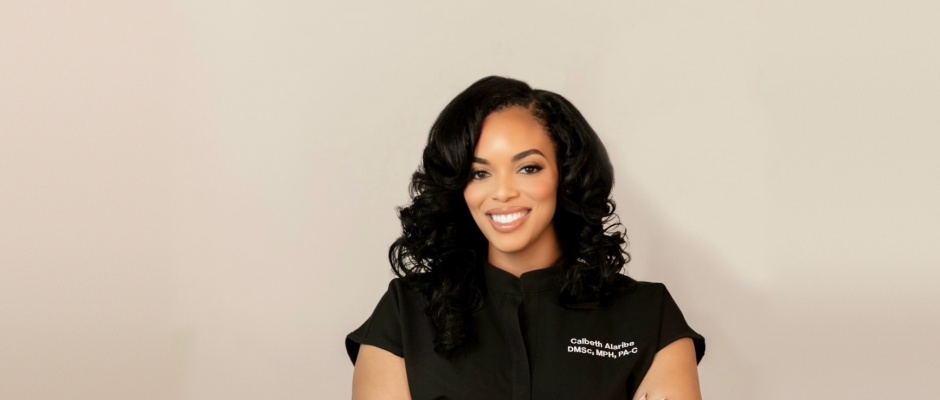
At 12, Calbeth Alaribe began experiencing the endometriosis symptoms she would live with for years. By 14, she had been diagnosed. But before that diagnosis, she remembers being told that the pain was normal, that it was in her head, or that she was exaggerating.
Years later, after becoming a clinician and working in obstetrics and gynecology, Dr. Alaribe began to see Black women who, like her, had endometriosis while experiencing preeclampsia and eclampsia—potentially life-threatening complications of pregnancy—she wondered what pregnancy might look like for her.
“It became a very terrifying thing to think about,” she says.
Endometriosis is a chronic inflammatory condition affecting an estimated 10% of reproductive-aged women and those born with a uterus in the United States, and over 190 million women worldwide. Previous research has found a modest association between endometriosis and preeclampsia, a hypertensive disorder of pregnancy that can cause serious complications for both mother and baby. But Dr. Alaribe wanted to know something a bit more specific: what did researchers know about this relationship among Black women in the United States? She found that the answer was remarkably little.
In this new scoping review published in BMC Public Health, Dr. Calbeth Alaribe and Dr. Kimberly D. Sapre searched over nine databases, including PROSPERO, an international database/registry of systematic reviews, for studies published through March 2024. Of 370 records identified, 19 articles were reviewed in full, but none met all the study criteria. As a result, no eligible study examined the relationship between endometriosis and preeclampsia or eclampsia specifically in Black women in the United States. Dr. Alaribe and Sapre emphasize that this is a gap in the evidence, not evidence that no association exists.
This gap is especially significant because Black women already face disproportionate risks during pregnancy. The authors cite US data showing that Black women were five times more likely than white women to die from preeclampsia and eclampsia. At the same time, Black women are less likely to be diagnosed with endometriosis, despite experiencing symptoms of the condition.
Some of the problem lies in how research handles race. Some US studies identified by the review collected race data but used race only as a variable in statistical models, and did not report whether the relationship between endometriosis and pregnancy complications differed by race.
For Dr. Alaribe, this was one of the most striking findings. The information was there, but it was not being used to answer the question she was asking.
“It was astonishing to me,” she says. “Why aren't we taking a look at race in general when it comes to this specific correlation between two impactful conditions?”
This matters, Dr. Alaribe says, because race is not simply a biological characteristic. “Race is a social construct that can nonetheless shape health through structural conditions, including access to healthcare, treatment, chronic stress, and exposure to racism.”
Those factors may intersect with endometriosis long before pregnancy. Black women can experience delays in diagnosis and treatment, while longstanding misconceptions about Black women's pain can influence whether symptoms are believed or investigated. The review cites research showing that Black patients with pelvic pain are less likely to be referred to pelvic pain specialists.
The history of medicine must also be considered within this context. Dr. Alaribe points to the legacy of medical practices in which Black women were subjected to painful procedures without anesthesia, based on racist assumptions about their ability to tolerate pain. She argues that the stereotype of the “strong Black woman” has not disappeared simply because medical practice has changed.
“We have to dismantle that,” she says. “Black women are just like any other race, any other ethnicity. They still have pain.”
The research gap therefore has consequences beyond academic knowledge. If endometriosis is underdiagnosed, and the relationship between endometriosis and pregnancy complications is not adequately studied among Black women, clinicians have less evidence to draw on when caring for those patients.
Dr. Alaribe believes one response is to stop treating representation as an afterthought. Researchers need to recruit enough Black women, as well as other underrepresented populations, to make meaningful analysis possible. They also need to report outcomes by race rather than collecting demographic information and leaving it buried in a dataset.
Clinicians can respond to the uncertainty, too. Dr. Alaribe says that when a patient with endometriosis is considering pregnancy, her gynecological history should be part of her obstetric care rather than treated as a separate medical story. That can mean paying closer attention to blood pressure history and considering whether additional specialists should be involved.
There is still much that researchers do not know. Dr. Alaribe's review may not necessarily establish causation, and the authors acknowledge that their strict criteria may have excluded some relevant studies, but for Dr. Alaribe, having to ask the question herself is part of the problem. “Who knows what other conditions could have impacts [on] maternal healthcare in the US, especially for Black women?” she asks.
Dr. Alaribe’s research began with a deeply personal concern about what pregnancy might mean for her own body. It has ended up exposing a much broader question about whose bodies medical research has been designed to understand. The first step toward answering that question may be as simple and as consequential as “deciding to actually look at the data.”