

Endometriosis 2026:
A Nerve-centric Disease
Medical Conference - March 6-7, 2026
3 Times Square, New York City
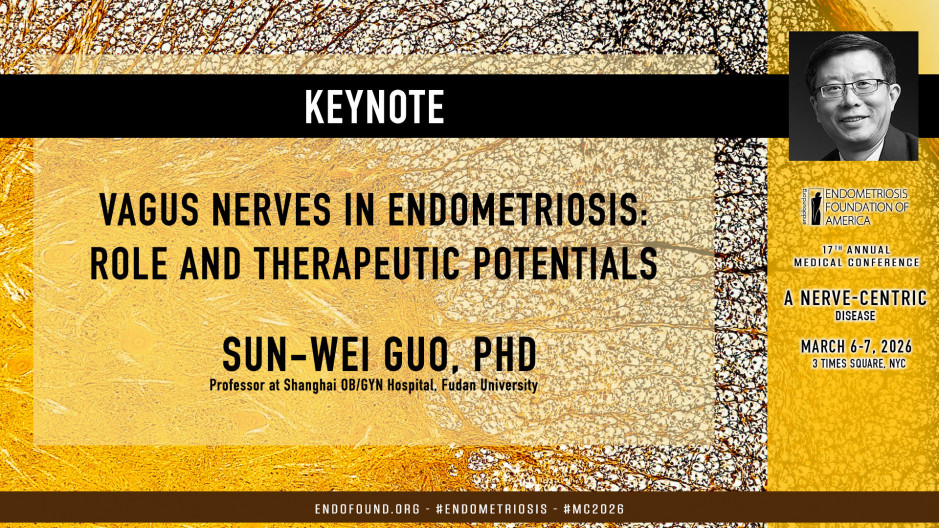
Well, it is immense pleasure to meet here and I thank Dr. Dan and for actually inviting me over. Now I have to say, I just did use SK mutants. What I'm doing is actually I'm standing on the shoulders of the joints. And actually I went through a lot of papers by Dr. Tracy's and essentially common chronologic anti-inflammatory pathways. But here I'm actually assigned to talk about vegan nerves, but since there's not much work in NDCL, so what I'm going to do is actually try to approach the issue from the drug development standpoint. I think here's my disclosure. And the one thing I have to mention that this one is actually the prototype for the vego stimulation instrument developed by the Singapore company, EA3 Healthcare. So then here's the list of drugs for three immunitosis. The drugs actually, except probably the non-steroid anti-inflammatory drugs actually, we've actually reviewed the papers that very, very few documented efficacy, including endometriosis.
Although that's actually hormone drugs, they have a very conspicuous commonality which actually stops bleeding or stop menstruation. Of course, some of them also has the effect of suppressing estrogen productions, and this is actually how they work. Unfortunately, there's a strong undercurrent surface very recently. I think that this is a survey did in EIP. And I'm sure that in other possibles, especially in India, which is usually against the hormonal drugs, I think that the mentality is probably is even harder in a sense that it is a version of hormonal drugs. In fact, that the two-thirds of women actually saw it, they expressed a desire to use some plant-based medications. Unfortunately, drug development for initiosis has been essentially very, very unsuccessful. And there's a popular disappointment. I think that polyly training actually once said that there's actually, he lacked this situation to waiting for good, which essentially was waiting for something that has actually never happened.
I have myself actually wrote along with my colleagues and tried to call more transparency with clinical trials because to me, I think that the four year is probably more educational than success because from these theoretical clinical trials, we can actually learn lessons and try to develop better therapeutics. I think one example is one of the drugs for Vestran is actually the estrogen receptor antagonist. It was launched before the turn of the century with great vent there was actually the result was never published and presumably to be failed. So in this case, we don't know why this actually is bad for the people working in this area. And these are actually three drugs being approved since 1986, centrally agonist. GWGS actually is not approved in the United States, but recently proved is the GNH antagonist. And when you looked at all these drugs, none of them actually is target specific pathways.
It's essentially on the general principle that is the estrain suppression and essentially stop the few through the lesions. If you look at the cancer field, tons of drugs have been developed for various cancers. In fact, that over 100 drugs have been developed. So there's a stock contrast.
A few days ago, I actually searched the clinicaltrial.gov and then about over clinical trials and interventional trials, prephase one, phase one, and also phase two and three. But when all of them, there are some results. Many trials actually terminated withdrawal simply because of interval side effects. And also some of the trials actually turned out to be not just as good as placebo. For example, also dopamine acceptedD2 agonist, the previous publication said that it's actually effective, but the recent publication says it's actually just as good as placebo. And also, this is actually the LANABU trial conducted by LAGA was actually essentially built And this drug is actually the LQST17B1 inhibitor, which is supposedly to suppress the production of estrogens. So if we read the papers and the consensus is actually estrogen-depending disease. So why if you suppress the production of estrogen, the actually the trial had to fold.
So in this case, there's lots and lots of questions. And so they actually would paper essentially that it's probably a little bit proactive. I think there's an invasion drought in terms of the IND pipelines, it seems to be trickling. And so we have to ask ourself.
And one thing is models that we use preclinically is actually do not recapture the human conversions. In many cases, the induction period is too short so that the lesion does not have enough time to develop fully, essentially, especially fibrosis. So into this actually you'll see, yes, the drugs, it's very effective. So that's why you know nice that Dr. Rogers, about how well the induction period is. Usually the fibrosis occur after the week five or week six. All weeks is usually too short. And also, because we are focusing on proliferation, inflammation, we do not see some other things going on, for example, fibrosis. Once there's a fibrosis, the vascularity goes down. So you have a challenge to deliver the drug to the target tissue because of reduced blood vessels.
And also there's another thing that is what I call this very therapeutic corridor. This actually can be illustrated by this very famous hypothesis that is the treatment window. The interest is actually interpenal disease. So we have to suppress the production of estrogens, but if you keep the estrogen level too low, it's going to cause harm. Bone density may be also the risk of cardiovascular disease, so that's actually we have to keep it in a therapeutic window. So this is very similar. We have to keep the estrogen level to. And this is what we see typically in endometriosis. On one hand, there's inflammation and maybe angiogenesis, so we have to muffle it contain this inflammation, suppress these inflammation or angiogenesis. And essentially we have a very precarious neurotherapeutic corridor. So when it's physiologically neutron, all these things, for example, project post-gland E2 signaling, hypoxia signaling, glycolysis, inflammation, androgenesis, proliferation on one hand is actually to help the anchotic lesion to maintain and go, but one hand, all of these signals are needed in neutral physiology.
So essentially we have a very rare therapeutic corridor. So when it comes to select drugable targets, we're actually working on a very type up. It is a size, it's also art, and also we need a lot of.
The trick is try to find corridor that is wide enough so we can actually contain the disease. Oil, we can actually transcend this corridor. The question is why? Actually it comes to the nerves. What happens on the impact of sensory nerves on the development of ntosis? It turns out the sensory nerves that not transmit the pain signals to the brain so that actually the patient can perceive pain, but also the wings actually secrete neurotrophic factors that actually essentially increase nerve fiber density. And the issue is session nerves also secrete a lot of neuropeptides, for example, substance P and also CGRP. And these neuropeptides also facilitate the growth and progression of lesions. It turns out actually that's why you can see that the deep lesions in the tremors are entitled in many neural cases actually different simply because deep lesions are usually in proximity to the various nerve plexus.
So that's why they're actually close to sensory nerves and these sensory nerves secrete the normal peptides that actually facilitate or accelerate regional progression. And we also identified shown cells, and that actually plays a role in the development of adenomyosis and also identified sympthetic nerves actually when they secrete epinephrine, nopinephrines that will activate the angiomergic receptor beta to express some lesions and also facilitate lesional progression. So I think that a decade, I think there's an increasing awareness of the body brain circuit. In this case, I think that this paper was published that two years ago, essentially when there's in prepared the tissues organ, there's an inflammation that were actually the sensory nerve vegan nerves that were transmitted to the nucleus of the solitary tract or MST in the brainstem, and actually the burn stent somehow that will secrete some signals that will actually suppress the systemic inflammation.
And that's where actually that's the visual nerves actually is also the longest granular in the body and connects all the internal organs, including, I think that here is actually in this uterus and also the female reproductive tract.
So it's actually a key component of the parasympathetic nerve system and regulates many functions integrating heart rate as actually in axial that they actually different nerve systems actually activate it. And it turns out that the 8% of these has actually defined the 20% different. So there's a true communication highway between the brain and also the body. So in the context of the endometriosis that I learned that Dr. Tracey's become anti-inflammatory pathway, essentially that by the disease or disorders, there's an imbalance. Essentially there's increased sympathetic term, but that decrease the vegoturn. But if you stimulate the vegan nerves, there will actually rank up the legal nerve megaton that will help to secrete some of the ST column. They will actually bind the alpha-7 nicotinnicorn receptors in wound cells, for example, microphages that will actually suppress the NCAPA B and also suppress the inflammation. So essentially that's what this pathway is.
So insurances, we do know there's pain and also infertility, and also some of the anxiety or depression will cause psychological stress that will actually activate the HPA SAN axis that will cause the use of some of the adrenal wounds. They will actually activate generalgic receptor beta-2 on lesions that will actually help to progress the lesions. And also there's some of the new receptors that's actually activated some of the previous speakers talked about, and inflammation. But if you stimulate the vegan nerves, hopefully that will actually suppress the inflammation stress because the stress is actually the neural inflammation and several clinical trials we demonstrated that vegal nerve stimulation actually can allude some of the symptoms of depressions and also insomnia. And another thing is actually we actually that the alpha-7 ecotenic as the colony receptor is actually also depressed in lesions. And actually if you use the agonist, actually that will slow down the lesion of progressions.
So in this case, the thing is that all the existing drugs is not curative, nor can they actually completely eravricate lesions. So they immediately stop menstruation and allevial symptoms. But once you actually stop the taking the drug, all the symptoms actually will return. So in this case, if there's any therapeutic agent or procedure, in this case, vigor nerve stimulation can achieve similar effect, I think those should definitely explore these kind of possibilities. So that's why that the first thing we did is actually try to see whether there's an imbalance between the vegetarian and also sympathetic term. It turns out that the enrollment with ovarian neutron compared with controls, actually some of the signs for the wigoturn is actually depressed. And on the other hand, some of the symphetic term is actually activated. And so in this case, compared to controls patients with insurances exhibit reduce of ego churn and also elevated sympthetic activity, essentially the balance is disrupted.
So this we actually can take some of the mouse experiment to see whether we can actually rectify this kind of situation. This is actually one experiment. We actually looked at the regotomy on lesion development. We actually essentially denerate the regal nerves in mice, and we actually found that the lesion is actually elevant, and also the pain behavior is actually worsened. And also some of the molecular markers for the lesional development, for example, epithelial mess and chemical transition and fiber vascular differentiation in fibrogenosis, they all increased essentially or they actually suppressed. And so actually, no. So the EMT is actually become more complete, FMT also become more complete, and also there's increased fibrosis in lesions. And so in this case, we can actually find that if you did eliminate the nerves, the lesions actually, they developed faster. So the next experiment, we actually looked at the vegal nerve stimulation in vitrotic lesions, and we actually started vego stimulation one day before the induction of the lymphosis, and then 15 mils a day for two weeks, and extension for control mice essential same setup, but there's no electrodic current.
So in this case, we used this instrument, and this is actually, fortunately, the mice is actually like humans. The vegan nerves, the branch is actually also connected to the air lobe, and we did this, and we actually found that the lesion of it is actually reduced significantly, and some of the molecular processes leading to lesion progression is somehow horted or retarded. So in this case, we can actually see that the lesional EMT/FMT actually is substantially stalled. And so in this case, we do another experiment to try to see if the vegan nerve stimulation has any therapeutic effect. We induce the lupusly select lesions as too fibrotic and maybe still can respond to inflammation. So the induction period is two weeks, and then we started a daily session of 15 minutes vego stimulation. And after two weeks of intervention, we can actually see that the lesion weight is actually significantly reduced, and also some of the EMT and FMT process has been severely retarded, and also lesional fibrations actually significantly reduced.
And suggesting that actually this legal stimulation does have a therapeutic effect.
What about this? Recently, we also did the same thing and we actually looked at the ... Yes, indeed, some of the signs for vego sympatic terms and balances again is disrupted, again, just like the endometriosis. In this case, the lesional stiffness seemed to be negatively related with the VGO-10. And that these ecostimulation things are actually very safe, and these are actually some of the instrument commercially available, and this one is actually a cell in Chinese. The website is actually cells for 30 bucks, and it's very, very cheap. And so we should get part of study for levomyosis, but it's not randomized. It's actually, it is essentially by choice, but potentially it's some bias. And essentially, actually, we use this one, 30 bucks on instrument. And we actually found that ... No, actually it's essentially comparable very nice index comparable. The treatment group actually has slightly longer uterus and uterus stiffness is actually a bit lower, suggesting probably these leaves are slightly younger.
And also a baseline dysmenorrhea scores is comparable and COX administration symptom scales are also comparable. So after two months of intervention, each day for 30 minutes of legal nerve stimulation, this is actually the baseline. This is actually the change of the dysmenorrhea. Essentially, the baseline, no difference, but one month after the intervention, the treatment group actually has significantly reduced VM dysmenorrhea scores and two months after significant difference between these two groups. Again, the treatment group also compared with their baseline as also a significant reduction. And this is actually a change in COX menstrual symptoms scale. Again, very similar. You can see baseline, no difference. One month treatment, actually there's also significant improvement and treatment after, again, significant improvement. This is Hamilton depression scale scores and baseline no difference, but again, two months after significant difference and also compared with baseline significant reduction. This is Hamilton Anxiety Scale scores very similar, although in this case, there's not a difference between the two groups, but for the treatment group, if you compare the baseline, there's a significant reduction.
And this is actually consistent to the vego stimulation. The vegotine is actually improved compared with the control group, essentially there's no change. And this is again, same thing. Again, although this is not significant, but compared for the treatment group, compared with the baseline, there's improvement. Same thing for the high frequency, that's another parameter to measure the legal term. So transcartaneous oracle convenous actually was well tolerated without any adverse events. In fact, just two weeks after the intervention, when the investigator asked the patients how they actually feel, most people say, okay, my sleep is actually improved, simply because I think that it rectified the vegosympathetic balance. So it's possible for the boosting of the vego activity, but also possible that, because I heard one of speakers talked about the increase of the noepinephrine systeme level. Noepinephrine actually actually can suppress uterine contractivity. That's probably another kind of a reason.
So get a second study. The reason is actually that the person actually who did the first studies is the graduate student from another hospital, she was actually a doctor then always asked me to publish, but he always can have some other family due. And so I said, "Oh, let's do a quick study in our hospital." And we actually did a second one in the hospital. It's a small sample, but we actually extended from two months to six months. There's actually four pneumomadic patients, two endometrium patients on average age of 36, and they had averaged five years of history of dysaminora and they had median RAS score about six, fairly severe. And each patient actually had the 30 minutes of regal nerve stimulation per day was six months. So again, that were tolerated and they all reported improved sleep quality and also alleviation of this manure.
And you can see that this is a baseline. The median is about six. This three months after the median is about three. So in this case, a six month, even lower on average. And also consistent with the procedure, there's increasing improvement in vegoturn. You can see that there's actually RMS SD and also this PM at 50 high frequency and also the low frequency that's essentially measured the sympthetic turn. And also there's a very nice correlation between the vegoturn and also the dysmenorrhea vesco. And this is actually, you can see here, they're all correlated in this case. And so in conclusion, I think the synthetic vego imbalance is real for patients with insurances and amneomyolysis. And given the importance of body, brain connections in health and disease in general, I think the word of bleeding those initials is I think that should need to be further exploited and balance the sympthetic regoton may have therapeutic potentials with minimal side effects and Transcutaneous oracle stimulation, regional stimulation is safe, cheap, and also seemly effective.
And in terms of the magneto reduction improvement of dysmenorrhea, it's actually on par with other homologous, for example, or contraceptive and also the DUI didn't ingest. And of course, it's a true efficacy and needs to be validated on randomized clinical trials. But this, I thank my collaborators and they also did all the work and caught your attention to the germ was dedicated exclusively to endometriosis and uterine disorders. So I'll stop here and I'll be happy to entertain any questions. I