

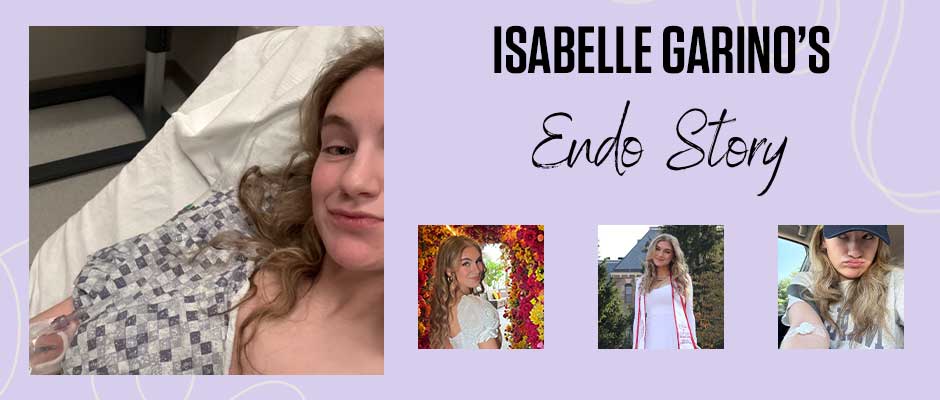
In high school, Isabelle Garino exhibited the intellect and tenacity of a leader. She was vice president of her school’s National Honor Society, captain of the mock trial team, and graduated with a 4.0 GPA. Three and a half years later, she graduated magna cum laude from Seton Hall University and is now a law student at Rutgers University. She already has her first full-time law position lined up for after graduation next spring, before she even takes the bar exam.
Those accomplishments came while Garino was continually battling debilitating pain, excruciating periods, and excessive bleeding that sometimes lasted for months, all because of endometriosis.
“As a law student with endometriosis, I’ve learned that zealous advocacy also applies to yourself,” Garino said. “You know your body better than anyone else. Don’t let anyone ever tell you otherwise.”
The facts of Garino’s story are straightforward. The reality was anything but.
Her symptoms began with her periods when she was 14. She started birth control at 17, and underwent successful surgery in March after nearly seven years of birth control failed to relieve her symptoms. But the real story is in the details of a young woman trying not merely to survive, but to flourish in a career she’s been pursuing since she was a teenager.
“My freshman year of high school was when I started missing school because I was in pain all the time. I’d clutch my side and try my best not to cry out, and I’d release the tension with an exhale, something I would eventually perfect,” Garino said. “My mom told me that bad periods just ran in the family, so I gaslit myself into thinking I was just being dramatic and needed to toughen up. I took four Advil every few hours and used adhesive heating pads until my senior year, when I was bleeding so much that my mom thought I was hemorrhaging.”
That’s when Garino saw an OBGYN for the first time and started on birth control.
“From then until my surgery this past March—from 17 to 23—I was put on every type of birth control you could be on,” Garino said. “She’d throw one at me and then try another after the previous one didn’t work. Or sometimes she’d try the same one to see if it would work differently. There’s that quote that insanity is doing the same thing twice and thinking the result would be different, and that’s kind of what we were doing. It never resolved any of the issues.”
Despite her symptoms, Garino fought through, never once considering giving up on law school.
“When I started, I was thinking, ‘How is this going to work when I’m in pain on the bathroom floor or curled in a ball?’ But I just pushed myself. I’d worked too hard not to. I was going to find a way to get through it.”
When Garino started at Rutgers, she kept what she called a “mini emergency kit” in her backpack.
“It had everything,” she said. “Advil, Tylenol, Aleve, adhesive heating pads, alcohol wipes to sniff when I was nauseous, disposable underwear, iron supplements. And I was like the mom to the other women on campus. If they needed something, they knew I had it.”
Garino’s self-advocacy kicked in at the start of this year after she had bled for nearly three consecutive months, leaving her iron levels severely depleted. When ultrasounds and other tests didn’t lead to a diagnosis, Garino said her doctor’s solution was to try taking two different birth control pills at the same time.
“I finally just had to say that I wasn’t taking another birth control pill,” Garino said. “Dealing with all of that while going to law school—I was fed up. I wasn’t doing that for the rest of my life. I didn’t want any more medications.”
Having done her own research—which included a time when she Googled on her phone “knife-like stabbing pain in abdomen” while crying on her bathroom floor—Garino convinced her doctor that she likely had endometriosis. The doctor referred her to a minimally invasive gynecological surgeon.
“I saw the surgeon in January. She said, ‘Yeah, you probably have endometriosis,’ and we scheduled the surgery for March,” Garino said. “I walked out of there and couldn’t believe how easy it was. My surgery was on the Monday during spring break, and I was back in class the following Monday, still with surgical tape on me.”
Garino said the surgeon removed endometriosis that was scattered across her pelvis, including on her ovaries. She also found a pool of blood in Garino’s abdomen. Today, six months later, Garino is feeling the best she has in a decade.
“I feel so much better. So much better,” Garino emphasized. “I still have a few dull pains, but I’m not bleeding like before. I don’t feel like a zombie. I don’t look ghastly pale from depleted iron reserves. And my periods are normal. I realize now that this is actually how they’re supposed to feel.”
Following her surgery, Garino visited her OBGYN to show her the pathology report and photos from the operation, hoping it would help future patients. Based on the doctor’s reaction, it should.
“She told me I was going to be the reason that she starts referring patients sooner to this surgeon,” Garino said.
As Garino has had time to reflect on what she’s been through, she realizes how her path to a diagnosis has reflected her journey toward becoming an attorney.
“When I got out of surgery and was told they found endometriosis, my mom told me that she was so proud of me for advocating for myself. And I realized she was right. I was my own client,” Garino said. “It was like going to court in a medical office, doing direct examinations and cross-examinations of my doctors. My exhibits and pieces of evidence were my bloodwork and symptoms. I was very persistent. My own advocate. My own attorney.
“You have to be a lawyer for yourself, even if you’re not in law school,” she continued. “Pretend you’re on Law & Order, in a courtroom, and you’re your own client. Who better to represent you than yourself, the one who knows everything about you? You know your history and what’s normal for you. Trust your gut and instinct, and don’t give up.”
*Patient stories submitted to EndoFound.org are the patient's views, not necessarily those of the foundation. All testimonials are from real patients, may not reflect the typical patient’s experience, and are not intended to represent or guarantee that anyone will achieve the same or similar results.