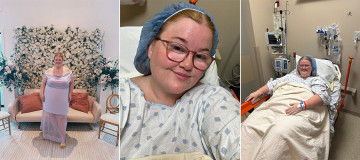


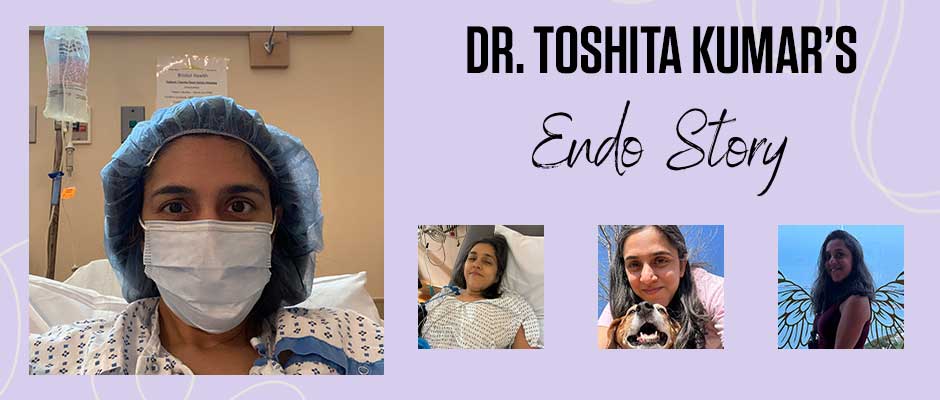
Toshita Kumar, MD, is the director of sleep medicine at Bristol Hospital in Connecticut. She is also board-certified in internal medicine, pulmonary medicine, and critical care medicine. When she reached out to EndoFound with her story, we were moved by her eloquent, poetic style, an uncommon way of describing the experience of living with such a debilitating disease.
Dr. Kumar’s symptoms began when she was in her 30s and continued for 15 years. She’s had two surgeries—the first in 2021 to remove a cyst, which led to the discovery of stage IV endometriosis, and the second in April 2025 to excise the endometriosis and perform a hysterectomy. She learned about the disease and was ultimately led to excision surgery not through her medical training, but primarily by reading other women’s stories in online forums.
“I want to share my story to show that, despite being in the system, I had the same struggles other women have,” she said.
Dr. Kumar has been feeling much better since the surgery and said she’s been lucky enough to be able to adjust her lifestyle—such as cutting back on long hours at work—to conserve her energy and focus on her health.
“But the system should not be dependent on us being lucky,” she said.
Here is Dr. Kumar’s story, in her own words, unedited:
First, I was furious with myself. How could I not have known something was devastatingly wrong? How had I accepted this level of pain as normal?
But that anger was naïve. I was in the perfect position to ignore it.
I was inside the medical system—trained by it, shaped by it. I knew this kind of pain would not be easily recognized or validated. It didn’t fit neatly into labs or scans. I had seen what happens to patients with invisible illnesses—the quiet skepticism, the subtle dismissal. So I did what I had been trained to do.
I translated my suffering into measurable terms—lab trends, anemia, numbers. I avoided the unquantifiable parts. The doubling-over pain. No one asked directly, so I didn’t volunteer it. I wanted to be a “good” patient—especially as a doctor.
Residency had already trained me to override my body. Hunger, fatigue, pain—all suppressible.
As an immigrant woman in medicine, you work twice as hard, stay twice as grateful, and never complain. There is no room for fragility.
So the inflammation continued. Ten, fifteen years of it.
Bleeding. Scarring. Fibrosis.
A pelvis later described by a gynecologist friend, after unexpected surgery, as “a hot mess.”
I remembered structuring my life around surviving my periods. Passing out on the toilet. Lying on the cold floor, thinking, “This must be normal. This must just be my body.”
Once a year, I would mention it. Gently. I was offered birth control pills. I tried them, felt unlike myself, and stopped. Instead, I turned inward: What did I eat? What did I do wrong?
It was easier to blame myself than to imagine the system—or colleagues—had missed it.
Now I understand there are two battles:
The first is to be diagnosed.
The second is to be managed.
And in between is a strange no-man’s-land where no one quite owns the disease. It’s labeled “gynecologic,” but it is whole-body—immune, neurologic, hormonal. It steals time, energy, clarity, intimacy, joy.
I once thought my delayed diagnosis was a personal failure. But millions of women live this story every day.
I also thought the impulse to make meaning from pain—to write, to create, to turn experience into story, art, or poetry—was simply how I had learned to survive it. I’m beginning to understand that I’m not alone in that, either. Women have been doing this for generations.
Still, how often did I wish for a different body? A reset? Even while minimizing my own suffering.
But suffering is not a competition. And silence does not make it noble.
So where do we go from here?
We advocate.
For ourselves first, even when it’s uncomfortable. Then for research, funding, earlier recognition, and better referrals. For language that validates rather than diminishes.
We teach our daughters that pain is not a character test. Not a requirement of womanhood. That strength is not enduring the unbearable.
The invisible does not mean imaginary.
*Patient stories submitted to EndoFound.org are the patient's views, not necessarily those of the foundation. All testimonials are from real patients, may not reflect the typical patient’s experience, and are not intended to represent or guarantee that anyone will achieve the same or similar results.