

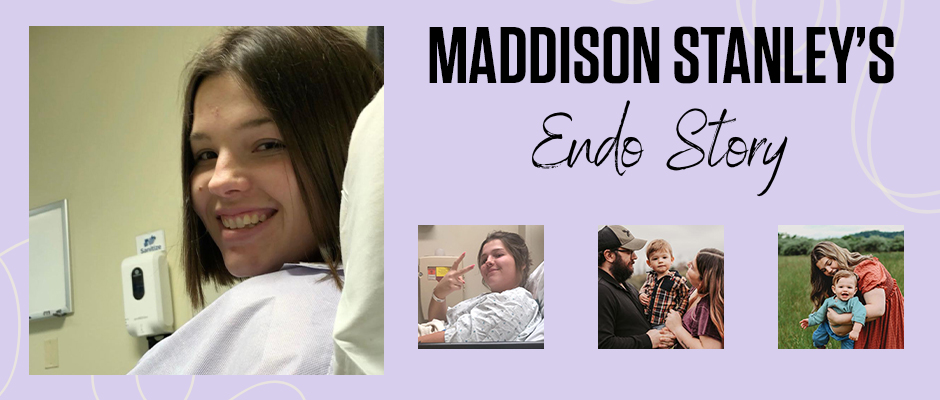
Maddison Stanley has been down a vicious health road that few women her age can imagine.
“It’s been difficult and emotional,” Stanley said. “I wouldn’t wish it on anyone. I hope things change with this disease and that people stop telling women that these things are normal.”
Wanting to be part of that change, Stanley, 25, shared her story with EndoFound.
Stanley is an oncology medical assistant from Shinnston, West Virginia, about 35 miles southwest of Morgantown. She started experiencing uncontrollable bleeding and pelvic pain when she was 12. Doctors put her on different types of birth control in middle school and high school, but nothing worked.
“Even when the birth control wasn’t working, they’d just say that everything I was feeling was normal,” Stanley said. “Sometimes I had to leave school early because I bled through my pants. The bleeding, the cramps, the pain—I was miserable.”


When Stanley was 19, a doctor noticed on a scan that she had an ovarian cyst. When he went in to remove it, he found endometriosis throughout her pelvic region. Stanley had never heard of the disease and was grateful to have a diagnosis that explained her symptoms, but that doctor was not qualified to treat it. Stanley received little guidance on how to proceed.
That same year, Stanley’s husband, Michael, was assigned to an Air Force base in Missouri. After settling into their new home, Stanley found an endometriosis specialist in Kansas City, about an hour away. She’d heard positive things about this doctor and liked her bedside manner, but Stanley didn’t know that the doctor’s treatment—laser surgery—was not the best method and could cause complications. As EndoFound cofounder Dr. Tamer Seckin has discussed, deep excision surgery removes the disease at its root and is the gold standard for treatment. Laser surgery only shaves it off at the surface and can create excessive and painful scar tissue.
“Once I had the first surgery, I pretty much had one every five to seven months for the next several years. It was an aggressive cycle,” Stanley said. “I’d get a cyst that wouldn’t go away, they’d go in for that, and then they’d find new endometriosis that they’d have to burn out. At one point, they said it was like plastic wrap around all of my organs.”
During these years, Stanley’s pain—physical and emotional—would continue. She had miscarriages in 2019 and 2023, had an oophorectomy of her right ovary, and was diagnosed with Von Willebrand disease, an inherited bleeding disorder that prevents blood from clotting. The best news amid all these trials was that she miraculously gave birth to a healthy son through in vitro fertilization in June 2024. She and Michael hoped he would be the first of multiple children, but the endometriosis and Von Willebrand disease were too much for Stanley’s body to handle.
After 10 laser surgeries (nine in Kansas City and one in Albany, New York, where they lived briefly), Stanley had her first excision surgery in Pittsburgh in April 2025. Unfortunately, while the surgeon was able to remove all of the disease, the Von Willebrand symptoms—specifically, the menstrual bleeding—kicked in to an extreme in the weeks that followed.
“My hematologist couldn’t control the bleeding, and I was having infusions multiple times a day,” Stanley said. “I couldn’t go to work or even take care of my son. I had no life.”
In June, Stanley had a hysterectomy in Morgantown to stop the menstrual bleeding. During that surgery, they discovered she had adenomyosis, significant scar tissue from the numerous laser surgeries, and more endometriosis.
“The surgeon said it took two and a half times the normal time it usually took him to do that kind of surgery because of the scar tissue and because my cul-de-sac was covered with endometriosis already—just since April.”
Stanley said she is “doing okay” today. Remarkably, she was back to work just five weeks after the hysterectomy and was relatively pain-free—until another cyst popped up at the end of August. This one is on her left ovary, the only reproductive organ the surgeon left. She will have that cyst removed at the end of this month and will probably have an iron infusion soon after that.
“I’m also still emotionally processing the hysterectomy,” she said. “It just came so quickly. We weren’t ready for something like that.”
Stanley and Michael started dating when they were sophomores in high school and married when they were 18.
“He was supportive of my pain and periods even in high school. He had a good mother who taught him not to be disgusted by a woman’s menstrual cycle,” Stanley said. “When we found out I had endometriosis, he jumped right in. He’s done research on how to take care of me and has been amazing. The hysterectomy has been hard on him, too, but he knew we had no other option.”
While Stanley can’t change her past, she knows that sharing her story could impact someone else’s future. She encourages everyone to fight for proper care when something doesn’t feel right.
“Do your research and advocate for yourself,” she said. “I always tell my oncology patients that if something doesn’t feel right, then it’s not right. Get a second, third, or even fourth opinion.
“With my symptoms, I was shoved aside by so many doctors,” she continued. “It’s not normal to be in pain all the time. Yes, we have cramps, but they shouldn’t be to the point that they are debilitating and you’re missing work, missing school, and bleeding through your pants or bed sheets. No matter what anyone says, those things are not normal.”
*Patient stories submitted to EndoFound.org are the patient's views, not necessarily those of the foundation. All testimonials are from real patients, may not reflect the typical patient’s experience, and are not intended to represent or guarantee that anyone will achieve the same or similar results.