

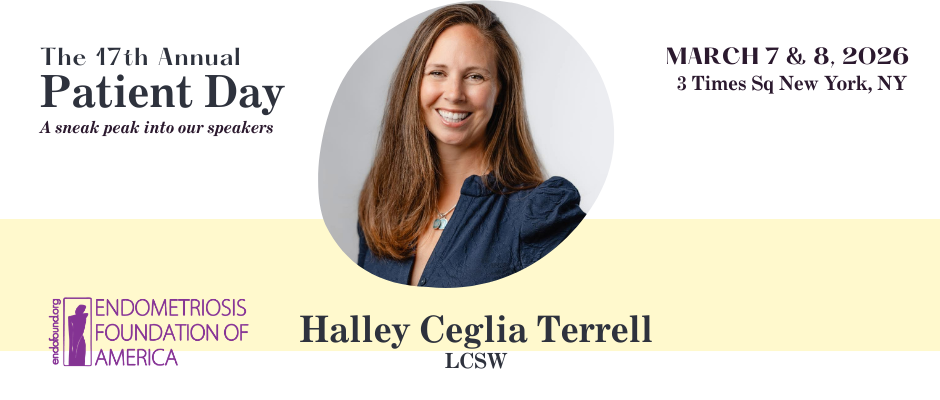
As part of our Patient Day Spotlight Series, we're delighted to spotlight Halley Ceglia Terrell, who will be speaking on the benefits for endometriosis patients of acupuncture and Traditional Chinese Medicine on Sunday March 8th. Register for the 17th Annual Patient Day today.
It took Halley Ceglia Terrell twenty-nine years to get her endometriosis diagnosis. That’s nearly three decades of navigating self-doubt and dismissal. Today, as a licensed clinical social worker, she channels that experience into her work with clients, many of whom are living the same story she once lived. For her, this therapeutic alliance itself—the sense that someone is truly on your team—is foundational. “I will be on your team,” Terrell explains of her approach. “I see you, and we’re going to get there together.”
At this year’s conference, Terrell will lead a session titled Persistence, Pain & Psychotherapy: A Dual Lens Approach to the Endo Journey. This dual lens is key. She brings both clinical training and lived experience to her work, and she believes that combination is what has been missing from the conversation around endometriosis and mental health.
The centerpiece of her session is practical: a toolkit that attendees can actually use. The toolkit has two layers. The first is practical and outward-facing, including preparing structured questions before medical appointments, rehearsing language to communicate pain clearly to providers, and learning how to advocate for yourself at these appointments. The second layer is internal, and Terrell draws on dialectical behavioral therapy, breathwork, gentle movement, and nervous system regulation to help clients manage the psychological weight of chronic illness. Chronic pain, she explains, often keeps the body locked in a constant state of fight-or-flight that has real consequences for sleep, digestion, focus, and emotional regulation. “A lot of my work is formulated around listening to your body,” she says. “Let’s quiet ourselves down to hear what our body is telling us.”
The toolkit also contains a framework for processing medical trauma, including reflective exercises like letter-writing to providers who dismissed or misled patients, and reframing anger and grief as fuel to move forward.
Many of Terrell’s clients don’t come to her as endometriosis patients. They come in for anxiety, depression, ADHD, or major life transitions. But from the very first intake session, she begins with the body and asks detailed questions about menstrual history, pain patterns, fatigue, and past medical experiences. “I always look at the medical parts of a person before we pursue what could be going on with their mental health,” she explains.
Time and again, she says, patterns emerge that no one has connected before. And when they do, her role expands beyond traditional therapy into psychoeducation and helping the clients understand their condition, identify the right specialists, access resources, and navigate a system that often fails them. As a licensed clinical social worker, certified health coach, and yoga and meditation teacher, she sees this broader role as a fundamental part of the job.
Equally important is reframing mental health symptoms within the context of chronic illness and pain. “You’re not crazy,” Terrell tells her clients. Depression, anxiety, and even PTSD symptoms are not personal failures but understandable responses to persistent pain and continuous systemic dismissal. In her session, she will discuss how these symptoms can become catalysts for change rather than a source of shame.
Belonging is another key theme in Terrell’s work. She encourages clients to seek out community, whether within family, peer networks, advocacy groups, or educational spaces, online or in-person, to identify where they feel supported. But most importantly, she encourages cultivating an internal sense of connection to your body. In early sessions, she asks not only about symptoms but also about where clients feel seen and where they do not. That awareness aids treatment planning and practical self-care.
Ultimately, if there is one thing Terrell hopes people leave her session with, it is that endometriosis patients are not alone. “There are real resources to help you through the pain, and all your symptoms can actually become catalysts that give you the strength to move forward.”
Register for the 17th Annual Patient Day today. Tickets are $50 for each day. Patients who would also like to attend the Medical Conference on Friday, March 6, can do so for an additional $50. For more information and to register, visit www.endofound.org/patientday.