


In statehouses across the country, endometriosis is gaining legislative momentum, and state lawmakers are taking notice. Thanks to the dedicated work of activists and policymakers, a growing number of states have introduced innovative legislation to address the pressing needs of the endometriosis community.
Such progress is exciting, yet it is unevenly spread across the country. While some states have made tremendous strides, others have not seen much meaningful legislative progress, leaving serious policy gaps in need of attention.
So, what can be done, and where can we go from here? To make future progress, we first need an up-to-date landscape of state legislation. As part of EndoFound’s advocacy team, I carefully researched each state’s endometriosis legislation and any bills introduced but not passed. This research revealed promising, but uneven progress across states, as well as an encouraging shift in the types of legislation states introduce.
Previously, most legislation was limited to resolutions recognizing Endometriosis Awareness Day or Month. While awareness resolutions are very important in drawing attention to the issue and building support for endometriosis, the next step is implementing policies that directly support those living with endometriosis. Many states are now taking that step by introducing more substantive policy solutions, such as required endo education in schools,improved provider training, and mandated insurance coverage for endo treatment.
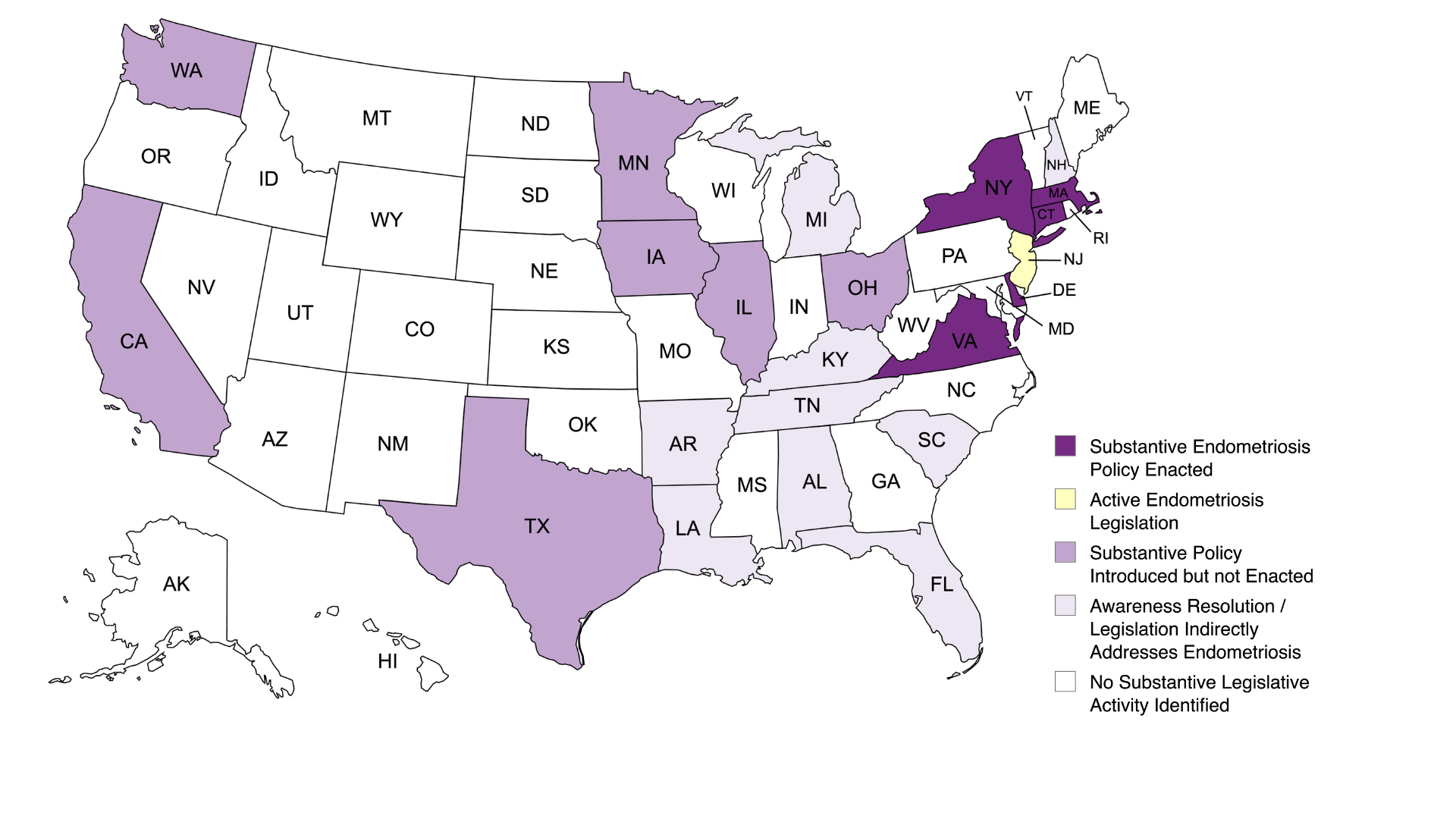
As of November 2026:
- 5 states have passed legislation addressing endometriosis with meaningful policy solutions
- 1 state has active legislation under consideration
- 7 states have introduced substantive endometriosis legislation that failed to pass
- 9 states have passed awareness resolutions or legislation that addresses endometriosis indirectly
- 28 states have no substantive legislative activity identified
Active legislation and current opportunities
This summer, elected officials passed endo legislation in three states. In Delaware, HB223 was signed into law by Governor Matt Meyer, which will bring educational resources about endo to schools across the state. In Massachusetts, an endometriosis task force was created through the passage of the FY2027 state budget. This task force will assess current endometriosis research and treatment, and it will then develop a strategic plan for the state to improve endo treatment, support services and awareness, which will be reported to the governor and legislature by June 30, 2027. Connecticut also passed endo legislation, establishing a state endometriosis working group.
Additionally, there are several active bills under consideration in the New Jersey legislature. These bills would establish a Women’s Menstrual Health Program within the state health department, require schools to teach students about menstrual health, and establish requirements for perinatal care providers to refer patients who have preeclampsia and endo symptoms for an endometriosis evaluation. Two of these bills, A2197 and A2181/2188, have had recent forward progress. Both were reported favorably out of committee at the end of October, which means that the legislative committees working on these bills voted in their favor, and they will move forward to the next step in the legislative process.
A total of nine states considered endometriosis bills this year, with encouraging success and ongoing progress in Delaware, Massachusetts, Connecticut, and New Jersey. Unfortunately, the bills in the remaining five states have not passed during their state’s respective legislative cycles. (If a legislative cycle—usually lasting two years—ends before a bill passes, the bill “dies,” and the whole process would need to start from scratch the next time the legislature convenes). Though disappointing, these setbacks are common; bills are often introduced in several subsequent legislative cycles before they are ultimately adopted.
The good news is that most state legislatures will begin a new legislative cycle in January 2027, at which time new legislation can be introduced. Advocacy between now and then can focus on increasing awareness and encouraging legislators to introduce endometriosis bills early in the legislative session, when they have the best chance of progressing.
Why focus on the state level? Legislation outside of my state won’t affect me. Plus, wouldn’t national laws have a bigger impact?
State advocacy is both a prudent legislative strategy and an incredible opportunity to implement policies that can bring widespread benefits to the endometriosis community. States are particularly promising for advocacy work, as it is often much more feasible to pass legislation at the state level rather than the federal level, and state legislation can often have a larger impact on individuals’ day-to-day lives.
States can also serve as “laboratories of democracy” by implementing new policy solutions before they are adopted by other states or the national government. Laws passed in one state can help pave the way for needed endometriosis legislation in another. In fact, states often “copy” one another by using a bill passed in another state to introduce similar legislation in their own.
For example, in 2023, Connecticut passed legislation establishing a state-sponsored endometriosis biorepository program, and in 2025, Minnesota lawmakers introduced a bill to establish a similar biorepository program in their state. Momentum is clearly growing as states follow the examples of their neighbors leading the endometriosis policy movement.
Endo advocacy successes in New York
One early leader in this policy movement is the state of New York. In the past several years, New York has experienced a series of endo policy successes—from early advocacy to raise awareness, to the enactment of state legislation, to ongoing efforts to pass new laws. This progression can serve as a roadmap for advocates and policymakers in other states.
Advocacy in New York began with awareness and education. To help adolescents understand endo and recognize its symptoms, EndoFound worked closely with state lawmakers to incorporate endometriosis education in the state’s Teen Health Awareness Campaign. These victories in awareness and education opened the door to then pass state legislation. In 2019, EndoFound and dedicated endo advocates helped secure the passage of a landmark menstrual health education bill. This law directs the state to produce educational materials about endometriosis and other menstrual disorders for students and healthcare providers. These materials have since been distributed to schools and providers across the state, increasing the reach and availability of endo education.
The passage of this legislation was a momentous victory, but the work has not stopped there. In 2026, state Senator Monica Martinez joined EndoFound and other advocates at the state capitol to advocate for a bill that would allow the state to incorporate menstrual disorders into its health education curriculum. This progression from awareness, to policy, to implementation, and to new legislation can serve as a guide for future advocacy in other states.
New York does not stand alone in this policy movement. Leaders from other states have worked tirelessly to promote innovative legislation and other avenues to support endometriosis. In Connecticut, Representative Jillian Gilchrest founded the Connecticut Endometriosis Working Group. EndoFound has collaborated closely with the Working Group, which has been very effective in securing numerous endo wins for the state, including spearheading the creation of EndoRISE, Connecticut’s statewide endometriosis initiative. In May of this year, Connecticut passed further legislation, establishing an ongoing endometriosis working group within the state Legislative Department. It will bring together patients with endometriosis, lawmakers, physicians, researchers, and healthcare administrators to evaluate and make recommendations on endometriosis diagnosis, treatment, research, education, and public awareness in the state of Connecticut.
Meanwhile, in Virginia, lawmakers have made the shift from awareness resolutions to legislative solutions. After designating March as Endometriosis Awareness Month in 2018, the state legislature passed a law in 2025 establishing a Women’s Menstrual Health Program to educate providers and patients about endometriosis and other menstrual disorders. Though the approaches and policy solutions can vary by state, they all play a crucial role in addressing the needs of the endometriosis community, and they help pave the way for future legislative success across the country.
What can I do to support state endo advocacy? There are many ways to get involved with state endo advocacy—even and especially in states without much prior legislative success. Lawmakers cannot pass legislation for a problem they do not know exists, so increasing awareness and education is a crucial first step. This can be done in a number of ways:
- Write to your representatives. Tell them about your own endo story and the need for policies that increase research, improve diagnosis and treatment, or promote education.
- Attend your local school board/town council meetings to educate your local elected officials about endometriosis. Ask them to incorporate endo education in schools in your locality.
- Sign petitions and write to government officials to support specific pieces of legislation.
- Join EndoFound’s dedicated advocacy team, the UpEndo Coalition.
No matter how you choose to get involved, state advocacy has the ability to make a profound impact, both for your state and the entire endometriosis community.