

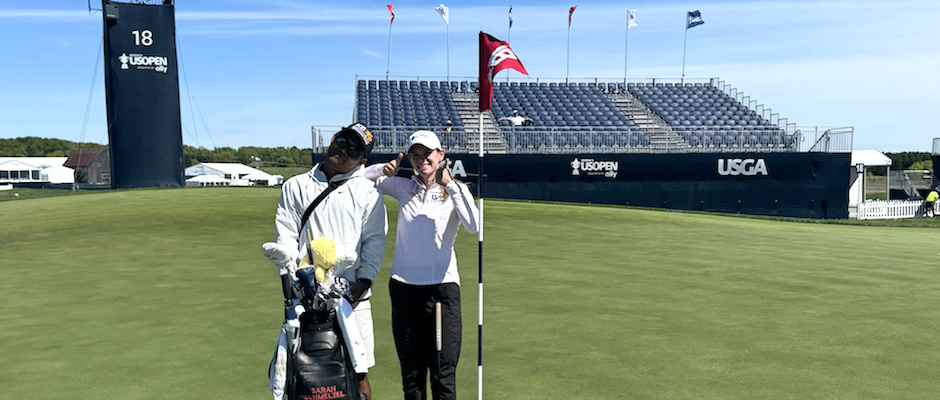
Since LPGA golfer Sarah Schmelzel turned pro in 2019, she has played in 166 tournaments, made the cut 77 percent of the time, and recorded 18 top-ten finishes. By any measure, she has built an impressive résumé.
Yet Schmelzel accomplished this while silently enduring a 15-year battle with debilitating pain and excessive bleeding stemming from deep-infiltrating stage IV endometriosis and adenomyosis.
“My surgeon said I had so many adhesions sticking my organs together that every time I swung, I was pulling organs out of place,” she said.
Schmelzel received a medical exemption from the 2026 tour after extensive excision surgery in December 2025. She’s spent the year rebuilding her physical and mental strength and looks forward to returning to the links in February for the 2027 season.
“I don’t like to look back at the ‘what if’ of what might have happened in my career if I didn’t have endometriosis. I really think where I am now is exactly where I’m supposed to be,” she said. “I know it may sound crazy to hear that because I’ve endured so much over the last 15 years, but it’s given me a new purpose, which I believe is to help other people through this disease.”
Schmelzel, from Phoenix, Arizona, was a gymnast and golfer in elementary school. In middle school, she quit gymnastics to focus solely on golf, a sport her older brother played and their father coached. Around the same time, she got her first period and quickly realized something wasn’t right.
“It was very heavy and uncomfortable, and compared to my friends, a lot more intense,” Schmelzel said. “Many times when I was on my period, I’d have to change into my gym uniform in school because I bled through my jeans.”
In high school, Schmelzel saw a gynecologist for the first time.
“I told her I had a sensation the week before where I sneezed and felt like my right ovary had exploded—it hurt so badly,” Schmelzel said. “She kind of giggled and said, ‘Welcome to womanhood.’”
Schmelzel repeatedly asked that gynecologist and other doctors she saw over the next decade if she might have endometriosis. She knew what the disease was as a teenager because her mother and two aunts had it, and their symptoms were similar to hers. But doctors repeatedly dismissed her concerns and offered nothing more than birth control as a solution.
“When she said, ‘Welcome to womanhood,’ that immediately normalized my pain and was etched in my mind at a very formative time in my life,” Schmelzel said. “I feel like you disassociate so much from the process as you’re going through it. I just thought, ‘Okay, I guess I have to deal with this. This is what being a woman is like.’”
In addition to birth control, Schmelzel took Advil or Tylenol for the pain and tranexamic acid for the bleeding.
“It was all about symptom control, and when nothing worked, I told myself, ‘You gotta be tougher than this because they said nothing is wrong with you. And if you act like something is wrong, you’re just being weak,’” she said. “That’s how I got through it.”
Schmelzel won several Arizona city championships in middle school, led her high school team to the state championship as a senior in 2011, and won the American Junior Golf Association Bass Pro Shops/Payne Stewart Championship by 12 strokes that same year.
Despite her persistent symptoms, she attended the University of South Carolina in 2012 on an athletic scholarship, 2,000 miles from home.
“South Carolina was really the only school that pursued me with a full ride,” she said. “I didn’t have any doubts about going so far from home at that point because I think I was young and naive. As I said, what that OBGYN told me at my first appointment shaped my thoughts about my period. It was just life, part of being a woman, and I had to deal with it.”
Her success continued in college, where she earned Southeastern Conference All-Freshman Team honors and honorable mention All-American recognition as a senior. All the while, her symptoms continued to worsen.
“There were times in college when I was on my period and bleeding so much and in so much pain that I would ask myself, ‘Should I be going to the hospital right now?’ But I was afraid that would be considered extreme,” she said.
“As much as I was gaslit by doctors, I gaslit myself. When you’re being told there are no solutions other than birth control and nothing is helping, you decide you just have to figure it out yourself.”
After graduating from South Carolina in 2016, Schmelzel turned pro in 2017 and joined the Symetra Tour (now known as the Epson Tour), the LPGA’s minor-league circuit. In 2019, she earned her LPGA Tour card and played in 25 tournaments, making the cut 20 times. Her world ranking improved and her earnings increased almost every year, even as her condition continued to deteriorate.
“Because it was adding layers of pain over time and not hitting me all at once, I’d say to myself, ‘Okay, it’s just a little bit worse than before. I can get through this,’” she said.
Schmelzel went off birth control pills in her late 20s and tried an IUD for six months. When it provided no relief, she had it removed and stayed off all birth control for good. “When I was on my period after that, it just got worse and worse,” she said. “I wasn’t functioning as a human anymore.”
One doctor finally did an ultrasound and found an endometrioma on each ovary but said they were nothing to worry about.
“I was told, ‘Well, you could have endometriosis, and you could have surgery, but there’s no telling if that will help you,’” Schmelzel said. “And at that point, I was so conditioned to think, ‘If it’s not going to help me, then I’m not going to try it because I’ve already been through so much hell trying to fix this.’”
One night in 2024, she woke up before her first major tournament of the season with the worst pain she’d ever felt on her right side.
“I was shaking, ice cold, feverish—I was hysterical,” Schmelzel said. She went to the hospital, where they did a CT scan and ultrasound. “They said, ‘You know, we might see some freestanding blood in your pelvis, but we think you’re just really constipated.’ They gave me some colonoscopy prep medication, and when I asked if I could play in the tournament the next day, they said, ‘Yeah, it’s all about your pain tolerance.’ So I played.”
Schmelzel missed that cut, along with six more in subsequent tournaments. Still, despite her family’s urging that she take a break, she continued playing and finished the year with a personal-best seven top-10 finishes, including second place at the Blue Bay LPGA in China.
In the summer of 2025, she experienced another incident similar to what happened at the start of 2024.
“I went to the hospital, and they asked if I had any medical history that could explain the pain. When I told them I might have endometriosis, they did a pelvic ultrasound, wrote on the diagnostic line in the discharge papers ‘endometriosis,’ and told me that I could go play golf,” she said.
“I remember after that hospital visit thinking that if a hospital can’t help me, who can? Genuinely, who can? I didn’t think there were any answers for me, so I kept playing. There were tournaments where I was in so much pain that I was counting down the holes. I would go into a porta-potty during a round and wonder how I’d get through the rest, but I’d find a way. It became so ingrained, like part of my identity.”
Schmelzel reached her breaking point in October 2025, more than 6,000 miles from home, while playing in the BMW Ladies Championship in South Korea. She finished 49th out of 77 players. Just making it through the tournament felt like a miracle.
“When I was at the hotel each night after a practice round or tournament round, I had to peel myself out of bed just to go downstairs for dinner. It was so laborious, but I didn’t really have any other way to get food,” she said. “After I’d eat, I’d drag myself back to the room and collapse in bed with my heating pad. I realized then how hard even the normal, everyday tasks had become.”
Schmelzel texted her parents, who were back home in Arizona.
“I said, ‘I really need help. Please find me an endometriosis specialist,’” she said. “Getting to that lowest point—where I couldn’t function and wasn’t enjoying any aspect of my life—was when I knew I had to have surgery.”
Schmelzel returned to the U.S. and visited a specialist her parents had found in Los Angeles. After considering her family history with endometriosis, her symptoms, and the endometriomas on her ovaries, the specialist told her she likely had the disease and that surgery would provide her relief.
He operated on her in December.
“It was stage four deep-infiltrating endometriosis with adenomyosis as well,” Schmelzel said. “I had so many adhesions throughout my pelvis that my reproductive organs and bowel were stuck together. My surgeon also had to carefully identify and free my ureters from the surrounding scar tissue to remove the endometriosis.”
When Schmelzel woke up from surgery, she was relieved simply to learn that she had the disease.
“It was that feeling of, ‘Oh my gosh. I wasn’t crazy.’ It was like I knew it but didn’t know it because I’d spent so long convincing myself that I didn’t have it or that it wasn’t as bad as it was,” she said. “Now, all of a sudden, it was okay for me to actually believe it had been affecting my life for so long. That was an unexpected feeling.”
Schmelzel described the surgery as the best thing that could have happened to her. She said it “completely turned my life 180” and that her day-to-day life has “improved dramatically.” Her recovery, though, hasn’t been easy.
“I think being a professional athlete and trying to return to that level definitely adds another layer to the recovery process. Needing to rotate your body for a living after having major pelvic surgery is certainly challenging,” she said. “I tried to train and come back this year, adding on slowly, piece by piece, but I wasn’t making a ton of progress. Around May or June, I decided that I needed to take this year off.”
Schmelzel said that while her pain and bleeding have significantly decreased, both symptoms still surface at different points during her period, creating physical and mental challenges.
“Dealing with adenomyosis feels like a moving target. Sometimes when I’m on my period, the pain and bleeding show huge signs of improvement. But other times, both symptoms can be really challenging to manage,” she said. “I do a lot of somatic therapy, which helps me both mentally and physically, and I have completely changed how I train from a strength standpoint. Endo took me away from so many activities, but now I’m trying to break the cycle of how guarded I was against movement for so long.”
She also wants to help break the cycle for those who are suffering from symptoms and don’t know what’s wrong or how to find proper treatment.
“The only thing that made me feel seen was being on Instagram or hearing a podcast and seeing or hearing someone openly say they had symptoms. Raising that awareness is the only way to get closer to a cure and earlier diagnosis, and I want to be part of that,” Schmelzel said. “I want to be there for those women who go to work every day with dreams and ambitions, but are wondering how they’re going to get out of bed. And for those girls in middle school and high school—I don’t want them to feel different like I did. I don’t want them crying in the bathroom before school, wondering how they’re going to make it through the day, or hating themselves in their own body because they feel so misunderstood.”
As for Schmelzel’s personal goals heading into her 2027 return, they have less to do with strokes and more to do with being kinder to herself.
“I work really hard and trust my process, so I expect to perform well, but I also expect a much different mindset,” she said. “I think I treated golf as the barometer for if I was okay or not, but now, I’ve learned to rest and honor my body and trust myself again. If I have bouts with a flare-up, I’m not going to blame myself anymore. I expect to be easier on myself and grateful for the place I’m in. I’m just excited to not push through anything anymore.”