

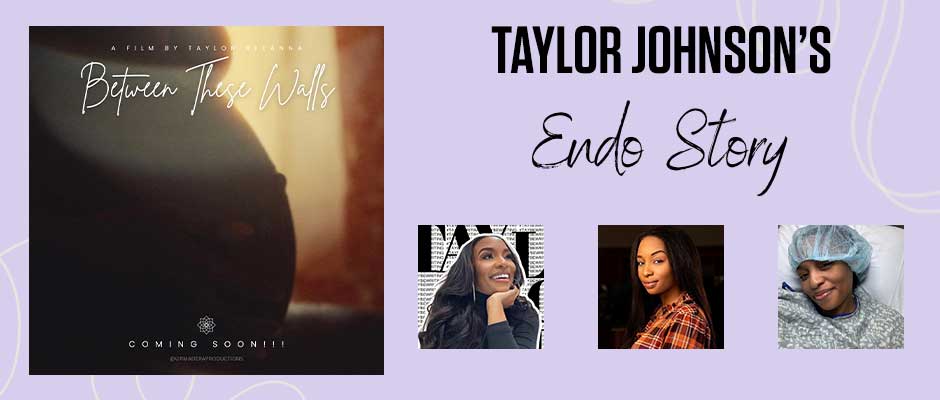
In 2024, Taylor Johnson’s screenplay, Between These Walls, was one of just a handful selected for the second round of competition in the Sundance Institute’s Development Track Program. Though her script did not advance to the renowned Sundance Film Festival, she hasn’t given up. In fact, her story recently grew even more compelling.
Johnson’s screenplay is about her years of physical, mental, and emotional suffering from fibroids. But during surgery six weeks ago, she was also diagnosed with endometriosis. She is now revising her script to include this new revelation about a disease she knew little about until then.
“The surgeon told my mom she didn’t know how I lived with the pain,” Johnson said. “We were not educated on endometriosis or that it had stages, so hearing that I was in stage four was discouraging.”
While Johnson dedicates much of her time to her work as a multimedia specialist for a K-12 school district, the screenplay and helping women who are seeking answers to their pain have become her passions.
“This road has been devastating and traumatic for me, but I realize I have a story here in little old Orangeburg, South Carolina, that can help other women see themselves,” Johnson said. “I think that’s the reward God has given me for having gone through this, being able to tell this story.”
Johnson, 33, had her first period when she was nine, though she didn’t experience any severe symptoms until she was 16. When she told her OBGYN about her painful stomach cramps, he told her it was nothing out of the ordinary and “some people just have it worse than others.” He suggested that she take Tylenol and “toughen it out,” so she did—for 12 years.
From the ages of 16 to 28, Johnson’s period each month lasted for eight days with heavy bleeding. She went through so many tampons that she eventually had to switch to adult diapers. She couldn’t work out at the gym for more than 20 minutes before running out of breath. Her arms, legs, and lower back cramped up to the extent that wrapping herself in blankets and heating pads was the only way she’d feel relief.
“The first three days of my period were the worst,” Johnson said. “I would vomit, pass out, crawl on the floor, and cry. I was so miserable that I remember sometimes praying to God that I couldn’t do this anymore.”
And that was just the physical toll. The mental and emotional effects were equally horrific.
“I was in a Verizon store one day when a lady came up and whispered to me, ‘Sweetheart, you’re coming through the back of your dress,’” Johnson recalled. “Another time, when I was cheering at a basketball game my senior year of high school, I went to the restroom after we came off the court, and the whole diaper under my uniform was soaked in blood. If I had stayed on the court any longer, it would have been so embarrassing. And through everything, I was still thinking this was normal, that it was okay.”
In 2021, when Johnson was 28, a new OBGYN in South Carolina did a dilation and curettage (D&C) to clean out her uterus, though the doctor wasn’t clear about what she was doing or why it should make Johnson feel better. Johnson had that same procedure a year later when her pain roared back, at which time the doctor suggested the pain might be in Johnson’s head.
With that comment, Johnson saw another OBGYN in South Carolina in 2024 for the same D&C, but then visited a doctor in Atlanta soon after. That was at the recommendation of Johnson’s cousin, who thought Johnson might have fibroids. That Atlanta doctor agreed that fibroids were likely the culprit and also mentioned the possibility of endometriosis.
“I was 31 years old,” Johnson said, “and it was the first time I’d ever heard of endometriosis.”
Johnson said the doctor offered to prescribe her medication that is known for managing heavy menstrual bleeding from fibroids and pain from endometriosis. But Johnson said that’s not how the doctor presented it to her.
“She said, ‘I can give you this new medicine that will cure endometriosis if you have it,’” Johnson said. While EndoFound co-founder Dr. Tamer Seckin considers excision surgery the gold standard for treating endometriosis, there is no cure for the disease.
“Cure was her exact word,” Johnson continued. “When I heard that, after not having answers since I was 16, I was like, ‘What? Cure it?’ She said, ‘Yep. I don’t know if you have it, but if you do, this will cure it.’ She never explained what endometriosis was and gave me a sample of the medicine before I left her office.”
Johnson learned quickly that the medication wasn’t a cure when it did little to alleviate her symptoms. Now armed, though, with information on fibroids and endometriosis, Johnson spent 2025 searching for a new OBGYN. She found one back in South Carolina, who said Johnson appeared to have four fibroids ranging in size from a cherry to a grapefruit. Johnson, now concerned about her fertility, was referred by that OBGYN to a fertility specialist who also had the skills to remove fibroids and endometriosis.
Johnson had excision surgery in March.
“It was supposed to be a three and a half hour surgery that turned into five,” Johnson said. “The fibroids were crushing my appendix so bad that they had to call in another doctor to remove my appendix, and the endometriosis was all over everything—my bowels, my bladder, my fallopian tubes. They had to remove one of the tubes.”
Johnson is grateful to still have what she said her doctor calls “a perfectly functioning uterus,” though Johnson knows the fibroids and endometriosis can return. Since the surgery, she’s changed to a pescatarian diet, consumes no dairy, and drinks herbal teas. She is also considering IVF, something that was emotional for her when doctors discussed the option.
“Even though it’s a blessing to have the opportunity to have a child through that process, I always thought I would get married and have children the natural way,” Johnson said. “Knowing that I could have to pay thousands of dollars to have this chance is mentally and emotionally difficult, and it’s all because of endometriosis. I don’t know if people really understand what endometriosis does to a person.”
Which is why she’s determined, through word of mouth, in writing, or, hopefully, on the big screen one day, to spread her story.
“My dream is to see Lupita Nyong’o lead the film with Viola Davis bringing it to life as a producer, Tasha Cobbs Leonard guiding the soundtrack, and my all-time favorite director, Ava DuVernay, as the director,” Johnson said. She said her research shows that Nyong’o, Davis, and Cobbs Leonard have each experienced fibroids or endometriosis. “They are the real heroes, women who continue to show up every single day, pouring into their craft and inspiring us through film and music, all while carrying a level of pain that still doesn’t receive the funding, research, or attention it deserves,” Johnson said.
Johnson knows her story may be overwhelming and heartbreaking to many who know it, but she also calls it “a joyful journey of trust and faith.”
“This is no longer a bad dream. This is my ministry. It’s bigger than me. My purpose and goal are to break the stigma of shame for women who are going through this,” Johnson said. “I’ve found a deeper kind of joy in writing Between These Walls, one rooted in purpose, in truth, in calling. This is my love letter to women, to our pain, our resilience, our beauty, and our strength. I won’t stop until it’s brought to life on screen, until women everywhere can finally see themselves fully, honestly, and unapologetically.”
*Patient stories submitted to EndoFound.org are the patient's views, not necessarily those of the foundation. All testimonials are from real patients, may not reflect the typical patient’s experience, and are not intended to represent or guarantee that anyone will achieve the same or similar results.