

“Twenty-four years.”
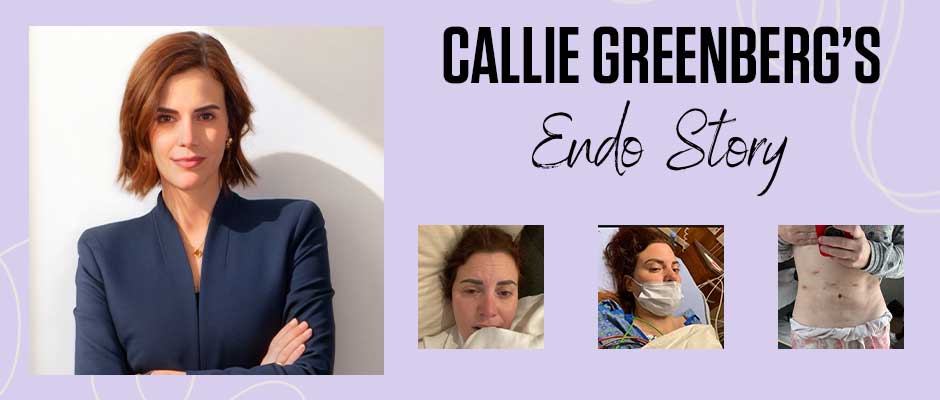
Callie Greenberg repeated that phrase during an interview last month about her endometriosis journey. She was referring to the 24 years it took before, one day, she finally found a doctor who showed her compassion, listened to her, and concluded that she likely had the disease.
“That was four years ago, when I was 37,” Greenberg said. “The only time I’d ever heard of endometriosis before then was when [actress and writer] Lena Dunham talked about having it. I felt like I related to her story, but even then, I didn’t think that was me. I thought if I had it, certainly one of the many doctors I’d seen over 24 years would have caught it.”
Greenberg is a Denver-based medical device sales rep and the founder of Own My Endo, a platform that helps women and girls find answers to their symptoms and advocate for themselves. She hosts a weekly podcast at ownmyendo.com called “Endo Warriors,” which features endometriosis patients and women’s health professionals sharing their stories and expertise. Greenberg started the podcast just three months ago, yet it is fully booked into late spring.
“I wanted to give women a platform that I didn’t have growing up,” she said.
Greenberg said the common theme among most of her guests mirrors her lifelong experience: repeatedly being dismissed. Greenberg saw a gynecologist for the first time when she was 13. She’d already missed a lot of school, athletic events, and social functions due to every symptom imaginable, including heavy blood flow, debilitating pelvic pain, nerve pain, back pain, and migraines—sometimes all at once.
“I’ll never forget that first visit,” Greenberg recalled. “I was in so much pain, but she said everyone has periods and there was nothing at all to be concerned about. She sent me home and told me to take ibuprofen and use a heating pad.”
The next 24 years were unrelenting and terrifying. Relief was fleeting. Like many with endometriosis symptoms who haven’t heard of the disease, Greenberg and her family didn’t know what questions to ask doctors and put all their faith in them.
When Greenberg was a young teenager and a doctor prescribed birth control, she bled for the first 13 days. She’d stay on it for more than two decades because each doctor she saw told her she should, though it rarely helped.
During one of her numerous emergency room visits for severe pain, a doctor told her that she had several cysts on her ovaries.
“He said they were common and would take care of themselves, and then he discharged me,” she said.
At 18, Greenberg spent a week hospitalized with a stomach “so distended that I looked like I was pregnant.” The doctor blamed it on an antibiotic Greenberg was taking for an illness.
“He said I was likely allergic to it, so from 18 to 37, I thought that was the case,” she said. “And they never could explain why I was in the amount of pain I was in.”
As a medical device sales rep, Greenberg’s presence is sometimes required in surgeries.
“I had times when I’d be in the OR, get a sharp stabbing pain, and have to excuse myself,” she said. “I’d go into the bathroom, close the stall door, wail and cry on the floor, then pick myself up and go back into the OR.”
Greenberg eventually began to question her sanity.
“When all these different doctors are all looking at you, reading the same medical history, and insisting nothing is wrong, you start to think, ‘Am I making this up?’ ‘Is this all in my head?’ ‘Am I just weak and can’t handle the pain?’ My friends and I never talked about our periods, so I didn’t know what was normal.”
When Greenberg was 35, she stopped taking birth control, expecting her pain couldn’t get any worse.
“I thought I was dying when I went off it,” she said. “It was like there was barbed wire in there, like someone was stabbing me over and over. My husband would have to physically pick me up from the bathroom floor and carry me to the bed. I ended up in the ER five months in a row.”
During one of those trips, Greenberg said she was “sweating, shaking compulsively, dry-heaving, and had no color.” A nurse asked Greenberg to rate her pain level.
“I told her I was at a 30,” Greenberg said. “She looked me in the eyes and told me that I didn’t know how a pain scale worked. She said one was nothing and 10 was the worst. I thought, ‘Oh, I am not the person you want to say that to!’”
It was a pivotal moment for Greenberg’s self-advocacy.
“I told her that I was very aware of how the pain scale worked,” Greenberg said. “She then looked at my husband and asked him if I was on anything.”
After drawing blood, the nurse offered Greenberg two options.
“She said she could send me home with OxyContin, or I could have emergency surgery with no idea what for or what would happen.”
Greenberg chose a third option.
“I ripped out my IV and told my husband, ‘Let’s get the [expletive] out of here.’”
During her next ER trip, after her husband carried her into the hospital, Greenberg again had to fight for herself against the medical professionals who were supposed to be helping her.
“They said it was likely appendicitis, called an emergency doctor in, and prepped me for surgery without doing a CT scan,” Greenberg said. When she insisted they do a scan, they pushed back, but she eventually won the battle.
“They would have done an unnecessary surgery. It wasn’t my appendix,” Greenberg said. “The scan showed I had multiple large ovarian cysts. But, again, they told me it was nothing to worry about, it would take care of itself, and I should follow up with my gynecologist.”
In 2021, Greenberg’s friend referred her to her own “amazing” gynecologist. That appointment changed Greenberg’s life.
“All that doctor did when she walked in the room was look at me and say, ‘Tell me what’s going on,’” Greenberg said. “She sat with me for over an hour, let me speak, and never interjected as I gave her everything I’d been through over 24 years. When I was finished, she gave me a hug, told me how sorry she was, and said, ‘I believe you have endometriosis.’”
The doctor explained the disease to Greenberg and that it could cause infertility. Uncoincidentally, Greenberg and her husband had been trying to have a child for more than a year without success. The doctor referred Greenberg to an endocrinologist, who saw Greenberg four days later.
“After going through my chart, without doing any exams or tests, she said, ‘You have one of the worst cases of endometriosis I’ve ever seen in my 20 years of practice,’” Greenberg said. While endometriosis can only be officially diagnosed through surgery, 24 years of notes and images from previous doctors made the obvious… well, obvious, at least to a doctor with experience dealing with the disease.
“She did excision surgery, and when I woke up five hours later, she explained that the endometriosis had taken over everything,” Greenberg said. “I had multiple endometriomas on both of my ovaries. My fallopian tubes were completely blocked. I had masses inside and outside my uterus, and attached to my bowel and bladder. I also had a septum growing in my uterus that she had to remove. Once I was in recovery, she said I had just a 1 to 3 percent chance of ever conceiving, even with the surgery. She also said, given how advanced the endo was, that it was likely going to return within 18 to 22 months.”
Greenberg tried four rounds of IVF after surgery, all of which failed. In 2023, just as the surgeon had predicted, the symptoms and endometriosis had returned. Greenberg had a full hysterectomy and went into menopause at the age of 39.
“For the last two years, I’ve been dealing with everything that comes with menopause, along with all the grief and anger from the fact that it took me 24 years to get a diagnosis while living with a disease that destroyed my chances of having children,” she said.
Sadly, the years of distress also contributed to the end of her marriage.
“This disease affects every relationship you have,” she said. “I became completely isolated and felt very alone for so long. As I look back on those 24 years, everything now makes so much sense. I have flashbacks of so many hardships that now make me realize, ‘Wow, that wasn’t X, Y, or Z. That was endo.’”
Greenberg still faces emotional struggles, along with flare-ups and fatigue.
“But I have a life now,” she said. “The podcast helps, along with everything else I’m pouring my heart and soul into. I have some things in motion that I think are going to be super beneficial for the community and younger generations.”
Reaching younger generations, especially girls who are nearing their first period, is critical to her.
“If someone had just believed me when I was 13, would I be having this conversation with you? Even if I had known about endometriosis in my 20s, I could have frozen my eggs,” she said. “For me, it was 24 years before I was diagnosed. But even if it’s six months, no one should have to go that long when you present symptoms that are not normal.”
*Patient stories submitted to EndoFound.org are the patient's views, not necessarily those of the foundation. All testimonials are from real patients, may not reflect the typical patient’s experience, and are not intended to represent or guarantee that anyone will achieve the same or similar results.