

Endometriosis 2026:
A Nerve-centric Disease
Medical Conference - March 6-7, 2026
3 Times Square, New York City
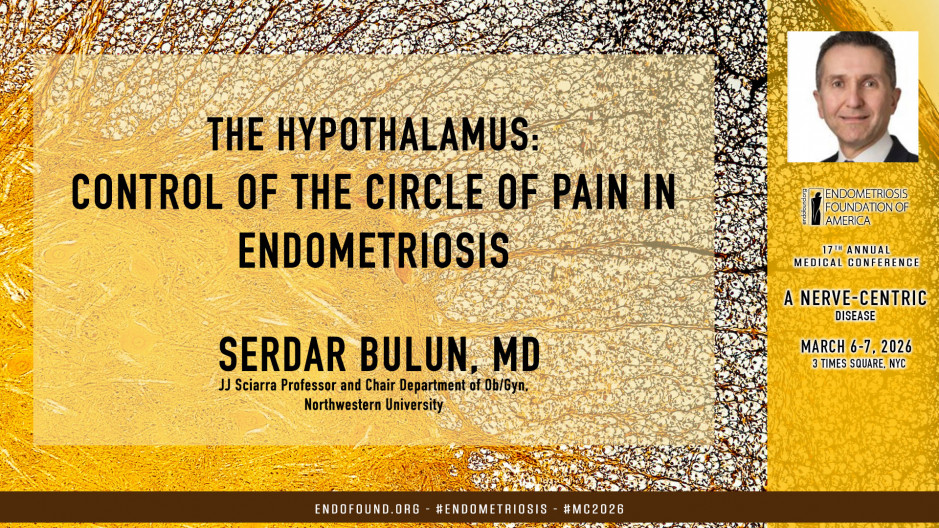
Thank you. Today, I would like to emphasize the role of ovulation, retrograde menstruation, and the role of nerves in this paradigm. As Tamar last night emphasized, I think the most important thing that we should think about are our patients. I mean, what do our patients want? What do they feel? And one of the most important things is when we manage endometriosis, we manage pain. And then where does the pain come from? But again, let's not forget how we get there. I argue that endometriosis is the ultimate gynecologic disease. And these are these poor patients who get through ... The disease starts in the teens and they all go through these decades. And many of them end up in hysterectomy, which may or may not even address pain.
Again, let's not make any mistakes. Endometriosis starts with ovulation. And the ovulation starts at hypothalamus. In an adolescent team, what starts menses or the menarchy are the maturation of the nerves, the GNH secreting neurons in the hypothalamus. This starts this entire cascade. And again, no ovulation, no endometriosis. And I'm not going to get into the details of it, but you could always read my review for that. Once we get into these other situations in which ovulation happens, retrograde menstruation happens, there are nerve tissues that are stimulated in endometrium and on peritoneum. I feel like we are now talking about tertiary syphilis. I mean, the problem has already started.
I always show this slide and Tamak gave this picture to me and I shamelessly forgot to include his name in the publication. And I'm sure he will always remind me this. But this is the key slide. If this is a woman tamatic laparoscopy on a woman who just menstruated, and this is what the pelvis looks like. And Emin who's here and Tamara and their friends, they very elegantly show now that endometriosis happens because of this retrogradely menstruated tissue together with blood, because they very elegantly matched all the mutations through DNA evidence of utopic endometrium to endometriosis. So endometriosis originates from eutrophic endometrium.
How do the nerves get into this? I'll get to that in a second. Another important thing to recognize is the retrograde menstruated material, the quality and the quantity of this material is extremely important. The endometrium goes from a couple of millimeters to 10 to 12 millimeters right before menstruation. We all know that. And there are layers and layers and layers of the stromal cells with a single layer of epithelial cells. And all this material together with blood goes back into the abdominal cavity after an ovulatory menses. Whereas in a patient who's taking birth control pills, endometrium is all thinned out and very few cells can be carried by blood back to the tubes into the uterine cavity. So this is an important detail to remember that's why birth control pills are absolutely suppressive of both ovulation and endometriosis.
Imanian colleagues, they concentrated on the mutations in the epithelial cells in the utopic endometrium and the retrograde menstruated material. For the past 30, 35 years, we have been concentrating on the stromal cell. Probably the majority of the cells in endometriosis are these stoma cells. And except for rare mutation, most of these abnormalities are epigenetic abnormalities. That means the DNA is programmed in a defective manner in these utopic endometrial stromal cells that go back into the pelvic cavity. And this is the reason why we came up with this vicious cycle over the years. All of these are defectively programmed DNA consequences of epigenetic abnormalities, including these transcription factors who are not supposed to be expressed in these stromal cells, leading to aromatase and other stereogenic gene expression, leading to estradiol formation, leading to progesterone resistance, and leading to this perpetual production of prostaglandin-82 and estradiol. And are these important?
They are because if we use COX-2 inhibitors or other NSAIDs or aromathese inhibitors, they stop pain. And I would like to try to connect this to the nerve situation in a second.
Again, when we talk about some of the other speakers, I'm sure they covered this, but what is a naceptor? They are like either free nerve endings or nerve endings ending up in another cell in the target tissue, target organ, such as the peritoneum. And they may make a straight connection to the spinal cord, or this could be modified by a sensory ganglion that exists in the body. And it's almost like, I mean, this classical picture whereby if you stick a needle into the skin, these nacicceptors, mostly like these nerve endings, free nerve endings, make a connection to the dorsal root of the spinal cord where the neuronal body exists.
And I would like to start with this, then the lesion through which these nerve endings start transmission of pain, and that goes through the dorsal roots of the spinal cord and the neuronal body, of course, exists in gray matter. And then it goes, the second connection goes straight to the brain. And again, I'm not a pain expert in the brain, but the thalamus is a very important first connection, whereas there are several other connections that are unknown, but there are connections to the cortex and connections to the hypothalamus. The key is that concerns my research is this.
These nerve endings here, they do include these classical, now we can call it classical pain receptors, TRPB1. And very elegantly recently, I think woo et al show that prosaglandin E2 and others show that estradiol modifies this connection. So this occurs, the role of PG2 and estradiol occurs right at the lesion that we all studied over the years, but others also found that there are prosaglandin E2 effects even in the central nervous system in spinal cord. And estradiol also modifies this through ER beta. So how do we end up back in hyperthalamus? I recently checked out a very innovative paper in the bio archives by Dr. Hayashi, and they very elegantly show that microglia are microglial cells, which are some sort of astrocyte. They are increased in number, not only in thalamus or hippocampus or cortex, the classical pain perception areas in the brain, but also in hypothalamus.
So we are sort of like the generation neurons are in the hyperthalamus. Now we are back to hyperthalamus to start the pain. Hyperthalamus is the troublemaker. I mean, it starts ovulation as a result. The retrograde menstruation happens with humongous amounts of endometrium going onto the peritoneal surfaces. Then they sort of tell the hypothalamus, "Maybe don't do this. " This is like hurting the entire system. I'm not sure. We got into brain research in my laboratory because we were interested in the role of estrogen in the memory function and Alzheimer's disease. And we have tools to knock out, for example, aromatase in different portions of the brain. And we are hoping that in the future we use these tools to also ER alpha to study pain that may be originating from the peritoneum. So I always show this slide about the GNH neuron causing all these issues, but in the future or from now on, I'm going to add this part, which kind of completes the cycle, if you will.
And now from another neuronal body sending another message to hyperthalamus, and who knows what it says. So I think this is another ... And I really would like to thank Tamara and all of you for inspiring these thoughts. I did not think about hypothalamus that could act in this manner, but maybe there's something there. Thank you. I