
Patient Day 2026
Mapping Pain: Pelvis to Brain
March 7-8, 2026
3 Times Square, New York City
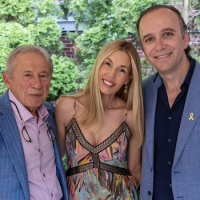
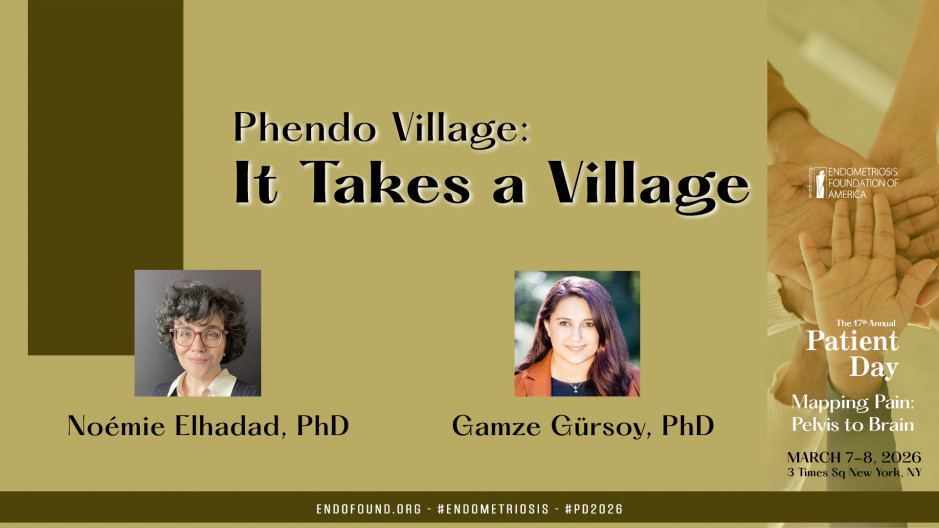
Hi everyone. We have a very enigmatic and mysterious title. The point of this session is to tell you about our research and we're both researchers. We're also both patients with endometriosis and we are starting a new project called Fando Village. And the goal of the session really is to tell you a little bit about the study, but really to have it be very interactive and hear from you what would make you want to participate in this study. Okay? So who are we? We want to tell you about genetics of endometriosis and this new study, Fando Village. I'm Noemi. I'm Noemi El-Hadad. I'm chair of the Department of Biomedical Informatics at the Medical School at Columbia University. I am also the lead director of the AI initiative for the medical school at Columbia University. And I do a lot of research in artificial intelligence. I'm a computer scientist by training in human-centered AI, which is this new field that maybe you'll relate to as users of AI that says that AI is actually built for humans and for the betterment of humanity rather than making it difficult for humans to continue being part of humanity.
And I also do a lot of research on endometriosis. As I said, I'm a patient myself and about seven years ago, I decided to move a lot of my work in women's health and in endometriosis in particular. And so I lead the Evan project and it's a data-powered women's health initiative at Columbia University. And I also lead specifically for endometriosis, a project called the Citizen Endo Project. And part of it is an app called Fando, which you might have heard of. We have a table over there, and I'll tell you a little bit about it. Fendo is a research tracking app for people who have endometriosis to day-to-day, tell researchers about their symptoms. I want to introduce Gamse Gersoe, who's right here. Gamze is a faculty in my department in biomedical informatics. She's also a core faculty at the New York Genome Center, and her research is on privacy and security.
These are very important terms when we collect a lot of data that's sensitive about patients and in machine learning and AI and genetics and genomics. And Gamze is also a patient with endometriosis. And so Gamze has joined this project with a personal interest, but also a lot of expertise in genomics and genetics. I'm actually going to get Gamze to tell us about the rest of the project for a second.
Hi, everybody. Do you
Hear
Me? Yes. So as Noemi mentioned that I am interested in endometriosis because I'm a patient myself, but also I feel like my background, both in genetics and genomics, as well as privacy and security can bring unique perspectives to how we understand and the most importantly, how we early diagnose this disease. So I just want to talk about a little bit what the genetics tells us so far and what we don't know and how we can get there. So you probably did not hear about this term called heritability in diseases. So how we measure heritability means that there's a large genetic component of a disease. And how we measure it usually is we look at twins because twins are genetically very similar. So if they are experiencing the same disease, that usually means that there is a genetic component to that disease. And how it works is we do genetic sequencing on the twins, and then we looked at the phenotypes, diseases that they experience to understand which of these diseases have genetic component.
So in endometriosis, it has been shown that when you do twin studies, about 50% of the patients are actually experiencing the disease because of a genetic component. So that just means that there is 50% heritability. So if your mother experiences or your sister experiences, there's a high likelihood that you will experience as well.
So basically roughly half of your risk for endometriosis is basically written in your DNA. So there are also other types of genetic studies because it's very difficult to find twins that experience the same disease. So what we usually do in the field, in human genetics field, is this thing called genome-wide association studies. What it does is it collects data from patients and also controls. And then for every single genetic mutation in your DNA, it asks the question, "Do I see this more in the patients compared to the controls?" And by doing that for every genetic mutation, you can basically tell if there is a mutation that is associated with the disease. So when they do this study for endometriosis, they could only explain 26% of the heritability of the genetic basis of endometriosis. And there are many different reasons for that because GWAS is limited in looking at common genetic variations, meaning that if a genetic mutation is common in the population, then you can tell something about it.
But if it's very rare in the population, you cannot actually associate it because you never have enough patients at hand. And there are also certain types of mutations that you don't look when you do GVAS because the technology does not capture those type of mutations. For example, one of which that I'm very interested in is copy number variation. So we think that because of these gaps that GWAS has, it is only explaining 26% of what we observe in twin studies.
So now we want to move beyond GWATS because of these limitations to be able to understand how we can find all these genetic mutations that might be causing endometriosis. So we want to use new technology, one of which is whole exome sequencing, which means that we would be able to sequence every single gene in your genome rather than what the old technology that GWAS was using was just a select number of genetic mutations. And when you do whole exome sequencing, you don't only get regular mutations that you would use in a regular association study, but you can get some different things. For example, the structural changes in the DNA, which I mentioned, which is called copy number variation. We also are interested in trio-based sequencing. What does threo-based sequencing means? It means that when we sequence a patient, we would like the sequence also their mothers or their unaffected sisters or even their fathers.
Because some of the rare genetic mutations, because they are so rare that we don't have power to capture it from the population, by looking at the family structure itself, we can see what is being transmitted from the parents to the child and what is being acquired as a new mutation. And that way we can actually tell whether these rare mutations have any effect on endometriosis. And of course, we don't want to keep this study just trio based because if you don't have any family members to participate this study, you are still more than welcome because the more is the marriage, right? As I mentioned, that we want more patients that have harbored these genetic mutations. And where is the inspiration coming from for this study is actually the autism research. So for years, people search for the genetic basis of autism, and they sequence many, many children to find if there is any common genetic variation across them.
And only when they realize that the signal was hidden in the rare mutations. So all of these children were harboring rare mutations and also these structural changes. And how they figured that out is by basically sequencing the mothers and the fathers. And then it turns out that the fathers generates new mutations in their sperm that gets inherited to the child. And those mutations are likely the genetic basis of autism. So we got really inspired by this because there is high heritability in autism, but you don't see that when you just do regular genetic studies. So we thought that perhaps a similar thing happening in endometriosis, and the only way to find out is to do the study. There is also a lot other issues why we cannot do regular genomide association studies that comes with how different the patients experience this disease. And for that, Noemi is going to talk more about that.
Thanks, Gamze. So you must know as people who are sitting in this room that endometriosis means many different things for many different people. There's different ways in which we experience it day-to-day, but also from one patient to another. And there's been a lot of work in the research field of enometriosis trying to understand what are the subtypes of endometriosis. Why do we care about this is because first of all, when we have an estimated six to 10% of a population that has a disease, it's very unlikely that it's just a single disease, right? It's just too broad of a population that's being affected for it to be explained by one thing.
And so you must have heard of stages, stage one to four of endometriosis. Others have thought about disease subtypes by the types of lesions that we have in endometriosis going from superficial lesions to endometrioma in cysts in the ovary to deeply infiltrated endometriosis. There's also adenomyosis, which some of you might already know about, which is endometriosis within the muscle of the uterus. So why do we care again about these different subtypes is that probably they could be explained by different causes or they could be treated differently. And right now, as you know, we're treating them all at once and without enough precision probably. And so we want to understand very carefully what are the subtypes of disease, but there is also ... Sorry, I'm going to ... There's also other ways of describing the variation and potential subtypes of disease, and that comes with the symptoms.
And in fact, there's been some research that has shows that the way we experience the disease day-to-day, the type of symptoms we have, might actually not correlate very well with what we find on a pathology surgery report. And so in other words, there might be some people that are asymptomatic, and when they get surgery, they for some whatever reason, for the most likely one is they have appendicitis, they get surgery, and we find endometriosis there, but there's no symptoms. Others have debilitating symptoms, but when we look into a laparoscopic surgery, might find just a superficial type of endometriosis. And so that doesn't mean that the symptoms are wrong or the subtypes are wrong. What it means is that it's very complex. And we still, as researchers, have not understood how the symptomatic variability and these surgical kind of characteristics are actually interacting with each other.
And so when we're thinking about it from the standpoint of what Gamze has described, which is this genetic variation and potentially rare coding type of mutations, it's very useful to know for us, not only what do people have, do they have anometries is yes, no, but more precisely, what type of symptomatic variations do they have? What type of surgical variations do they have? And so that we can start mapping from the genomic variation mutation, genetic mutations to these variations. So this is where the Fendo in fandovillage comes in. We had built this up, FanDo many years ago now, more than six years ago, in the hope of actually capturing this symptomatic variation. Researchers love data, and before this app, there was no dataset where we could study scientifically, really carefully study what are the different day-to-day symptoms that women with endometriosis experience. And so this app allows us to do this.
There is very granular symptom tracking where you can track your pain very carefully according to where it's happening in your body, time of the day where it happens, type of symptoms, others, and pain. And we've done a lot of research in ... In fact, as soon as we had about 2000 participants, we did research in trying to identify subtypes of endometriosis based on these symptoms, and we found some really interesting, very complementary types of subtypes to the ones that were surgical in nature.
And so now we have about 21,000 participants worldwide. It's a free research app. And I want to emphasize because it's important nowadays that first of all, it's free. It's research and it's HIPAA compliance. So none of the data is shared with anybody. It's only for researchers at Columbia University and our research partners. Research partners are other universities like Mount Sinai in particular that are recruiting together with us. There are many other participants from many different countries. In fact, we have more than 70 countries represented and it's a multilingual app. What the other important thing I want to mention is that, and this is why we're excited to talk with you today, is that all of the app was actually designed using the principles of citizen science. So in partnership with patients, I think that maybe you feel this way, but I definitely felt it as a patient when I started this work, I think that we as patients have a lot to say about what the disease is and maybe not surgically because we don't have access to understanding our inside our body, but we understand our symptoms.
And so every question in the app was designed together with patients and with the help of Endometriosis Foundation of America, in fact, where we did focus groups and interviews and surveys. We also went online and did AI on all sorts of subreddits and online communities, trying to get a sense of the swath of symptoms that people talk about when they talk about their disease. So that's the kind of thing you can be tracking on it, but the point again is that what it allows us to do is understand better the disease from the standpoint of patients. And we've had a lot of publications that we've put on our website and you're welcome to take a look at them. We also have videos and other things and interviews that explain the results of the research so far, many different aspects of it. I will say in two words, one, patients are diverse.
Indeed, there are many different subtypes of disease. Second, we've learned from our patients that even though they love to track for the sake of science, they also love to track for their own sake. And they asked us following the principles of citizen science, how can I use this app so that it can help me talk to my doctor? And we've built tools and I have carefully studied, in fact, all the ways in which doctors and patients are misaligned sometimes when trying to work together towards managing endometriosis. So what is Fando Village? Fundo village is this idea of doing the trio sequencing. So the village is because there's many people in the village. There's a patient and there is a biological mother and a sister. There could be other biologically related people in there. And there's a friend. Why do we need a friend? We need a female without endometriosis because the way sequencing is done is it's better to have a control at the time of sequencing.
That's called the batch effect, and we can describe this to you in better details, but that's a very common way of making sure that what we find in the data analysis is not due to some weird artifact of the way the genetic code was analyzed. The type of data we are asking our participant to provide to us is this whole exome sequencing. So providing us with a saliva, some saliva, and then we extract DNA and we can do whole exome sequencing so that we can look for these very specific rare variants and copy number variants that Gamze talked about. We want to know the variety of subtypes of endometriosis. And so we're asking for two more things, the pathology report from the surgery of the person who was diagnosed with endometriosis, and we are asking for people to use the FanDo app so we can have these day-to-day variations.
So I want to say that the study is approved by the IRB. The IRB of a university is the set of people who pay attention to, is this ethical, is this private? Are you respecting the privacy and the security of patients, et cetera? It's all approved by your IRB at Columbia University. And we're about to start recruitment and we'd love it if you were part of it, but really for today, what we're interested in is what's your first reaction? We want to communicate about this study and we want it to be as successful as possible and we need your help basically. We want to know what do patients care about? What would make you or make you worried about participating? My app is telling me to stop talking in participating in this study. And so we are going to take a stop here. We're going to stop talking because the app said to stop talking, but first we want to hear from you, just raise your hand if you have any questions about the genetics or the genomics or anything.
I love that there's already so many hands reason. And then we start or active participation. Carolyn, do you want to say something?
You need a mic? Okay. And then you have a few post-its and pen on your chair and we're asking you to write your questions about the study or anything, and then we're going to put them on the board and start looking at themes of interest or concerns, but I'll first start taking some questions. And if you have a question right now, you really want to ask, go for it. Yeah, absolutely.
I'm just curious, I love the idea of this being someone with endometriosis whose sister also has it and whose mother probably has it, but how are you collecting the biosamples?
We will send a kit and we will pay for the shipment and then you will just send us back the saliva. Everything will be prepared. So if you ever done 23andMeAncestry.com or any of those genetic websites, they sent you a kit, so it will be the same thing.
I just have a question. I have a background in clinical research, so my mind is going to that side too. How are you controlling for the control, right? So if we have a friend who doesn't have endometriosis, but so many of us are undiagnosed, how are you controlling them?
Yeah, you're asking a fantastic question. So the question is, we say we need controls. In all genetic studies, we always want controls. The hardest thing with endometrial disease, where are the controls? So we have a few ways of doing so. First is we are going to be very stringent with our controls where we're going to ask people, basically you're going to need to have many friends so that we can find someone who does not have endometriosis, sadly, but we're going to ask people who have no dysmenoria. So that means no pain during their periods, no pelvic pain even outside of their period that is chronic in nature. We're also asking for a basic medical history type of questionnaire to get at that idea. And we might find that someone looks a lot like they have enometriosis from their DNA, and if so, we will take that into account, but we're going to try to be more stringent.
Hi, thank you for that, because I know one reason that we traveled out here, because we're from Michigan, is so that we could get into it, because we actually are identical twins. So I know that we were trying to get ... One reason we traveled out here was so that we could do that. But one thing I had a question about is, how can we be more widespread about getting it out there and trying to get people to participate? Because I know we had to travel here to look, and we're identical twins, we're set up perfect for these studies, but they're really, really difficult to find. So I guess my question would be, how can we extend out more and recruit to everybody, I guess?
Yeah, thank you for that question. And I love that Gamzem was like, "It's very hard to find twins." And then here you are.
Laughing. We're like, "Oh, we're right here."
So this is why we're doing this type of events is to start talking to people one-on-one. It's a very powerful thing to be able to hear patients and communicate with them. We work a lot with doctors, doctor's offices. We put flyers in doctor offices, these kind of things. Anddofound has been amazing in helping us put out the word for FanDo, the app that has been existing for many years now. And so I often give reports usually at the medical conference of the research, et cetera. And we do a lot of social media, although I have to say we have done less social media recently for whatever reasons of what's happening in our country and women's health, but we're going to know that we're starting a new kind of study, we're going much bigger in terms of help. But the hope is really, I mean, I don't mean it as like it's your responsibility of anyone's responsibility, but I think what's been helpful always has been word of mouth and working with different patient advocacy groups because there's a lot of trust questions in all of these studies and that only comes from, I've talked to the person who does the research, they've told me who's funding it and they've told me where the data resides and who's just sharing it is.
And so if someone doesn't tell you this, then ask the question and that's the kind of reason why we're here.
I was going to add, so I know that the study, we're going to have the mom and the sister and then the friend, are they going to be anywhere we can put through the app? Can me and my twin sister, can we connect our accounts for that kind of data? Is that something that we can do?
Gamze wants to answer genetic questions. No, I'm sorry. So the app, because the app is like our generic data collection instrument, we're keeping it as you register for it and you sign in the app, there's a consent to say, "This data is going to be used for research. We explain to you what we're doing with the data, and that belongs to that. " The Fundo Village is a study is where there will be the linkage of everything. Typically, Fundo participants don't want to share their account with someone else, and so we are keeping it that way for Fundo.
Cool.
I had a question about your research findings up until this point, actually. I know that it can be passed down by mother to daughter. I'm actually one of six. I'm the youngest of six. I have four sisters, a brother, and me. I only have one sister that's my full biological sister, and my three other sisters, we share a father. The three other sisters that we share a father, they all have endo. My one biological sister does not have endo at all. So can it be passed down on the father's side? And would it be ... Mine is much worse than theirs. And I was told I had malarianosis in utero and they said I had endopetriosis in utero. Have you guys come across anything that could relate to that?
Thanks for saying it. Do you want to- Yeah.
Yeah, definitely. I mean, it can be passed on from father as well. So it could be that you have an unaffected mother, but there is a mutation in the father and because your father doesn't have the kind of organs that you have, then it doesn't do anything to him, but perhaps it ... So that's a hypothesis also that we are investigating, but nobody has ever done that kind of study because then we have to sequence your father as well. So that's why I would say actually not just biological mother, but biological parent, more the merrier. If we can look into that as well, so that's one of our hypotheses, but if there is willingness in the patient community for that kind of study, it is a very interesting hypothesis. And so I mean, what you are describing is basically that your sisters from your father's side is experiencing this, and that's quite interesting actually for us to look into.
There's definitely a ... We have one of the publication we're showing here, we've done an analysis of not of our fando data, but of commercial claims datasets. So these are 40 million patient records in the United States, and we did find very strong associations with autoimmune conditions, Eller Daniel syndrome being one of them for sure. I think Carolyn has some questions online.
Yes, thank you. We have a number of questions from online attendees. The first is about whole exome sequencing or the genetic testing that's done. How much of this do they receive? Is it all of the sequencing or just findings related to endometriosis? And then is there somebody who can or does go through them with you?
So the results of the study will, of course, be shared publicly, but that will not have any individual information. So nobody will receive any individual genetic information, but the results of the study and aggregated results of study will be shared.
So I guess let me rephrase a little bit just so we're clear on what's returned. So we're not sharing with anybody any individual data in the publications we're reporting aggregated results. That's what Gamze is saying about our findings of the study. There is a question maybe of, as a participant in the study, will I get any results back about my own DNA? And what we think we can definitely return to individuals is what their GWAS results are because that we know has been tested by others and there's some level of replicability of what we will have found and what others have found in the literature, but we won't be returning quite yet more detailed de novo kind of variants or anything like that because we need to do more ... Collecting and analyzing is one step and then we'll need to do more results. And so we don't want to share things before we're fully 100% sure of what they are.
I'm so glad there's so many questions. I want to make sure we have time for people to write their questions on a board on their card and then put them up here and maybe we can take about five minutes left. Is that how much time? 10 minutes. We have 10 minutes left. Okay. So how about we take two minutes for everyone writes their question or it doesn't have to be a question. It could be I'm in, or it could be like, I'm really not in. And if so, we'd love to understand why you would be worried or you would have questions about whether it makes sense to participate. The things we're looking for, if that you can help us figure out how to communicate about that is we'd love any data. And so on one hand we're going to say, we want these trios of biological mother and sister and an affected friend, but like you mentioned, maybe your half sister from your father's side might make more sense or maybe you don't have a sibling, but you have two living parents who are willing to participate.
And if so, that works too because any familial data is helpful. So those are complex things to explain on a flyer. We'd love some insights from you guys about you think that's a doable thing to ask or should we ask very carefully just biological mothers and nothing else or something like that. That's just one example of the things we're asking ourselves.
Yes.
While everyone is ... How much saliva?
Multiple. I mean, I think that they can ... Oh, I have to describe it. But I don't know in millimeters. So in the kit, there is a line that you need to fill, but it's not that much really. Like you can just spit in it and that will be enough.
It's a one time thing.
Yeah, just one spit.
Many years. And my experience has been anything above a milliliter is very hard.
Good to know. Thank you so much. Yeah. We'll make sure to have kits that are compliant with that observation. Yeah.
Yeah. What is a general processing time for the data to be done?
So we want to sequence everything together because of the batch effect that Noemi mentioned. So we would be probably doing it in batches where we collect hundreds of samples and process them, analyze them while the other batch comes in. So it's really hard to tell what the processing is. In an ideal world, when we receive a sample, it's actually pretty quick. You can sequence it the next day and then analyze it. But because we have to analyze this within the context of everybody else, the first thing will be the data collection, but we will freeze it at some point after we collect enough patients alives. And then after that, it should be pretty quick.
Feel free to moving session really. Feel free to good question.
Hi. I loved your statement on we just want to collect data. So I was just thinking about my case. So I was diagnosed later because of infertility and I'm asymptomatic and my dad had 13 brothers and sisters, and so I have a ridiculous amount of cousins. And what's interesting, and I'm curious of a questionnaire even that you can add in whether cousins and things like that are helpful. And here's why I say this. So I didn't worry about pregnancy because my grandmother had so many children, but she started much younger. I didn't start till I was 36. And because growing up in Florida, people tend to have children younger. And so there's this whole disease progression and fertility. And so it'd be really interesting to even have questions that you ask people that kind of give some of those dynamics to build an even bigger database.
But I'm now inspired. I'm like, "Well, my mom's dead. My grandmother's dead, unfortunately, if we would've done this a few years ago." But I think there's really interesting insights that you can gain by understanding some of those as well. So just-
No, you're making an excellent point. And I will say about the infertility, I know you say you're asymptomatic, but impaired fertility is a pretty big symptom. And the disease journey, that's something we hear a lot with our focus groups with patients and younger patients, young adults who have just gotten diagnosed, is this real anxiety about what should I do? Do I know whether I will have impaired fertility or not? It's a real issue. And I think, not that I have an answer yet, but it's one of the big motivations for this kind of work. We want precision in answers. It's not good enough to know, yes, you have endometriosis or not. You want to know what is my fertility outcome? You want to know, am I likely to have recurrence? You want to know what type of endometriosis you have, et cetera. And so that's a big motivation.
But back to your suggestion, I really appreciate it. And I agree. We want to have a better sense of familial type of dynamics. I see a lot of questions. Yes, Carolyn.
So I think we're coming up on the end of the session. So unfortunately, I think these will have to be some of the last ones, but there's a couple from online participants, which I will put as a part A and B, they're a little related. So the first question is, how often or prevalent is it to have no family members or no apparent genetic relation? And then the second question is around how strongly do genetics contribute compared with non-genetic factors such as environmental hormone or lifestyle factors?
So according to previous studies, it must be 50%, right? We see 50% heritability so that the other cases may not be genetics, it could be environmental. Even the cases that are genetics, there is definitely an interplay between environmental factors and genetics facts that oftentimes these complex diseases, you don't only look at genetics because you factor in their environment. And that's why these questionnaires are very helpful because we can look at the genetics, but we can also look at the environment of the patient to see if the environment ... For example, if you have two patients with very similar genetic makeup, then you can ask the question, why are they experiencing symptoms differently? And it could be completely environmental. So I would not separate environmental factors from genetics. I think it's both. And that's why I think it's really hard to come up with early diagnosis or other stuff.
And this study is exactly designed to be able to answer these questions.
Has to be the last question. Yeah.
All right. I have a question about the genetic component of it. So how do other genetic mutations correlate with endos? So I have MTHFR, which is pretty prominent in the world, and it's a methyfold the way that your body converts methyfolate. So I was just wondering, I have both of them, both different types, one for my dad and one for my mom, and my mom has endo. So I didn't know if that, because folate is the huge component of the mutations. So didn't know if there was any research on that.
So I am not familiar with the particular mutation you're talking about, but from the endometriosis research, and in fact, from the complex disease genetics research, we know that it's not a single mutation that is causing or that is correlated with the disease. It's a small effect of many different mutations coming together. And each mutation have a certain effect size. So for example, we know that rare mutations usually have huge effects because of how selection and evolution works out. And then more common mutations have smaller effects because that means that the people all the way from our ancestors, they survive with those mutations, meaning that the effect to the health is small. So what we are looking for is the combination of all these mutations. So it could be that in your case, this mutation and with combination with some other mutation plus environmental factors is the reason.
And for some other patient, it could be that they don't carry this mutation, but they carry other genetic risk mutations, and that's why they're experiencing it. And that's why it's important to look at these very rare mutations. And that's why we want to do the TRIOS, because we can only figure out if a mutation is happening just only you or passed down from your parents, but uncommon in the population if we have familial information as well.
I think that was our last question. I will end. I think your point is really critical actually, which is that we often hear in the news like, what's a gene for diabetes? What's a gene for obesity? What's the gene for ... And in fact, for a very prevalent condition, there's never one gene. It's what Gamza described. It's many, many, many mutations, and most likely the ones that are going to have a big effect are the ones that are very rare and only present in a small amount of people. Thank you so much for all of the questions. We're super excited to go take a look at that. We're around today at the table. Come say hi. Definitely check this out. There is a place to sign up for interest. As we said, we're not starting recruitment yet because we want to make sure we know how to talk to people when we recruit them, but please sign up.
And also just if you want to sign up for the app, that's there and that exists. And so sign up for the app as well. Thank you so much.
And feel free to send us any questions if you have. Our emails are there too and through this QR code, also you can send us some emails about your questions. Thank you.